
Homework Answers

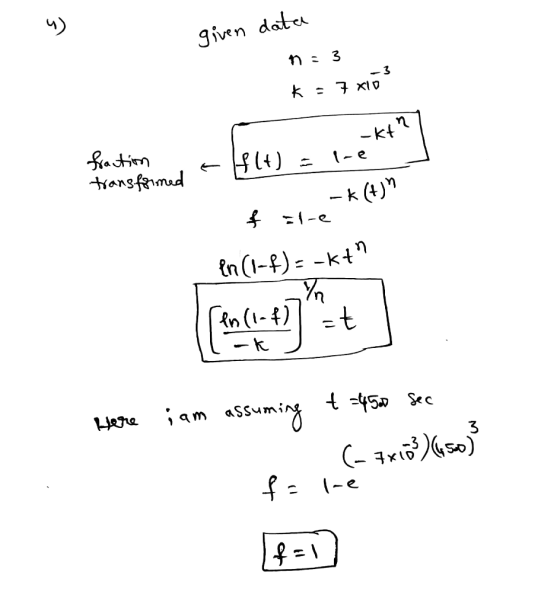
It is known that the kinetics of recrystallization for some alloy obey the Avrami equation and that the value of n in the exponential is 2,5. If, at some temperature, the fraction recrystallized is 0,40 after 200 min, determine the rate of recrystallization at this temperature
Add Answer to:
3. For some transformation having kinetics that obey the Avrami equation, the parameter n is known...
For some transformation having kinetics that obey the Avrami equation (Equation 10.17), the param...
For some transformation having kinetics that obey the Avrami equation (Equation 10.17), the parameter n is known to have a value of 1.6. If, after 104 s, the reaction is 50% complete, how long (total time) will it take the transformation to go to 96% completion?
For some metal alloy it is known that the kinetics of recrystallization obey the Avrami equation,...
For some metal alloy it is known that the kinetics of recrystallization obey the Avrami equation, and that the value of k in the exponential is 2.63 x 10⁻⁶, for time in seconds. If, at some temperature, the rate of recrystallization is 0.0014 s-1, what total time (in s) is required for the recrystallization reaction to go to 90% completion?
The kinetics of some phase transformations obey the Avrami relationship. Using the fraction trans...
The kinetics of some phase transformations obey the Avrami relationship. Using the fraction transformed-time data given below, determine the total time required for the transformation to go to 91 % completion. Fraction transformed Time (s) 0.2 11.9 0.8 27.3
1. Using the isothermal transformation diagram for an iron-carbon alloy of eutectoid composition, specify the nature...
 1. Using the isothermal transformation diagram for an iron-carbon alloy of eutectoid composition, specify the nature of the final microstructure (in terms of microconstituents present and approximate percentages of each) of a small specimen that has been subjected to the following time-temperature treatments. In each case assume that the specimen begins at 760°C and that it has been held at this temperature long enough to have achieved a complete and homogeneous austenitic structure (a) Rapidly cool to 400°C, hold for...
Make a copy of the isothermal transformation diagram for an iron–carbon alloy of eutectoid composition provided...
 Make a copy of the isothermal transformation diagram for an
iron–carbon alloy of eutectoid composition provided overleaf and
then sketch and label time–temperature paths on this diagram to
produce the following microstructures:
a) 25% martensite and 75% austenite
b) 100% fine pearlite
c) 25% pearlite, 25% bainite, 45% martensite, and 5%
austenite.
d) 100% tempered martensite.
800 A 1400 Eutectoid temperature 700 A 1200 A P 600 1000 500 800 AXTIS 400 A 600 300 M(start 50% 200 400 M+A...
Make a copy of the isothermal transformation diagram for an
iron–carbon alloy of eutectoid composition provided overleaf and
then sketch and label time–temperature paths on this diagram to
produce the following microstructures:
a) 25% martensite and 75% austenite
b) 100% fine pearlite
c) 25% pearlite, 25% bainite, 45% martensite, and 5%
austenite.
d) 100% tempered martensite.
800 A 1400 Eutectoid temperature 700 A 1200 A P 600 1000 500 800 AXTIS 400 A 600 300 M(start 50% 200 400 M+A...
Using the isothermal transformation diagram for an alloy steel (type 4340) specify the nature of the final microstruct...
 Using the isothermal transformation diagram for an alloy steel (type 4340) specify the nature of the final microstructure (in terms of micro-constituents present and approximate percentages) of a small specimen that has been subjected to the following time-temperature treatments: In each case assume that the specimen begins at 760°C and that it has been held at this temperature long enough to have achieved a complete and homogeneous austenite structure. (a) (a) Rapidly cool to 400°C, hold for 10 seconds, and...
Problem 3 (20 pts): Using the phase diagram and isothermal transformation diagram for an iron- carbon alloy of eutectoid composition. Assuming that the specimen begins at 760-C and that it has...
 Problem 3 (20 pts): Using the phase diagram and isothermal transformation diagram for an iron- carbon alloy of eutectoid composition. Assuming that the specimen begins at 760-C and that it has been held at this temperature long enough to have achieved a complete and homogeneous austenitic structure, answer the following questions: 1400 Eutectoid temerabre 1000 800 400 600 300 400 200 MC90%) 100 200 Time (s) We were unable to transcribe this image
Problem 3 (20 pts): Using the phase...
Problem 3 (20 pts): Using the phase diagram and isothermal transformation diagram for an iron- carbon alloy of eutectoid composition. Assuming that the specimen begins at 760-C and that it has been held at this temperature long enough to have achieved a complete and homogeneous austenitic structure, answer the following questions: 1400 Eutectoid temerabre 1000 800 400 600 300 400 200 MC90%) 100 200 Time (s) We were unable to transcribe this image
Problem 3 (20 pts): Using the phase...
Detailed Subject: Materials Science and Engineering Please make a full explanation and plot in the isothermal...
 Detailed Subject: Materials Science and Engineering
Please make a full explanation and plot in the isothermal
diagrams using the graph above.
Using the isothermal transformation diagram for an iron-carbon alloy of eutectoid composition (Figure 10.22), specify the nature of the final microstructure (in terms of microconstituents present and approximate percentages of each) of a small specimen that has been subjected to the following time-temperature treatments. In each case assume that the specimen begins at 760°C (1400°F) and that it has...
Detailed Subject: Materials Science and Engineering
Please make a full explanation and plot in the isothermal
diagrams using the graph above.
Using the isothermal transformation diagram for an iron-carbon alloy of eutectoid composition (Figure 10.22), specify the nature of the final microstructure (in terms of microconstituents present and approximate percentages of each) of a small specimen that has been subjected to the following time-temperature treatments. In each case assume that the specimen begins at 760°C (1400°F) and that it has...
a. b.c.d. The following figure is the isothermal transformation diagram for a precursor of 0.76 wt%...
 a. b.c.d.
The following figure is the isothermal transformation diagram for a precursor of 0.76 wt% austenite (eutectoid steel) 800 1400 Eutectoid temperature 700 1200 600 1000 500 800 O400 600 300 M(start) M( 50%) M(90%) 50% 400 200 | | 100 10 10 10 10 Time (s) 10-1 10
a. b.c.d.
The following figure is the isothermal transformation diagram for a precursor of 0.76 wt% austenite (eutectoid steel) 800 1400 Eutectoid temperature 700 1200 600 1000 500 800 O400 600 300 M(start) M( 50%) M(90%) 50% 400 200 | | 100 10 10 10 10 Time (s) 10-1 10
Ou. 3 Chapters 10- 11: Phase Transformations/ Designations, Compositions and Typ Applications for Some Selected Steels (25%) Using the isothermal transformation diagram for an iron-carbon alloy o...
 Ou. 3 Chapters 10- 11: Phase Transformations/ Designations, Compositions and Typ Applications for Some Selected Steels (25%) Using the isothermal transformation diagram for an iron-carbon alloy of eutectoid composition 6), please, identify and name the final microstructures resulting from the two cooling curves labeled (@) and (b). (c): Draw and label on Figure 6 the cooling curve that yields the following microstructures: 50% of microstructure A (Figure 7a) and 50% of microstructure B (Figure 7b). (d) Please, provide missing information...
 1. Using the isothermal transformation diagram for an iron-carbon alloy of eutectoid composition, specify the nature of the final microstructure (in terms of microconstituents present and approximate percentages of each) of a small specimen that has been subjected to the following time-temperature treatments. In each case assume that the specimen begins at 760°C and that it has been held at this temperature long enough to have achieved a complete and homogeneous austenitic structure (a) Rapidly cool to 400°C, hold for...
 Make a copy of the isothermal transformation diagram for an
iron–carbon alloy of eutectoid composition provided overleaf and
then sketch and label time–temperature paths on this diagram to
produce the following microstructures:
a) 25% martensite and 75% austenite
b) 100% fine pearlite
c) 25% pearlite, 25% bainite, 45% martensite, and 5%
austenite.
d) 100% tempered martensite.
800 A 1400 Eutectoid temperature 700 A 1200 A P 600 1000 500 800 AXTIS 400 A 600 300 M(start 50% 200 400 M+A...
Make a copy of the isothermal transformation diagram for an
iron–carbon alloy of eutectoid composition provided overleaf and
then sketch and label time–temperature paths on this diagram to
produce the following microstructures:
a) 25% martensite and 75% austenite
b) 100% fine pearlite
c) 25% pearlite, 25% bainite, 45% martensite, and 5%
austenite.
d) 100% tempered martensite.
800 A 1400 Eutectoid temperature 700 A 1200 A P 600 1000 500 800 AXTIS 400 A 600 300 M(start 50% 200 400 M+A...
 Using the isothermal transformation diagram for an alloy steel (type 4340) specify the nature of the final microstructure (in terms of micro-constituents present and approximate percentages) of a small specimen that has been subjected to the following time-temperature treatments: In each case assume that the specimen begins at 760°C and that it has been held at this temperature long enough to have achieved a complete and homogeneous austenite structure. (a) (a) Rapidly cool to 400°C, hold for 10 seconds, and...
 Problem 3 (20 pts): Using the phase diagram and isothermal transformation diagram for an iron- carbon alloy of eutectoid composition. Assuming that the specimen begins at 760-C and that it has been held at this temperature long enough to have achieved a complete and homogeneous austenitic structure, answer the following questions: 1400 Eutectoid temerabre 1000 800 400 600 300 400 200 MC90%) 100 200 Time (s) We were unable to transcribe this image
Problem 3 (20 pts): Using the phase...
Problem 3 (20 pts): Using the phase diagram and isothermal transformation diagram for an iron- carbon alloy of eutectoid composition. Assuming that the specimen begins at 760-C and that it has been held at this temperature long enough to have achieved a complete and homogeneous austenitic structure, answer the following questions: 1400 Eutectoid temerabre 1000 800 400 600 300 400 200 MC90%) 100 200 Time (s) We were unable to transcribe this image
Problem 3 (20 pts): Using the phase...
 Detailed Subject: Materials Science and Engineering
Please make a full explanation and plot in the isothermal
diagrams using the graph above.
Using the isothermal transformation diagram for an iron-carbon alloy of eutectoid composition (Figure 10.22), specify the nature of the final microstructure (in terms of microconstituents present and approximate percentages of each) of a small specimen that has been subjected to the following time-temperature treatments. In each case assume that the specimen begins at 760°C (1400°F) and that it has...
Detailed Subject: Materials Science and Engineering
Please make a full explanation and plot in the isothermal
diagrams using the graph above.
Using the isothermal transformation diagram for an iron-carbon alloy of eutectoid composition (Figure 10.22), specify the nature of the final microstructure (in terms of microconstituents present and approximate percentages of each) of a small specimen that has been subjected to the following time-temperature treatments. In each case assume that the specimen begins at 760°C (1400°F) and that it has...
 a. b.c.d.
The following figure is the isothermal transformation diagram for a precursor of 0.76 wt% austenite (eutectoid steel) 800 1400 Eutectoid temperature 700 1200 600 1000 500 800 O400 600 300 M(start) M( 50%) M(90%) 50% 400 200 | | 100 10 10 10 10 Time (s) 10-1 10
a. b.c.d.
The following figure is the isothermal transformation diagram for a precursor of 0.76 wt% austenite (eutectoid steel) 800 1400 Eutectoid temperature 700 1200 600 1000 500 800 O400 600 300 M(start) M( 50%) M(90%) 50% 400 200 | | 100 10 10 10 10 Time (s) 10-1 10
 Ou. 3 Chapters 10- 11: Phase Transformations/ Designations, Compositions and Typ Applications for Some Selected Steels (25%) Using the isothermal transformation diagram for an iron-carbon alloy of eutectoid composition 6), please, identify and name the final microstructures resulting from the two cooling curves labeled (@) and (b). (c): Draw and label on Figure 6 the cooling curve that yields the following microstructures: 50% of microstructure A (Figure 7a) and 50% of microstructure B (Figure 7b). (d) Please, provide missing information...
Most questions answered within 3 hours.
-
Where is the error in this code sequence?
String s1 = "Hello";
String s2 = "ello";...
asked 10 months ago -
Financial data for Joel de Paris, Inc., for last year
follow:
Joel de Paris, Inc.
Balance...
asked 10 months ago -
Consider this reaction:
Al2(SO4)3 (aq)+ BaCl3
(aq) Al2Cl6 (aq)- +
3BaSO4(s) . What is the...
asked 10 months ago -
Suppose that Savneet is considering increasing her
recent random sample from 20 car rentals to 40...
asked 10 months ago -
Trucks arrive at an unloading terminal at an average rate of 120
per hour.
Trucks arrive...
asked 10 months ago -
Why are methanol and ethanol completely soluble in water while
octanol is not very little soluble....
asked 10 months ago -
A facilities manager at a university reads in a research report
that the mean amount of...
asked 10 months ago -
When the CuSO4 is rehydrated by adding water to the anhydrous
compound, is this an endothermic...
asked 10 months ago -
A ray of sunlight is passing from diamond into crown glass; the
angle of incidence is...
asked 10 months ago -
A block of mass 0.249 kg is placed on top of a light, vertical
spring of...
asked 10 months ago -
how do the kidneys compensate in the presences of acidosis
a) trigger hyperventilate
b) reserve acid...
asked 10 months ago -
Question 501 pts
The rental rate of capital to the firm increases. Which of the
following...
asked 10 months ago