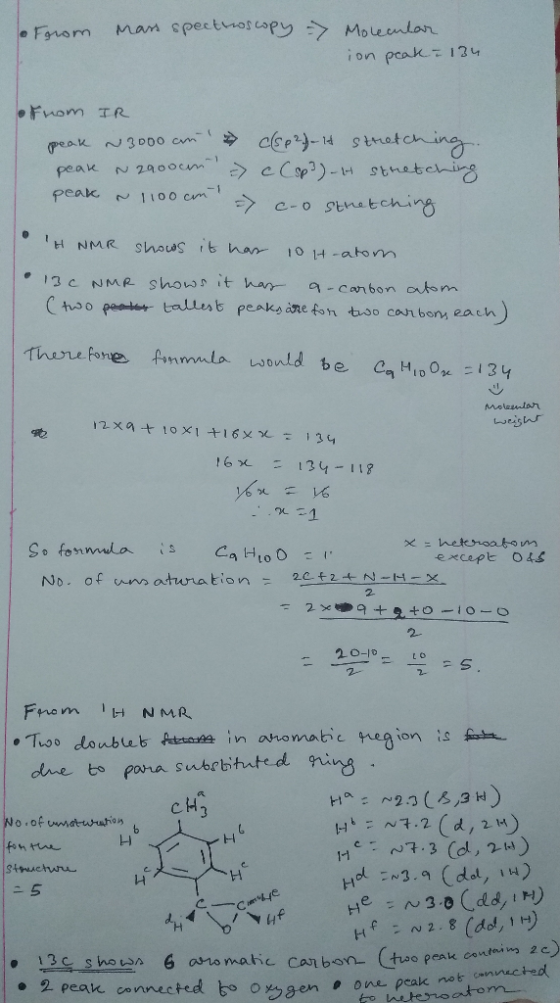
I have most of the information, but I need help to organize it based on the prompts below the pictures.


Mass Spec
Molecular Weight:
Important Fragments; what are they and what do they mean? (base peak structure, is there a halogen, is there a benzene ring, is there an odd number of nitrogens, other important fragments that tell something about the structure)
IR
Is there an OH? Wavenumber?
Is there a carbonyl group? If so what type (acid. ester, amide, aldehyde, ketone etc.)? Wave number?
Other important peaks (terminal alkyne, cyano group, aromatic, alkene, nitro group, amine etc.) and where are they?
1H-NMR
Identify every signal; chemical shift, what is it due to( i.e what type of proton, aromatic, aldehydic, O-H, N-H, vinyl etc.) and how many protons does it represent.
13C-NMR
How many different types of carbons are present?
What type of carbon does each signal represent?
How can you put the skeleton together?
LOGIC:
Carefully, and thoroughly show how you used the spectral data to determine your structure. Show how all your data confirms your structure. Especially useful is using 1H-NMR as confirmation.
Homework Answers
Add Answer to:
I have most of the information, but I need help to organize it
based on the...
I need to know what the unknown compound is and what the structure looks like based...
 I need to know what the unknown compound is and what the
structure looks like based off this H-NMR chart, IR peak and
Molecular Formula. Can you please draw
the structure out so I can see it. I also want to see how the peaks
on the H-NMR relate to the compound you have drawn (like
which peak goes to what point on the compond).Hint
something that would be leaking out of an oil sands talings pond,
also the molecule...
I need to know what the unknown compound is and what the
structure looks like based off this H-NMR chart, IR peak and
Molecular Formula. Can you please draw
the structure out so I can see it. I also want to see how the peaks
on the H-NMR relate to the compound you have drawn (like
which peak goes to what point on the compond).Hint
something that would be leaking out of an oil sands talings pond,
also the molecule...
Organic Chemistry - Using the following IR anaylsis identify the major peaks and possible functio...
 Organic Chemistry - Using the following IR anaylsis identify the
major peaks and possible functional group identity. Using the two
NMR spectra, discuss the integration of peaks, chemical shifts, and
splitting. Using the mass spectra, identify molecular weight and
important fragments to confirm the structure. Draw the fragments
that correspond to each peak in the mass spectra. Draw the
structure of the unknown that corresponds to all available data.
additional information: Unknown ‘J’ is a alkane.
H-NMR multiplet, 1OH triplet,...
Organic Chemistry - Using the following IR anaylsis identify the
major peaks and possible functional group identity. Using the two
NMR spectra, discuss the integration of peaks, chemical shifts, and
splitting. Using the mass spectra, identify molecular weight and
important fragments to confirm the structure. Draw the fragments
that correspond to each peak in the mass spectra. Draw the
structure of the unknown that corresponds to all available data.
additional information: Unknown ‘J’ is a alkane.
H-NMR multiplet, 1OH triplet,...
Provide the correct structure for your unknown based on the spectroscopic data provided. Provide the correct...
 Provide the correct structure for your unknown based on the
spectroscopic data provided. Provide the correct name for your
compound. Either the IUPAC name, or a commonly accepted name (i.e.,
ethyl acetate in place of ethyl ethanoate) will be accepted.IR
spectrum: Assign as many peaks as possible. In particular, you
should assign peaks that were important in making your structural
interpretation (i.e. functional group peaks such as OH, C=O, N-H,
etc.).
1H-NMR spectrum: Assign all the peaks in the spectrum...
Provide the correct structure for your unknown based on the
spectroscopic data provided. Provide the correct name for your
compound. Either the IUPAC name, or a commonly accepted name (i.e.,
ethyl acetate in place of ethyl ethanoate) will be accepted.IR
spectrum: Assign as many peaks as possible. In particular, you
should assign peaks that were important in making your structural
interpretation (i.e. functional group peaks such as OH, C=O, N-H,
etc.).
1H-NMR spectrum: Assign all the peaks in the spectrum...
Unknown Number: Molecular Formula: Index of Hydrogen Deficiency: Structure: Mass Spec Molecular Weight: Important Fragments; what...
 Unknown Number:
Molecular Formula:
Index of Hydrogen Deficiency:
Structure:
Mass Spec
Molecular Weight:
Important Fragments; what are they and what do they mean? (base
peak structure, is there a halogen, is there a benzene ring, is
there an odd number of nitrogens, other important fragments that
tell something about the structure)
IR
Is there an OH? Wavenumber?
Is there a carbonyl group? If so what type (acid. ester, amide,
aldehyde, ketone etc.)? Wave number?
Other important peaks (terminal alkyne, cyano...
Unknown Number:
Molecular Formula:
Index of Hydrogen Deficiency:
Structure:
Mass Spec
Molecular Weight:
Important Fragments; what are they and what do they mean? (base
peak structure, is there a halogen, is there a benzene ring, is
there an odd number of nitrogens, other important fragments that
tell something about the structure)
IR
Is there an OH? Wavenumber?
Is there a carbonyl group? If so what type (acid. ester, amide,
aldehyde, ketone etc.)? Wave number?
Other important peaks (terminal alkyne, cyano...
IR List the important peaks seen in the IR of the product and label with the...
 IR List the important peaks seen in the IR of the product and
label with the associated stretches and bends (eg. C-H stretch,
etc).
13C NMR List all the peaks in the 13C NMR and give them each a
number. Write the structure of the product and label the carbons
with the associated number for the peak. (The peaks from 21-25 can
be given the same number.)
1H NMR List all the peaks in the 1H NMR and give them...
IR List the important peaks seen in the IR of the product and
label with the associated stretches and bends (eg. C-H stretch,
etc).
13C NMR List all the peaks in the 13C NMR and give them each a
number. Write the structure of the product and label the carbons
with the associated number for the peak. (The peaks from 21-25 can
be given the same number.)
1H NMR List all the peaks in the 1H NMR and give them...
I have an proton NMR for a compound that I believe to be Salicylic Acid. It...
I have an proton NMR for a compound that I believe to be Salicylic Acid. It has major peaks at 11.0 ppm as well as around 10.5 ppm. Both peaks are broad singlets indicating that they should be -OH peaks. However, the typical Phenol has a peak around 5-6 ppm. Could it be possible that the aromatic ring and carbonyl group from the carboxylic acid influenced the phenol group enough to shift it that far downfield?
Identify the unknown molecule based on the following information Formula: CisHasNO IR peaks (cm): 3423 (broad),...
 Identify the unknown molecule based on the following
information
Formula: CisHasNO IR peaks (cm): 3423 (broad), 3350 (overlap), 1728 (strong), 1585 (weak) Mass Spec: base peak (m/2) - 136 UV-Vis - 379 nm (benzene - 255 nm) 13C: 8 186, 157, 155, 153, 150, 148, 147, 145, 143, 142, 139, 138, 135, 56, 52 "H: 8 13.11 (s, 1H), 9.94 (s, 1H, broad), 8.21 (d, 1H), 8.04 (d, 1H), 7.75 dd, 1H), 7.32 (dd, 1H), 7.05 (dd, 1H), 7.03 (d,...
Identify the unknown molecule based on the following
information
Formula: CisHasNO IR peaks (cm): 3423 (broad), 3350 (overlap), 1728 (strong), 1585 (weak) Mass Spec: base peak (m/2) - 136 UV-Vis - 379 nm (benzene - 255 nm) 13C: 8 186, 157, 155, 153, 150, 148, 147, 145, 143, 142, 139, 138, 135, 56, 52 "H: 8 13.11 (s, 1H), 9.94 (s, 1H, broad), 8.21 (d, 1H), 8.04 (d, 1H), 7.75 dd, 1H), 7.32 (dd, 1H), 7.05 (dd, 1H), 7.03 (d,...
please help me with this. I am not good at reading the IR charts. Spectroscopid Analysuts...
 please help me with this. I am not good at reading the IR
charts.
Spectroscopid Analysuts 호 Prot, Zuhncky deoded io analyse a whaleystaline solid left behind by a student one aftomoon. By using mass spectrometry, be igured out that the molecular weight or the axilpound wins 70 밂mol. Prot Zuhncky also n and obtained the folkowing IR and 1H-NMR spectra. Based on this nformation, determine the structure of this unknown by determining the moleculsr formula first them determining the...
please help me with this. I am not good at reading the IR
charts.
Spectroscopid Analysuts 호 Prot, Zuhncky deoded io analyse a whaleystaline solid left behind by a student one aftomoon. By using mass spectrometry, be igured out that the molecular weight or the axilpound wins 70 밂mol. Prot Zuhncky also n and obtained the folkowing IR and 1H-NMR spectra. Based on this nformation, determine the structure of this unknown by determining the moleculsr formula first them determining the...
please help me answer the IR, H NMR and 13C NMR questions based on the pictures...
 please help me answer the IR, H NMR and 13C NMR questions based
on the pictures below.
IR List the important peaks seen in the IR of the product and label with the associated stretches and bends (eg. C-H stretch, etc). 13C NMR List all the peaks in the 13C NMR and give them each a number. Write the structure of the product and label the carbons with the associated number for the peak. (The peaks from 21-25 can be...
please help me answer the IR, H NMR and 13C NMR questions based
on the pictures below.
IR List the important peaks seen in the IR of the product and label with the associated stretches and bends (eg. C-H stretch, etc). 13C NMR List all the peaks in the 13C NMR and give them each a number. Write the structure of the product and label the carbons with the associated number for the peak. (The peaks from 21-25 can be...
On the following pages are two problems. You have a molecular formula, an IR, a 1H...
 On the following pages are two problems. You have a molecular
formula, an IR, a 1H NMR and a 13C NMR. For
each
problem:
a. (1 pt) Calculate the index of hydrogen deficiency.
b. (4 pts) Propose a structure that is consistent with the
spectra.
c. (1 pt) Indicate the important peaks in the IR and what features
in your structure they correlate to. (Ignore the
fingerprint region.) Keep in mind that the IR can sometimes be
confusing.
d. (2...
On the following pages are two problems. You have a molecular
formula, an IR, a 1H NMR and a 13C NMR. For
each
problem:
a. (1 pt) Calculate the index of hydrogen deficiency.
b. (4 pts) Propose a structure that is consistent with the
spectra.
c. (1 pt) Indicate the important peaks in the IR and what features
in your structure they correlate to. (Ignore the
fingerprint region.) Keep in mind that the IR can sometimes be
confusing.
d. (2...
 I need to know what the unknown compound is and what the
structure looks like based off this H-NMR chart, IR peak and
Molecular Formula. Can you please draw
the structure out so I can see it. I also want to see how the peaks
on the H-NMR relate to the compound you have drawn (like
which peak goes to what point on the compond).Hint
something that would be leaking out of an oil sands talings pond,
also the molecule...
I need to know what the unknown compound is and what the
structure looks like based off this H-NMR chart, IR peak and
Molecular Formula. Can you please draw
the structure out so I can see it. I also want to see how the peaks
on the H-NMR relate to the compound you have drawn (like
which peak goes to what point on the compond).Hint
something that would be leaking out of an oil sands talings pond,
also the molecule...
 Organic Chemistry - Using the following IR anaylsis identify the
major peaks and possible functional group identity. Using the two
NMR spectra, discuss the integration of peaks, chemical shifts, and
splitting. Using the mass spectra, identify molecular weight and
important fragments to confirm the structure. Draw the fragments
that correspond to each peak in the mass spectra. Draw the
structure of the unknown that corresponds to all available data.
additional information: Unknown ‘J’ is a alkane.
H-NMR multiplet, 1OH triplet,...
Organic Chemistry - Using the following IR anaylsis identify the
major peaks and possible functional group identity. Using the two
NMR spectra, discuss the integration of peaks, chemical shifts, and
splitting. Using the mass spectra, identify molecular weight and
important fragments to confirm the structure. Draw the fragments
that correspond to each peak in the mass spectra. Draw the
structure of the unknown that corresponds to all available data.
additional information: Unknown ‘J’ is a alkane.
H-NMR multiplet, 1OH triplet,...
 Provide the correct structure for your unknown based on the
spectroscopic data provided. Provide the correct name for your
compound. Either the IUPAC name, or a commonly accepted name (i.e.,
ethyl acetate in place of ethyl ethanoate) will be accepted.IR
spectrum: Assign as many peaks as possible. In particular, you
should assign peaks that were important in making your structural
interpretation (i.e. functional group peaks such as OH, C=O, N-H,
etc.).
1H-NMR spectrum: Assign all the peaks in the spectrum...
Provide the correct structure for your unknown based on the
spectroscopic data provided. Provide the correct name for your
compound. Either the IUPAC name, or a commonly accepted name (i.e.,
ethyl acetate in place of ethyl ethanoate) will be accepted.IR
spectrum: Assign as many peaks as possible. In particular, you
should assign peaks that were important in making your structural
interpretation (i.e. functional group peaks such as OH, C=O, N-H,
etc.).
1H-NMR spectrum: Assign all the peaks in the spectrum...
 Unknown Number:
Molecular Formula:
Index of Hydrogen Deficiency:
Structure:
Mass Spec
Molecular Weight:
Important Fragments; what are they and what do they mean? (base
peak structure, is there a halogen, is there a benzene ring, is
there an odd number of nitrogens, other important fragments that
tell something about the structure)
IR
Is there an OH? Wavenumber?
Is there a carbonyl group? If so what type (acid. ester, amide,
aldehyde, ketone etc.)? Wave number?
Other important peaks (terminal alkyne, cyano...
Unknown Number:
Molecular Formula:
Index of Hydrogen Deficiency:
Structure:
Mass Spec
Molecular Weight:
Important Fragments; what are they and what do they mean? (base
peak structure, is there a halogen, is there a benzene ring, is
there an odd number of nitrogens, other important fragments that
tell something about the structure)
IR
Is there an OH? Wavenumber?
Is there a carbonyl group? If so what type (acid. ester, amide,
aldehyde, ketone etc.)? Wave number?
Other important peaks (terminal alkyne, cyano...
 IR List the important peaks seen in the IR of the product and
label with the associated stretches and bends (eg. C-H stretch,
etc).
13C NMR List all the peaks in the 13C NMR and give them each a
number. Write the structure of the product and label the carbons
with the associated number for the peak. (The peaks from 21-25 can
be given the same number.)
1H NMR List all the peaks in the 1H NMR and give them...
IR List the important peaks seen in the IR of the product and
label with the associated stretches and bends (eg. C-H stretch,
etc).
13C NMR List all the peaks in the 13C NMR and give them each a
number. Write the structure of the product and label the carbons
with the associated number for the peak. (The peaks from 21-25 can
be given the same number.)
1H NMR List all the peaks in the 1H NMR and give them...
 Identify the unknown molecule based on the following
information
Formula: CisHasNO IR peaks (cm): 3423 (broad), 3350 (overlap), 1728 (strong), 1585 (weak) Mass Spec: base peak (m/2) - 136 UV-Vis - 379 nm (benzene - 255 nm) 13C: 8 186, 157, 155, 153, 150, 148, 147, 145, 143, 142, 139, 138, 135, 56, 52 "H: 8 13.11 (s, 1H), 9.94 (s, 1H, broad), 8.21 (d, 1H), 8.04 (d, 1H), 7.75 dd, 1H), 7.32 (dd, 1H), 7.05 (dd, 1H), 7.03 (d,...
Identify the unknown molecule based on the following
information
Formula: CisHasNO IR peaks (cm): 3423 (broad), 3350 (overlap), 1728 (strong), 1585 (weak) Mass Spec: base peak (m/2) - 136 UV-Vis - 379 nm (benzene - 255 nm) 13C: 8 186, 157, 155, 153, 150, 148, 147, 145, 143, 142, 139, 138, 135, 56, 52 "H: 8 13.11 (s, 1H), 9.94 (s, 1H, broad), 8.21 (d, 1H), 8.04 (d, 1H), 7.75 dd, 1H), 7.32 (dd, 1H), 7.05 (dd, 1H), 7.03 (d,...
 please help me with this. I am not good at reading the IR
charts.
Spectroscopid Analysuts 호 Prot, Zuhncky deoded io analyse a whaleystaline solid left behind by a student one aftomoon. By using mass spectrometry, be igured out that the molecular weight or the axilpound wins 70 밂mol. Prot Zuhncky also n and obtained the folkowing IR and 1H-NMR spectra. Based on this nformation, determine the structure of this unknown by determining the moleculsr formula first them determining the...
please help me with this. I am not good at reading the IR
charts.
Spectroscopid Analysuts 호 Prot, Zuhncky deoded io analyse a whaleystaline solid left behind by a student one aftomoon. By using mass spectrometry, be igured out that the molecular weight or the axilpound wins 70 밂mol. Prot Zuhncky also n and obtained the folkowing IR and 1H-NMR spectra. Based on this nformation, determine the structure of this unknown by determining the moleculsr formula first them determining the...
 please help me answer the IR, H NMR and 13C NMR questions based
on the pictures below.
IR List the important peaks seen in the IR of the product and label with the associated stretches and bends (eg. C-H stretch, etc). 13C NMR List all the peaks in the 13C NMR and give them each a number. Write the structure of the product and label the carbons with the associated number for the peak. (The peaks from 21-25 can be...
please help me answer the IR, H NMR and 13C NMR questions based
on the pictures below.
IR List the important peaks seen in the IR of the product and label with the associated stretches and bends (eg. C-H stretch, etc). 13C NMR List all the peaks in the 13C NMR and give them each a number. Write the structure of the product and label the carbons with the associated number for the peak. (The peaks from 21-25 can be...
 On the following pages are two problems. You have a molecular
formula, an IR, a 1H NMR and a 13C NMR. For
each
problem:
a. (1 pt) Calculate the index of hydrogen deficiency.
b. (4 pts) Propose a structure that is consistent with the
spectra.
c. (1 pt) Indicate the important peaks in the IR and what features
in your structure they correlate to. (Ignore the
fingerprint region.) Keep in mind that the IR can sometimes be
confusing.
d. (2...
On the following pages are two problems. You have a molecular
formula, an IR, a 1H NMR and a 13C NMR. For
each
problem:
a. (1 pt) Calculate the index of hydrogen deficiency.
b. (4 pts) Propose a structure that is consistent with the
spectra.
c. (1 pt) Indicate the important peaks in the IR and what features
in your structure they correlate to. (Ignore the
fingerprint region.) Keep in mind that the IR can sometimes be
confusing.
d. (2...
Most questions answered within 3 hours.
-
Where is the error in this code sequence?
String s1 = "Hello";
String s2 = "ello";...
asked 11 months ago -
Financial data for Joel de Paris, Inc., for last year
follow:
Joel de Paris, Inc.
Balance...
asked 11 months ago -
Consider this reaction:
Al2(SO4)3 (aq)+ BaCl3
(aq) Al2Cl6 (aq)- +
3BaSO4(s) . What is the...
asked 11 months ago -
Suppose that Savneet is considering increasing her
recent random sample from 20 car rentals to 40...
asked 11 months ago -
Trucks arrive at an unloading terminal at an average rate of 120
per hour.
Trucks arrive...
asked 11 months ago -
Why are methanol and ethanol completely soluble in water while
octanol is not very little soluble....
asked 11 months ago -
A facilities manager at a university reads in a research report
that the mean amount of...
asked 11 months ago -
When the CuSO4 is rehydrated by adding water to the anhydrous
compound, is this an endothermic...
asked 11 months ago -
A ray of sunlight is passing from diamond into crown glass; the
angle of incidence is...
asked 11 months ago -
A block of mass 0.249 kg is placed on top of a light, vertical
spring of...
asked 11 months ago -
how do the kidneys compensate in the presences of acidosis
a) trigger hyperventilate
b) reserve acid...
asked 11 months ago -
Question 501 pts
The rental rate of capital to the firm increases. Which of the
following...
asked 11 months ago