Show the recursion tree for T(n) = 4T(n/4) + c and derive the solution using big-Theta...
Show the recursion tree for T(n) = 4T(n/4) + c and derive the solution using big-Theta notation. Explain the intuition why this result is different from the solution of T(n) = 4T(n/2) + c.
Homework Answers
 Please note that in the first recurrence relation n is divided into 4 parts in the algorithm with 4 recursive calls and in the second relation if you observe n is divided into 2 parts with 4 recursive calls. That is why computing complexities of both the algorithms are different than one another.
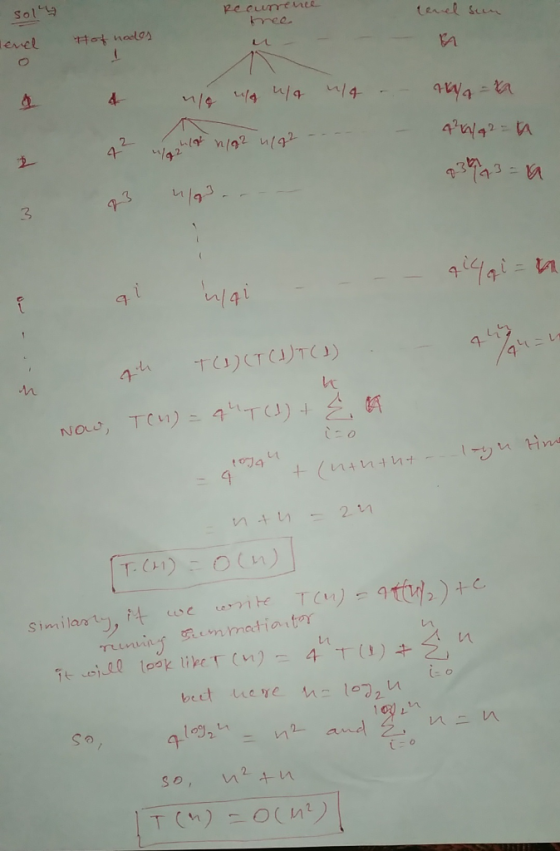
Please note that in the first recurrence relation n is divided into 4 parts in the algorithm with 4 recursive calls and in the second relation if you observe n is divided into 2 parts with 4 recursive calls. That is why computing complexities of both the algorithms are different than one another.
Add Answer to:
Show the recursion tree for T(n) = 4T(n/4) + c and derive the
solution using big-Theta...
Use the recursion tree method to find a closed form solution to T(n) = 4T(n/4) +...
Use the recursion tree method to find a closed form solution to T(n) = 4T(n/4) + n.
(basic) Solve T(n) = 4T(n/2) + Θ(n^2) using the recursion tree method. Cleary state the tree...
 (basic) Solve T(n) = 4T(n/2) + Θ(n^2) using the recursion tree
method. Cleary state the tree depth, each subproblem size at depth
d, the number of subproblems/nodes at depth d, workload per
subproblem/node at depth d, (total) workload at depth d.
Please state everything that is asked for or your answer will be
downvoted.
(basic) Solve T(n)-4T(n/2) + Θ(n2) using the recursion tree method. Cleary state the d, workload per subproblem/node at depth d, (total) workload at depth d.
(basic) Solve T(n) = 4T(n/2) + Θ(n^2) using the recursion tree
method. Cleary state the tree depth, each subproblem size at depth
d, the number of subproblems/nodes at depth d, workload per
subproblem/node at depth d, (total) workload at depth d.
Please state everything that is asked for or your answer will be
downvoted.
(basic) Solve T(n)-4T(n/2) + Θ(n2) using the recursion tree method. Cleary state the d, workload per subproblem/node at depth d, (total) workload at depth d.
draw the first 3 levels of a recursion tree for the recurrence T(n) = 4T(n/2) +...
draw the first 3 levels of a recursion tree for the recurrence T(n) = 4T(n/2) + n. How many levels does it have? Find a summation for the running time and solve for it.
(a) Use the recursion tree method to guess tight 5 asymptotic bounds for the recurrence T(n)-4T(n/2)+n....
 (a) Use the recursion tree method to guess tight 5 asymptotic bounds for the recurrence T(n)-4T(n/2)+n. Use substitution method to prove it.
(12 pts) Solve each of the following Do not only state your solution- Show how you...
 (12 pts) Solve each of the following Do not only state your solution- Show how you obtained it. That is, if you use substitution, you must present the complete inductive proof that your solution is correct. If you obtained the solution from the tree. Note that you are to prove matching upper and lower bounds recurrences using substitution or a recursion tree. use a recursion tree, show the recursion tree and discuss how you (а) Т(п) — 4T (п/2) +...
Solve the recurrence relation using a recursion tree AND substitution method: T(n) = T(n-1) + 10n
Solve the recurrence relation using a recursion tree AND substitution method: T(n) = T(n-1) + 10n
Consider the recurrence T (n) = 3 · T (n/2) + n. Use the recursion tree...
Consider the recurrence T (n) = 3 · T (n/2) + n. Use the recursion tree method to guess an asymptotic upper bound for T (n). Show your work. • Prove the correctness of your guess by induction. Assume that values of n are powers of 2.
Solve the recurrence relation using a recursion tree AND substitution method: T(n) = 2T(n - 1)...
Solve the recurrence relation using a recursion tree AND substitution method: T(n) = 2T(n - 1) + 10n.
Solving the following recurrence relation using summation or the recursion tree method. 2.) T(n) = 2T(n-1)...
Solving the following recurrence relation using summation or the recursion tree method. 2.) T(n) = 2T(n-1) + 5^n Base Case: T(0) = 8
Course: Data Structures and Aglorithms Question 2 a) Use the substitution method (CLRS section 4.3) to...
 Course: Data Structures and Aglorithms
Question 2 a) Use the substitution method (CLRS section 4.3) to show that the solution of T (n) = +1 is O(log(n)) b) Give asymptotic upper and lower bounds (Big-Theta notation) for T(n) in the following recurrence using the Master method. T (n.) = 2T (*) + vn. c) Give asymptotic upper and lower bounds (Big-Theta notation) for T(n) in the following recurrence using the Master method. T(n) = 4T (%) +nVn.
Course: Data Structures and Aglorithms
Question 2 a) Use the substitution method (CLRS section 4.3) to show that the solution of T (n) = +1 is O(log(n)) b) Give asymptotic upper and lower bounds (Big-Theta notation) for T(n) in the following recurrence using the Master method. T (n.) = 2T (*) + vn. c) Give asymptotic upper and lower bounds (Big-Theta notation) for T(n) in the following recurrence using the Master method. T(n) = 4T (%) +nVn.
 (basic) Solve T(n) = 4T(n/2) + Θ(n^2) using the recursion tree
method. Cleary state the tree depth, each subproblem size at depth
d, the number of subproblems/nodes at depth d, workload per
subproblem/node at depth d, (total) workload at depth d.
Please state everything that is asked for or your answer will be
downvoted.
(basic) Solve T(n)-4T(n/2) + Θ(n2) using the recursion tree method. Cleary state the d, workload per subproblem/node at depth d, (total) workload at depth d.
(basic) Solve T(n) = 4T(n/2) + Θ(n^2) using the recursion tree
method. Cleary state the tree depth, each subproblem size at depth
d, the number of subproblems/nodes at depth d, workload per
subproblem/node at depth d, (total) workload at depth d.
Please state everything that is asked for or your answer will be
downvoted.
(basic) Solve T(n)-4T(n/2) + Θ(n2) using the recursion tree method. Cleary state the d, workload per subproblem/node at depth d, (total) workload at depth d.
 (a) Use the recursion tree method to guess tight 5 asymptotic bounds for the recurrence T(n)-4T(n/2)+n. Use substitution method to prove it.
 (12 pts) Solve each of the following Do not only state your solution- Show how you obtained it. That is, if you use substitution, you must present the complete inductive proof that your solution is correct. If you obtained the solution from the tree. Note that you are to prove matching upper and lower bounds recurrences using substitution or a recursion tree. use a recursion tree, show the recursion tree and discuss how you (а) Т(п) — 4T (п/2) +...
 Course: Data Structures and Aglorithms
Question 2 a) Use the substitution method (CLRS section 4.3) to show that the solution of T (n) = +1 is O(log(n)) b) Give asymptotic upper and lower bounds (Big-Theta notation) for T(n) in the following recurrence using the Master method. T (n.) = 2T (*) + vn. c) Give asymptotic upper and lower bounds (Big-Theta notation) for T(n) in the following recurrence using the Master method. T(n) = 4T (%) +nVn.
Course: Data Structures and Aglorithms
Question 2 a) Use the substitution method (CLRS section 4.3) to show that the solution of T (n) = +1 is O(log(n)) b) Give asymptotic upper and lower bounds (Big-Theta notation) for T(n) in the following recurrence using the Master method. T (n.) = 2T (*) + vn. c) Give asymptotic upper and lower bounds (Big-Theta notation) for T(n) in the following recurrence using the Master method. T(n) = 4T (%) +nVn.
Most questions answered within 3 hours.
-
Where is the error in this code sequence?
String s1 = "Hello";
String s2 = "ello";...
asked 10 months ago -
Financial data for Joel de Paris, Inc., for last year
follow:
Joel de Paris, Inc.
Balance...
asked 10 months ago -
Consider this reaction:
Al2(SO4)3 (aq)+ BaCl3
(aq) Al2Cl6 (aq)- +
3BaSO4(s) . What is the...
asked 10 months ago -
Suppose that Savneet is considering increasing her
recent random sample from 20 car rentals to 40...
asked 10 months ago -
Trucks arrive at an unloading terminal at an average rate of 120
per hour.
Trucks arrive...
asked 10 months ago -
Why are methanol and ethanol completely soluble in water while
octanol is not very little soluble....
asked 10 months ago -
A facilities manager at a university reads in a research report
that the mean amount of...
asked 10 months ago -
When the CuSO4 is rehydrated by adding water to the anhydrous
compound, is this an endothermic...
asked 10 months ago -
A ray of sunlight is passing from diamond into crown glass; the
angle of incidence is...
asked 10 months ago -
A block of mass 0.249 kg is placed on top of a light, vertical
spring of...
asked 10 months ago -
how do the kidneys compensate in the presences of acidosis
a) trigger hyperventilate
b) reserve acid...
asked 10 months ago -
Question 501 pts
The rental rate of capital to the firm increases. Which of the
following...
asked 10 months ago