Tariffs are not designed to result in...
Tariffs are not designed to result in...
(a) the increase of the price of the imported commodity.
(b) protection of domestic workers from the full impact of international competition. (c) prohibition of the importation of foreign-made commodities.
(d) increase of revenues for the government.
Homework Answers
Protection of domestic workers from the full impact of international competition.
Other listed points are the implicit or explicit objectives of international tarriffs.
The fear domestic producers express regarding dumping is that...
The fear domestic producers express regarding dumping is that...(a) it violates international environmental protection regulations. (b) it can lead to a trade war, which would force many foreign and domestic businesses into bankruptcy. (c) the low prices of imports will drive them out of business, eventually leaving the foreign competition free to raise prices. (d) by lowering the prices of imports, it reduces the revenues government can raise when it imposes tariffs.
The ratio of the prices of exported goods to the prices of imported goods is known...
The ratio of the prices of exported goods to the prices of imported goods is known as the: A. international inflation rate. B. terms of trade. C. price differential. D. ratio of advantage. Which statement is correct? A. Tariffs encourage international trade. B. There are both winners and losers from international trade. C. International trade lowers global production. D. It is always in the producers' interest to open borders to trade. Which statement is NOT an argument against free trade?...
TARIFFS AND PROTECTIONISM 1. Protectionist policies are those that: A. burden domestic producers but not foreign...
TARIFFS AND PROTECTIONISM 1. Protectionist policies are those that: A. burden domestic producers but not foreign producers. B. burden foreign producers but not domestic producers. C. burden domestic buyers but not foreign buyers. D. burden foreign buyers but not domestic buyers. 2. How are the demand and supply curves labeled when analyzing international trade? A. We label them as "private demand" and "private supply" respectively. B. We label them as "export demand" and "import supply" respectively. C. We label them...
1) Specific tariffs are a) import taxes stated in specific legal statutes b) import taxes calculated...
1) Specific tariffs are a) import taxes stated in specific legal statutes b) import taxes calculated as a fixed charge for each unit of imported goods c) import taxes calculated as a fraction of the value of the imported goods d) import taxes calculated based on the origin country 2) Ad valorem tariffs are a) import taxes stated in advertisements in industry publications b) import taxes calculated as a fixed charge for each unit of imported goods c) import taxes...
Which of the following is false about tariffs? A. They are taxes levied on both imports...
Which of the following is false about tariffs? A. They are taxes levied on both imports and exports. B. They are taxes only levied on imports. C. A significant reason taxes are placed on imports is to protect domestic producers from foreign competition. D. Tariffs are an important source of revenue for the government.
As a result of U.S. quotas on sugar imports, all of the following are true, EXCEPT:...
As a result of U.S. quotas on sugar imports, all of the following are true, EXCEPT: Question 2 options: a) the United States pays about twice the world price for sugar. b) the gains to American producers are greater than the losses to American consumers. c) foreign sugar producers—mostly in poor countries—suffer. d) a small group of domestic sugar producers benefit. Taxes and quotas on imports can ______ jobs in industries that import and ________ jobs in industries that export....
Question 23 (5 points) For privatization programs to succeed, it is essential to: A) use tariffs...
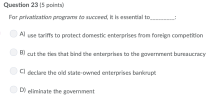 Question 23 (5 points) For privatization programs to succeed, it is essential to: A) use tariffs to protect domestic enterprises from foreign competition B) cut the ties that bind the enterprises to the government bureaucracy C) declare the old state-owned enterprises bankrupt D) eliminate the government
2021 estimates suggest that the “Chinese Trade War” will ultimately result in tariff increases averaging 28 percent in U...
2021 estimates suggest that the “Chinese Trade War” will ultimately result in tariff increases averaging 28 percent in U.S. markets. Assuming these estimates are correct: A. Would you expect the average price of imported good from China to increase prices by 38 percent in U.S domestic markets that rely on these imported goods to produce final goods and services (for example, tariffs on steel)? Explain. (A supply and demand graph maybe be helpful.) B. How would you expect the “Chinese...
QUESTION 17 When we look at tariffs and quotas, 0 a. domestic producers are indifferent between...
 QUESTION 17 When we look at tariffs and quotas, 0 a. domestic producers are indifferent between an equivalent tariff or quota being imposed O b. domestic producers would prefer quotas over tariffs 0 c, domestic producers would prefer tariffs over quotas. O d. foreign producers would prefer tariffs over quotas. QUESTION 18 Which of the following are reasons given for trade barriers? 0 a. interest rate stability O b. National defense Oc.consumer protection O d. natural monopolies QUESTION 19 Which...
All else equal, government imposed tariffs will ______. A - leave foreign competition unchanged B -...
All else equal, government imposed tariffs will ______. A - leave foreign competition unchanged B - limit foreign competition C - increase foreign competition
 Question 23 (5 points) For privatization programs to succeed, it is essential to: A) use tariffs to protect domestic enterprises from foreign competition B) cut the ties that bind the enterprises to the government bureaucracy C) declare the old state-owned enterprises bankrupt D) eliminate the government
 QUESTION 17 When we look at tariffs and quotas, 0 a. domestic producers are indifferent between an equivalent tariff or quota being imposed O b. domestic producers would prefer quotas over tariffs 0 c, domestic producers would prefer tariffs over quotas. O d. foreign producers would prefer tariffs over quotas. QUESTION 18 Which of the following are reasons given for trade barriers? 0 a. interest rate stability O b. National defense Oc.consumer protection O d. natural monopolies QUESTION 19 Which...
Most questions answered within 3 hours.
-
Where is the error in this code sequence?
String s1 = "Hello";
String s2 = "ello";...
asked 10 months ago -
Financial data for Joel de Paris, Inc., for last year
follow:
Joel de Paris, Inc.
Balance...
asked 10 months ago -
Consider this reaction:
Al2(SO4)3 (aq)+ BaCl3
(aq) Al2Cl6 (aq)- +
3BaSO4(s) . What is the...
asked 10 months ago -
Suppose that Savneet is considering increasing her
recent random sample from 20 car rentals to 40...
asked 10 months ago -
Trucks arrive at an unloading terminal at an average rate of 120
per hour.
Trucks arrive...
asked 10 months ago -
Why are methanol and ethanol completely soluble in water while
octanol is not very little soluble....
asked 10 months ago -
A facilities manager at a university reads in a research report
that the mean amount of...
asked 10 months ago -
When the CuSO4 is rehydrated by adding water to the anhydrous
compound, is this an endothermic...
asked 10 months ago -
A ray of sunlight is passing from diamond into crown glass; the
angle of incidence is...
asked 10 months ago -
A block of mass 0.249 kg is placed on top of a light, vertical
spring of...
asked 10 months ago -
how do the kidneys compensate in the presences of acidosis
a) trigger hyperventilate
b) reserve acid...
asked 10 months ago -
Question 501 pts
The rental rate of capital to the firm increases. Which of the
following...
asked 10 months ago