
Homework Answers

Add Answer to:
9. How would you make those two compounds using Grignard reaction for C-C bond formation? он
QUESTION 5 Grignardsd give the Grignard reagent you would use to complete the following reaction он...
 QUESTION 5 Grignardsd give the Grignard reagent you would use to complete the following reaction он 2. H3o* B. QUESTION 6 Grignardse How many of the carbon-carbon bonds in the following structure could have been made in a Grignard reaction with either a carbonyl compound (C o) or an epoxide? A 2 bonds B 3 bonds он D 5 bonds
Grignard reagent THE GRIGNARD REAGENT-PREPARATION AND REACTION In this experiment, you will prepa...
 i need help with the prelab questions please
Grignard reagent THE GRIGNARD REAGENT-PREPARATION AND REACTION In this experiment, you will prepare a Grignard reagent, phenyl magnesium bromide, from bromobenzene and magnesium metal. The Grignard reagent will then react with methyl benzoate to form triphenylmethanol. Introduction Grignard reagents, such as organomagnesium halides, were discovered in 1910 by French chemist Victor Grignard. The Grignard reaction is one of the most general methods for carbon- carbon bond formation in all of organic chemistry....
i need help with the prelab questions please
Grignard reagent THE GRIGNARD REAGENT-PREPARATION AND REACTION In this experiment, you will prepare a Grignard reagent, phenyl magnesium bromide, from bromobenzene and magnesium metal. The Grignard reagent will then react with methyl benzoate to form triphenylmethanol. Introduction Grignard reagents, such as organomagnesium halides, were discovered in 1910 by French chemist Victor Grignard. The Grignard reaction is one of the most general methods for carbon- carbon bond formation in all of organic chemistry....
3)- Show two routes as to how you would synthesize molecule A using appropriate organo-lithium. Grignard or hydride reagents. Note, a total of three products are expected. Make sure you display al...
 3)- Show two routes as to how you would synthesize molecule A using appropriate organo-lithium. Grignard or hydride reagents. Note, a total of three products are expected. Make sure you display all intermediates and the complete mechanism demonstrating bond retro-breaking in all synthetic steps (ie, show all reactive electrons). HO IA]
3)- Show two routes as to how you would synthesize molecule A using appropriate organo-lithium. Grignard or hydride reagents. Note, a total of three products are expected. Make sure...
3)- Show two routes as to how you would synthesize molecule A using appropriate organo-lithium. Grignard or hydride reagents. Note, a total of three products are expected. Make sure you display all intermediates and the complete mechanism demonstrating bond retro-breaking in all synthetic steps (ie, show all reactive electrons). HO IA]
3)- Show two routes as to how you would synthesize molecule A using appropriate organo-lithium. Grignard or hydride reagents. Note, a total of three products are expected. Make sure...
Grignard Reaction 1. Draw your complete reaction, including the formation of the Grignard reagent and the...
 Grignard Reaction 1. Draw your complete reaction, including the formation of the Grignard reagent and the reaction with your carbonyl compound. Below each reagent, write its molecular weight and density (if a liquid). Also write how much of each material you will use in ml (if liquid), grams, and moles. Also include the molecular weight and melting point of your final product. 2. How many moles of Grignard reagent are you synthesizing? What mass of water could fully react with...
II. What carbonyl compounds and Grignard reagents would you use to make the alcohols shown below?...
 II. What carbonyl compounds and Grignard reagents would you use to make the alcohols shown below? Show all possibilities. No mechanism necessary. (8 pts) НО. b OH
9. Devise the reaction for the following through formation of Grignard reagent. (a) Butane from chlorobutane...
9. Devise the reaction for the following through formation of Grignard reagent. (a) Butane from chlorobutane b) Hexane from hexanol c) Benzene from chlorobenzene d) Cyclohexane from cyclohexanol Looking to proof my answers with yours. Thanks!
show the mechanism for the third compound 8-49 Show how you would make the following compounds...
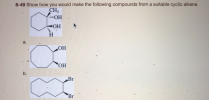 show the mechanism for the third compound
8-49 Show how you would make the following compounds from a suitable cyclic alkene. CH, «ОН ОН ОН ОН
show the mechanism for the third compound
8-49 Show how you would make the following compounds from a suitable cyclic alkene. CH, «ОН ОН ОН ОН
Show how the reaction of an allylic halide with a Grignard reagent might be used to...
Show how the reaction of an allylic halide with a Grignard reagent might be used to synthesize the following hydrocarbons (draw two starting compounds; one allylic bromide and one Grignard reagent.) Make sure your Grignard is a bromide in problem. 1. 5-methylhex-1-ene 2. 2,5,5-trimethylhept-2-ene 3. 1-cyclopentylpent-2-ene
Show how you would synthesize the following acid using carbonation of a Grignard reagent. Show how...
 Show how you would synthesize the following acid using carbonation of a Grignard reagent. Show how you would synthesize the following acid using carbonation of a Grignard reagent.
lain how you can use IR spectroscopy to differentiate samples of the following two compounds: он...
 lain how you can use IR spectroscopy to differentiate samples of the following two compounds: он он VS. 3 Would you expect a cis-alkene or a trans-alkene to have a stronger C-С IR signal? Explain. cis-alkene trans-alkene
 QUESTION 5 Grignardsd give the Grignard reagent you would use to complete the following reaction он 2. H3o* B. QUESTION 6 Grignardse How many of the carbon-carbon bonds in the following structure could have been made in a Grignard reaction with either a carbonyl compound (C o) or an epoxide? A 2 bonds B 3 bonds он D 5 bonds
 i need help with the prelab questions please
Grignard reagent THE GRIGNARD REAGENT-PREPARATION AND REACTION In this experiment, you will prepare a Grignard reagent, phenyl magnesium bromide, from bromobenzene and magnesium metal. The Grignard reagent will then react with methyl benzoate to form triphenylmethanol. Introduction Grignard reagents, such as organomagnesium halides, were discovered in 1910 by French chemist Victor Grignard. The Grignard reaction is one of the most general methods for carbon- carbon bond formation in all of organic chemistry....
i need help with the prelab questions please
Grignard reagent THE GRIGNARD REAGENT-PREPARATION AND REACTION In this experiment, you will prepare a Grignard reagent, phenyl magnesium bromide, from bromobenzene and magnesium metal. The Grignard reagent will then react with methyl benzoate to form triphenylmethanol. Introduction Grignard reagents, such as organomagnesium halides, were discovered in 1910 by French chemist Victor Grignard. The Grignard reaction is one of the most general methods for carbon- carbon bond formation in all of organic chemistry....
 3)- Show two routes as to how you would synthesize molecule A using appropriate organo-lithium. Grignard or hydride reagents. Note, a total of three products are expected. Make sure you display all intermediates and the complete mechanism demonstrating bond retro-breaking in all synthetic steps (ie, show all reactive electrons). HO IA]
3)- Show two routes as to how you would synthesize molecule A using appropriate organo-lithium. Grignard or hydride reagents. Note, a total of three products are expected. Make sure...
3)- Show two routes as to how you would synthesize molecule A using appropriate organo-lithium. Grignard or hydride reagents. Note, a total of three products are expected. Make sure you display all intermediates and the complete mechanism demonstrating bond retro-breaking in all synthetic steps (ie, show all reactive electrons). HO IA]
3)- Show two routes as to how you would synthesize molecule A using appropriate organo-lithium. Grignard or hydride reagents. Note, a total of three products are expected. Make sure...
 Grignard Reaction 1. Draw your complete reaction, including the formation of the Grignard reagent and the reaction with your carbonyl compound. Below each reagent, write its molecular weight and density (if a liquid). Also write how much of each material you will use in ml (if liquid), grams, and moles. Also include the molecular weight and melting point of your final product. 2. How many moles of Grignard reagent are you synthesizing? What mass of water could fully react with...
 II. What carbonyl compounds and Grignard reagents would you use to make the alcohols shown below? Show all possibilities. No mechanism necessary. (8 pts) НО. b OH
 show the mechanism for the third compound
8-49 Show how you would make the following compounds from a suitable cyclic alkene. CH, «ОН ОН ОН ОН
show the mechanism for the third compound
8-49 Show how you would make the following compounds from a suitable cyclic alkene. CH, «ОН ОН ОН ОН
 Show how you would synthesize the following acid using carbonation of a Grignard reagent. Show how you would synthesize the following acid using carbonation of a Grignard reagent.
 lain how you can use IR spectroscopy to differentiate samples of the following two compounds: он он VS. 3 Would you expect a cis-alkene or a trans-alkene to have a stronger C-С IR signal? Explain. cis-alkene trans-alkene
Most questions answered within 3 hours.
-
Where is the error in this code sequence?
String s1 = "Hello";
String s2 = "ello";...
asked 10 months ago -
Financial data for Joel de Paris, Inc., for last year
follow:
Joel de Paris, Inc.
Balance...
asked 10 months ago -
Consider this reaction:
Al2(SO4)3 (aq)+ BaCl3
(aq) Al2Cl6 (aq)- +
3BaSO4(s) . What is the...
asked 10 months ago -
Suppose that Savneet is considering increasing her
recent random sample from 20 car rentals to 40...
asked 10 months ago -
Trucks arrive at an unloading terminal at an average rate of 120
per hour.
Trucks arrive...
asked 10 months ago -
Why are methanol and ethanol completely soluble in water while
octanol is not very little soluble....
asked 10 months ago -
A facilities manager at a university reads in a research report
that the mean amount of...
asked 10 months ago -
When the CuSO4 is rehydrated by adding water to the anhydrous
compound, is this an endothermic...
asked 10 months ago -
A ray of sunlight is passing from diamond into crown glass; the
angle of incidence is...
asked 10 months ago -
A block of mass 0.249 kg is placed on top of a light, vertical
spring of...
asked 10 months ago -
how do the kidneys compensate in the presences of acidosis
a) trigger hyperventilate
b) reserve acid...
asked 10 months ago -
Question 501 pts
The rental rate of capital to the firm increases. Which of the
following...
asked 10 months ago