Part A [50] in c++ A toy that many children play with is a base with...
Part A [50]
in c++
A toy that many children play with is a base with three pegs and
five disks of different diameters. The disks begin on one peg, with
the largest disk on the bottom and the other four disks added on in
order of size. The idea is to move the disks from the peg they are
on to another peg by moving only one disk at a time and without
ever putting a larger disk on top of a smaller one. This child's
toy is actually an example of a classic mathematical puzzle called
the Towers of Hanoi problem.
Write a recursive solution to this problem. It may take you a while
to see the solution, but the program itself is quite short.
Consider the source peg is A, the temporary peg is B, and the
destination peg is C.
Sample Input/output
Enter number of disks: 1
Solution: A→C
Enter number of disks: 2
Solution: A→B A→C B→C
Enter number of disks: 3
Solution:A→C A→B C→B A→C B→A B→C A→C
Homework Answers
`Hey,
Note: Brother in case of any queries, just comment in box I would be very happy to assist all your queries
#include <iostream>
#include <string>
using namespace std;
void hanoi(int n, string source, string destination, string
help) {
if (n == 1) {
cout<<source<< "->" << destination
<< " ";
} else {
hanoi(n - 1, source, help, destination);
cout << source << "->" << destination << " ";
hanoi(n - 1, help, destination, source);
}
}
int main() {
int disks;
cout << "Enter number of disks:";
cin >> disks;
hanoi(disks, "A", "C", "B");
return 0;
}
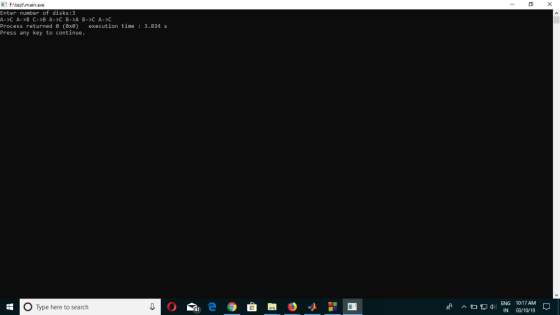
Kindly revert for any queries
Thanks.
Add Answer to:
Part A [50]
in c++
A toy that many children play with is a base with...
Describe a recursive algorithm for solving the Towers of Hanoi puzzle for an arbitrary n (see...
 Describe a recursive algorithm for solving the Towers of Hanoi
puzzle for an arbitrary n (see Creativity Exercise C-5.16 for more
details).
C-5.16 In the Towers of Hanoi puzzle, we are given a platform with three pegs, a, b, and c, sticking out of it. On peg a is a stack of n disks, each larger than the next, so that the smallest is on the top and the largest is on the bottom. The puzzle is to move all...
Describe a recursive algorithm for solving the Towers of Hanoi
puzzle for an arbitrary n (see Creativity Exercise C-5.16 for more
details).
C-5.16 In the Towers of Hanoi puzzle, we are given a platform with three pegs, a, b, and c, sticking out of it. On peg a is a stack of n disks, each larger than the next, so that the smallest is on the top and the largest is on the bottom. The puzzle is to move all...
write in c programming language . question 5.36 Fibonaco for its rets ing terms, a) Write...
 write in c programming language .
question 5.36
Fibonaco for its rets ing terms, a) Write a warruse function fibonacci(n) that calculatus 0, 1, 1, 2, 3, 5, 8, 13, 21,... (n) that calculates the n" Fib begins with the terms and 1 and has the property preceding terms. a) Write a cand unsigned long long int for i number. Use unsigned int for the function's paramete her that can be printed on your system. type. b) Determine the largest...
write in c programming language .
question 5.36
Fibonaco for its rets ing terms, a) Write a warruse function fibonacci(n) that calculatus 0, 1, 1, 2, 3, 5, 8, 13, 21,... (n) that calculates the n" Fib begins with the terms and 1 and has the property preceding terms. a) Write a cand unsigned long long int for i number. Use unsigned int for the function's paramete her that can be printed on your system. type. b) Determine the largest...
Write a recursive C++ program to solve the famous Towers of Hanoi problem. In addition to showing the moves, also display the current status of three pegs as follows.
Write a recursive C++ program to solve the famous Towers ofHanoi problem. In addition to showing the moves, alsodisplay the current status of three pegs as follows.Initial pegsA54321BCMove disk 1 from peg A to peg BA5432B1C…
Write the recursive MIPS code (with abundant explanatory comments) for the Tower of Hanoi problem of...
Write the recursive MIPS code (with abundant explanatory comments) for the Tower of Hanoi problem of transferring a stack of N disks (smaller sized disks stacked over the larger sized ones) from a source peg to a destination peg via a third (temporary rest peg) under the constraints: 1. Only one disk is moved at a time from one peg to another 2. At no time, a larger disk will sit on a smaller one.
Towers of Hanoi (15 points) Given: n disks, all of different sizes the size of the...
 Towers of Hanoi (15 points) Given: n disks, all of different sizes the size of the ith disk is į .3 pegs - A, B, C the number of pegs might change in a future version of the game Inally, all the disks are stacked on peg A Requirement: Never place a larger disk on top of a smaller disk (disk 5 is larger than disk 4, etc.) Objective: Move the disks from peg A to peg C Input: n,...
dont use a struct use the std::stack library In this assignment, you will finish the implementation...
dont use a struct use the std::stack library In this assignment, you will finish the implementation of an iterative solution to the Towers of Hanoi puzzle. Specifically, you will implement the puzzle initialization and the move operation utilizing the stacks provided. Do not rename existing functions, nor add any additional functions nor member variables! REQUIREMENTS The program will read in a text file with containing a single integer: the number of disks for the puzzle. The program will output the...
Program Purpose In this program you will demonstrate your knowledge in programming OOP concepts, such as classes, encapsulation, and procedural programming concepts such as lınked lists, dynamic me...
 Program Purpose In this program you will demonstrate your knowledge in programming OOP concepts, such as classes, encapsulation, and procedural programming concepts such as lınked lists, dynamic memory allocation, pointers, recursion, and debugging Mandatory Instructions Develop a C++ object oriented solution to the Towers of Hanoi puzzle. Your solution will involve designing two classes one to represent individual Disk and another to represent the TowersOfHanoi game. TowersOfHanoi class will implement the game with three linked lists representing disks on each...
In the classic problem of the Towers of Hanoi, you have 3 rods and N disks...
In the classic problem of the Towers of Hanoi, you have 3 rods and N disks of different sizes which can slide onto any tower. The puzzle starts with disks sorted in ascending order of size from top to bottom (e.g., each disk sits on top of an even larger one).You have the following constraints: (A) Only one disk can be moved at a time. (B) A disk is slid off the top of one rod onto the next rod....
Assignment 2 In this assignment, you will write two short programs to solve problems using recursion....
Assignment 2 In this assignment, you will write two short programs to solve problems using recursion. 1. Initial Setup Log in to Unix. Run the setup script for Assignment 2 by typing: setup 2 2. Towers of Hanoi Legend has it that in a temple in the Far East, priests are attempting to move a stack of disks from one peg to another. The initial stack had 64 disks threaded onto one peg and arranged from bottom to top by...
(IN JAVA) Legend says that this problem was originated either by Buddhist monks, Brahman priests, or...
(IN JAVA) Legend says that this problem was originated either by Buddhist monks, Brahman priests, or the guardians of a Vietnamese temple, take your pick. In each case, they believed that if the puzzle could be solved using 64 disks, the world would end. Since the number of moves required to solve the Tower of Hanoi problem using “n” disks is 2n - 1, and assuming that each move would take roughly one second, then moving 64 disks from one...
 Describe a recursive algorithm for solving the Towers of Hanoi
puzzle for an arbitrary n (see Creativity Exercise C-5.16 for more
details).
C-5.16 In the Towers of Hanoi puzzle, we are given a platform with three pegs, a, b, and c, sticking out of it. On peg a is a stack of n disks, each larger than the next, so that the smallest is on the top and the largest is on the bottom. The puzzle is to move all...
Describe a recursive algorithm for solving the Towers of Hanoi
puzzle for an arbitrary n (see Creativity Exercise C-5.16 for more
details).
C-5.16 In the Towers of Hanoi puzzle, we are given a platform with three pegs, a, b, and c, sticking out of it. On peg a is a stack of n disks, each larger than the next, so that the smallest is on the top and the largest is on the bottom. The puzzle is to move all...
 write in c programming language .
question 5.36
Fibonaco for its rets ing terms, a) Write a warruse function fibonacci(n) that calculatus 0, 1, 1, 2, 3, 5, 8, 13, 21,... (n) that calculates the n" Fib begins with the terms and 1 and has the property preceding terms. a) Write a cand unsigned long long int for i number. Use unsigned int for the function's paramete her that can be printed on your system. type. b) Determine the largest...
write in c programming language .
question 5.36
Fibonaco for its rets ing terms, a) Write a warruse function fibonacci(n) that calculatus 0, 1, 1, 2, 3, 5, 8, 13, 21,... (n) that calculates the n" Fib begins with the terms and 1 and has the property preceding terms. a) Write a cand unsigned long long int for i number. Use unsigned int for the function's paramete her that can be printed on your system. type. b) Determine the largest...
 Towers of Hanoi (15 points) Given: n disks, all of different sizes the size of the ith disk is į .3 pegs - A, B, C the number of pegs might change in a future version of the game Inally, all the disks are stacked on peg A Requirement: Never place a larger disk on top of a smaller disk (disk 5 is larger than disk 4, etc.) Objective: Move the disks from peg A to peg C Input: n,...
 Program Purpose In this program you will demonstrate your knowledge in programming OOP concepts, such as classes, encapsulation, and procedural programming concepts such as lınked lists, dynamic memory allocation, pointers, recursion, and debugging Mandatory Instructions Develop a C++ object oriented solution to the Towers of Hanoi puzzle. Your solution will involve designing two classes one to represent individual Disk and another to represent the TowersOfHanoi game. TowersOfHanoi class will implement the game with three linked lists representing disks on each...
Most questions answered within 3 hours.
-
Where is the error in this code sequence?
String s1 = "Hello";
String s2 = "ello";...
asked 11 months ago -
Financial data for Joel de Paris, Inc., for last year
follow:
Joel de Paris, Inc.
Balance...
asked 11 months ago -
Consider this reaction:
Al2(SO4)3 (aq)+ BaCl3
(aq) Al2Cl6 (aq)- +
3BaSO4(s) . What is the...
asked 11 months ago -
Suppose that Savneet is considering increasing her
recent random sample from 20 car rentals to 40...
asked 11 months ago -
Trucks arrive at an unloading terminal at an average rate of 120
per hour.
Trucks arrive...
asked 11 months ago -
Why are methanol and ethanol completely soluble in water while
octanol is not very little soluble....
asked 11 months ago -
A facilities manager at a university reads in a research report
that the mean amount of...
asked 11 months ago -
When the CuSO4 is rehydrated by adding water to the anhydrous
compound, is this an endothermic...
asked 11 months ago -
A ray of sunlight is passing from diamond into crown glass; the
angle of incidence is...
asked 11 months ago -
A block of mass 0.249 kg is placed on top of a light, vertical
spring of...
asked 11 months ago -
how do the kidneys compensate in the presences of acidosis
a) trigger hyperventilate
b) reserve acid...
asked 11 months ago -
Question 501 pts
The rental rate of capital to the firm increases. Which of the
following...
asked 11 months ago