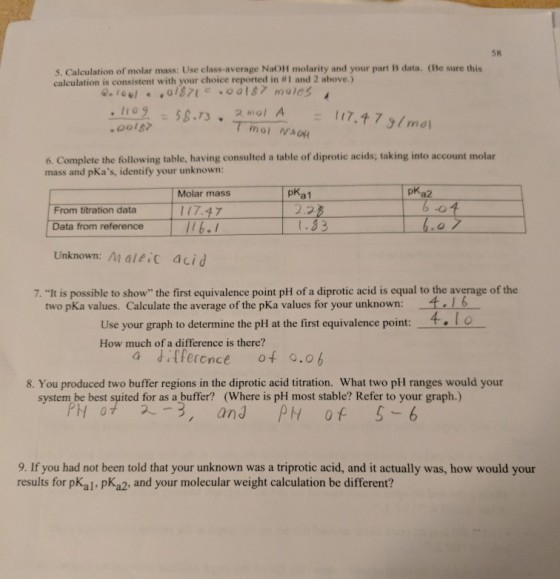
work check and help with the last question. pka2 is more accurate
than pka1.
Homework Answers
I have checked your work. Well done! Keep going ahead.
Now, coming to the last question:
The pKa1 and pKa2 values will be obtained more than the actual or expected values for a triprotic acid. As a result, the molecular weight will be less than the actual one.
Explanation: For a triprotic acid: pKa1 < pKa2 < pKa3
But here, if you don't know that you are using triprotic acid, you will treat it like a diprotic acid and you will get pKa1 and pKa2 values for diprotic acid type, whose values are more than those for the triprotic acid.
Now, Ka is inversely related to [acid]
pKa is inversely related to Ka.
Therefore, pKa is directly related to [acid], moles of acid.
As a result of an increase in no. of moles of acid, its molecular weight decreases.
Add Answer to:
work check and help with the last question. pka2 is more accurate
than pka1.
58 5....
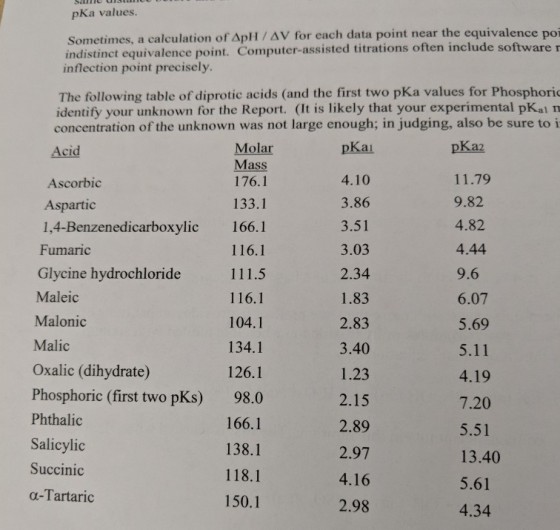
From the molar mass/pKa1/pKa2 values, how can I identify an unknown polyprotic acid? 217 1. Mass...
 From the molar mass/pKa1/pKa2 values, how can I identify an
unknown polyprotic acid?
217 1. Mass of unknown acid (9) 2. Volume of NaOH at first equivalence point (ML) (from titration curve and derivative graph) 11.418 .C02055 002055 3. Moles of NaOH at first equivalence point. 4. Moles of unknown acid. 5. Molar mass of unknown acid (g/mol). 6. Experimental pka 1 7. Experimental pka 2 8. Identity of unknown acid 105 1.95 6.04 9. Theoretical molar mass of unknown...
From the molar mass/pKa1/pKa2 values, how can I identify an
unknown polyprotic acid?
217 1. Mass of unknown acid (9) 2. Volume of NaOH at first equivalence point (ML) (from titration curve and derivative graph) 11.418 .C02055 002055 3. Moles of NaOH at first equivalence point. 4. Moles of unknown acid. 5. Molar mass of unknown acid (g/mol). 6. Experimental pka 1 7. Experimental pka 2 8. Identity of unknown acid 105 1.95 6.04 9. Theoretical molar mass of unknown...
1. Use the data given to calculate the following parts: a. Using your data for the...
 1. Use the data given to calculate the following parts:
a. Using your data for the value for VEP1, calculate the
molarity of H3PO4 at the 1st equivalence point, EP1. Show work
clearly, with units and correct significant figures.
b. Using your data for the value for VEP2, calculate the
molarity of H3PO4 at the 2nd equivalence point, EP2. Show work
clearly, with units and correct significant figures.
c. Calculate the percent error between these two molarity
values, % error...
1. Use the data given to calculate the following parts:
a. Using your data for the value for VEP1, calculate the
molarity of H3PO4 at the 1st equivalence point, EP1. Show work
clearly, with units and correct significant figures.
b. Using your data for the value for VEP2, calculate the
molarity of H3PO4 at the 2nd equivalence point, EP2. Show work
clearly, with units and correct significant figures.
c. Calculate the percent error between these two molarity
values, % error...
Phosphoric acid is a triprotic acid with the following pKa values: pKa1=2.148 pKa2=7.198 pKa3=12.375 You wish...
Phosphoric acid is a triprotic acid with the following pKa values: pKa1=2.148 pKa2=7.198 pKa3=12.375 You wish to prepare 1.000 L of a 0.0100 M phosphate buffer at pH 7.580. To do this, you choose to mix the two salt forms involved in the second ionization, NaH2PO4 and Na2HPO4, in a 1.000 L volumetric flask and add water to the mark. What mass of each salt will you add to the mixture? Mass NaH2PO4=? Mass Na2HPO4=?
I need helo on question #12. I solved the problem but the percent error is a...
 I need helo on question #12. I solved the problem but the
percent error is a large number. Are my calculations correct?
Titration of a weak unknown acid: Name: Noora Hamil Unknown acid A Mass of the Unknown acid: Volume NaOH added (letter or number on the unknown bottle) 0.19 Concentration of NaOH(aq):_01705 M рн 0.5 2.5 2.61 2.6u 2.67 2.69 2.73 2.77 2.81 2.86 2 .93 3.04 3.13 3.23 3.37 3 .5 u u.s 5:5 6.5 3.59 7.5 u.co...
I need helo on question #12. I solved the problem but the
percent error is a large number. Are my calculations correct?
Titration of a weak unknown acid: Name: Noora Hamil Unknown acid A Mass of the Unknown acid: Volume NaOH added (letter or number on the unknown bottle) 0.19 Concentration of NaOH(aq):_01705 M рн 0.5 2.5 2.61 2.6u 2.67 2.69 2.73 2.77 2.81 2.86 2 .93 3.04 3.13 3.23 3.37 3 .5 u u.s 5:5 6.5 3.59 7.5 u.co...
IF YOUR LAST NAME STARTS WITH A LETTER BETWEEN J-R, USE THIS SAMPLE DATA Sample Data...
 IF YOUR LAST NAME STARTS WITH A LETTER BETWEEN J-R, USE THIS SAMPLE DATA Sample Data - Diprotic Acid Titration Initial Data Enter the concentration of NaOH used in the titration: 0.500 Enter the mass of unknown acid you used in grams. (g) 0.75 pH vs Volume Measurements Enter all of the following data as prompted by the data point number. You have UNKNOWN B. Data Point # Volume (mL) pH Data Point # pH Volume (mL) 17.97 1 0.00...
this is the question here is the data EXP. 5 BUFFERS, TITRATION CURVES, AND INDICATORS...
 this is the question
here is the data
EXP. 5 BUFFERS, TITRATION CURVES, AND INDICATORS LAB REPORT WORKSHEETS Solution D: 20.0 mL of 1:1 buffer + 5.00 ml NaOH. See the Buffers - Calculate the pH of a Buffer Solution after a Strong Base is added (MP4 file) Calculate the pH of the solution after mixing the buffer and base. An ICE table may be helpful. Use the pka of acetic acid (previously determined using the 1:1 buffer) in...
this is the question
here is the data
EXP. 5 BUFFERS, TITRATION CURVES, AND INDICATORS LAB REPORT WORKSHEETS Solution D: 20.0 mL of 1:1 buffer + 5.00 ml NaOH. See the Buffers - Calculate the pH of a Buffer Solution after a Strong Base is added (MP4 file) Calculate the pH of the solution after mixing the buffer and base. An ICE table may be helpful. Use the pka of acetic acid (previously determined using the 1:1 buffer) in...
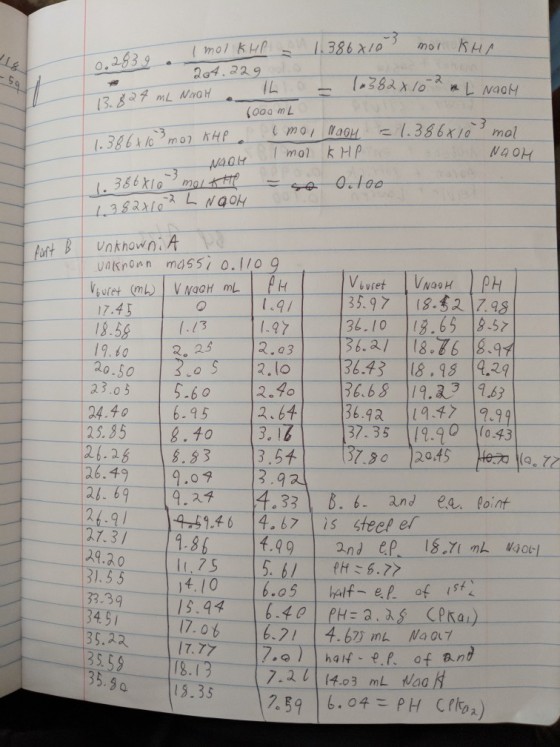
Trying to determine the molar weight and PKa values for an unknown diprodic acid. I have...
 Trying to determine the molar weight and PKa values for an unknown
diprodic acid.
I have .9010 molar NAOH titrant I have a mass of Unknown acid
being .1101 g. Equivalence point of Steepest point on graph equals
22.5mL NAOH. Equivalence OH- is 2.027×10^ -2
moles.
question---I need help to convert moles of OH ion added to
initial moles diprotic acid H2A PH 12Approximately pka1 is
approximately 3.5 at 6.25 mL OH.
data-
NaOHmL / PH 2.5 3 3.50 7.50...
Trying to determine the molar weight and PKa values for an unknown
diprodic acid.
I have .9010 molar NAOH titrant I have a mass of Unknown acid
being .1101 g. Equivalence point of Steepest point on graph equals
22.5mL NAOH. Equivalence OH- is 2.027×10^ -2
moles.
question---I need help to convert moles of OH ion added to
initial moles diprotic acid H2A PH 12Approximately pka1 is
approximately 3.5 at 6.25 mL OH.
data-
NaOHmL / PH 2.5 3 3.50 7.50...
molariity of NaOH is 0.09591 M Font 1.1. Paragraph 4.1 .5. 1. .2 . 1.1 ...6...
 molariity of NaOH is 0.09591 M
Font 1.1. Paragraph 4.1 .5. 1. .2 . 1.1 ...6 Table 1. Raw Data Trial 1 Trial 2 unknown acid un acid mass of unknown acid transferred to beaker(@) 0.589 0.556 concentration of NaOH titrant solution (M) equivalence point volume of NaOH titrant (mL) 26.67 ml 26.16 ml half-equivalence point volume of NaOH titrant (mL) 13.84 ml 13.08 ml half-equivalence point pH 4.91 pH 5.14 pH 1. Calculate the moles of NaOH delivered at...
molariity of NaOH is 0.09591 M
Font 1.1. Paragraph 4.1 .5. 1. .2 . 1.1 ...6 Table 1. Raw Data Trial 1 Trial 2 unknown acid un acid mass of unknown acid transferred to beaker(@) 0.589 0.556 concentration of NaOH titrant solution (M) equivalence point volume of NaOH titrant (mL) 26.67 ml 26.16 ml half-equivalence point volume of NaOH titrant (mL) 13.84 ml 13.08 ml half-equivalence point pH 4.91 pH 5.14 pH 1. Calculate the moles of NaOH delivered at...
Please here is my lab questions for titration of weak acid. The questions are very short....
 Please here is my lab questions for titration of weak acid. The
questions are very short. You have to determine the answers by just
looking at the graph based on the data points. Please give me the
answers of all of them. I would really appreciate. Please calculate
the molar mass question #7 as well. It will be of great help to
me.
Mass of the unknown acid: 0.2grams
Concentration of NaOH = 0.0500M
Formuld Bal pH of weak acid...
Please here is my lab questions for titration of weak acid. The
questions are very short. You have to determine the answers by just
looking at the graph based on the data points. Please give me the
answers of all of them. I would really appreciate. Please calculate
the molar mass question #7 as well. It will be of great help to
me.
Mass of the unknown acid: 0.2grams
Concentration of NaOH = 0.0500M
Formuld Bal pH of weak acid...
My main question is part A however if you could assist on part B and C...
 My main question is part A however if you could assist on part B
and C as well I'd appreciate that as well
Initial data Enter the concentration of NaOH used in the titration. (M) Enter the mass of unknown acid you used in grams. (9) pH vs Volume Measurements 0.500 0.75 Table 1. pH readings PH 1.23 Initial measurement Data point 1 Data point 2 Data point 3 Data point 4 mu Data point 5 Data point 6 Data...
My main question is part A however if you could assist on part B
and C as well I'd appreciate that as well
Initial data Enter the concentration of NaOH used in the titration. (M) Enter the mass of unknown acid you used in grams. (9) pH vs Volume Measurements 0.500 0.75 Table 1. pH readings PH 1.23 Initial measurement Data point 1 Data point 2 Data point 3 Data point 4 mu Data point 5 Data point 6 Data...
 From the molar mass/pKa1/pKa2 values, how can I identify an
unknown polyprotic acid?
217 1. Mass of unknown acid (9) 2. Volume of NaOH at first equivalence point (ML) (from titration curve and derivative graph) 11.418 .C02055 002055 3. Moles of NaOH at first equivalence point. 4. Moles of unknown acid. 5. Molar mass of unknown acid (g/mol). 6. Experimental pka 1 7. Experimental pka 2 8. Identity of unknown acid 105 1.95 6.04 9. Theoretical molar mass of unknown...
From the molar mass/pKa1/pKa2 values, how can I identify an
unknown polyprotic acid?
217 1. Mass of unknown acid (9) 2. Volume of NaOH at first equivalence point (ML) (from titration curve and derivative graph) 11.418 .C02055 002055 3. Moles of NaOH at first equivalence point. 4. Moles of unknown acid. 5. Molar mass of unknown acid (g/mol). 6. Experimental pka 1 7. Experimental pka 2 8. Identity of unknown acid 105 1.95 6.04 9. Theoretical molar mass of unknown...
 1. Use the data given to calculate the following parts:
a. Using your data for the value for VEP1, calculate the
molarity of H3PO4 at the 1st equivalence point, EP1. Show work
clearly, with units and correct significant figures.
b. Using your data for the value for VEP2, calculate the
molarity of H3PO4 at the 2nd equivalence point, EP2. Show work
clearly, with units and correct significant figures.
c. Calculate the percent error between these two molarity
values, % error...
1. Use the data given to calculate the following parts:
a. Using your data for the value for VEP1, calculate the
molarity of H3PO4 at the 1st equivalence point, EP1. Show work
clearly, with units and correct significant figures.
b. Using your data for the value for VEP2, calculate the
molarity of H3PO4 at the 2nd equivalence point, EP2. Show work
clearly, with units and correct significant figures.
c. Calculate the percent error between these two molarity
values, % error...
 I need helo on question #12. I solved the problem but the
percent error is a large number. Are my calculations correct?
Titration of a weak unknown acid: Name: Noora Hamil Unknown acid A Mass of the Unknown acid: Volume NaOH added (letter or number on the unknown bottle) 0.19 Concentration of NaOH(aq):_01705 M рн 0.5 2.5 2.61 2.6u 2.67 2.69 2.73 2.77 2.81 2.86 2 .93 3.04 3.13 3.23 3.37 3 .5 u u.s 5:5 6.5 3.59 7.5 u.co...
I need helo on question #12. I solved the problem but the
percent error is a large number. Are my calculations correct?
Titration of a weak unknown acid: Name: Noora Hamil Unknown acid A Mass of the Unknown acid: Volume NaOH added (letter or number on the unknown bottle) 0.19 Concentration of NaOH(aq):_01705 M рн 0.5 2.5 2.61 2.6u 2.67 2.69 2.73 2.77 2.81 2.86 2 .93 3.04 3.13 3.23 3.37 3 .5 u u.s 5:5 6.5 3.59 7.5 u.co...
 IF YOUR LAST NAME STARTS WITH A LETTER BETWEEN J-R, USE THIS SAMPLE DATA Sample Data - Diprotic Acid Titration Initial Data Enter the concentration of NaOH used in the titration: 0.500 Enter the mass of unknown acid you used in grams. (g) 0.75 pH vs Volume Measurements Enter all of the following data as prompted by the data point number. You have UNKNOWN B. Data Point # Volume (mL) pH Data Point # pH Volume (mL) 17.97 1 0.00...
 this is the question
here is the data
EXP. 5 BUFFERS, TITRATION CURVES, AND INDICATORS LAB REPORT WORKSHEETS Solution D: 20.0 mL of 1:1 buffer + 5.00 ml NaOH. See the Buffers - Calculate the pH of a Buffer Solution after a Strong Base is added (MP4 file) Calculate the pH of the solution after mixing the buffer and base. An ICE table may be helpful. Use the pka of acetic acid (previously determined using the 1:1 buffer) in...
this is the question
here is the data
EXP. 5 BUFFERS, TITRATION CURVES, AND INDICATORS LAB REPORT WORKSHEETS Solution D: 20.0 mL of 1:1 buffer + 5.00 ml NaOH. See the Buffers - Calculate the pH of a Buffer Solution after a Strong Base is added (MP4 file) Calculate the pH of the solution after mixing the buffer and base. An ICE table may be helpful. Use the pka of acetic acid (previously determined using the 1:1 buffer) in...
 Trying to determine the molar weight and PKa values for an unknown
diprodic acid.
I have .9010 molar NAOH titrant I have a mass of Unknown acid
being .1101 g. Equivalence point of Steepest point on graph equals
22.5mL NAOH. Equivalence OH- is 2.027×10^ -2
moles.
question---I need help to convert moles of OH ion added to
initial moles diprotic acid H2A PH 12Approximately pka1 is
approximately 3.5 at 6.25 mL OH.
data-
NaOHmL / PH 2.5 3 3.50 7.50...
Trying to determine the molar weight and PKa values for an unknown
diprodic acid.
I have .9010 molar NAOH titrant I have a mass of Unknown acid
being .1101 g. Equivalence point of Steepest point on graph equals
22.5mL NAOH. Equivalence OH- is 2.027×10^ -2
moles.
question---I need help to convert moles of OH ion added to
initial moles diprotic acid H2A PH 12Approximately pka1 is
approximately 3.5 at 6.25 mL OH.
data-
NaOHmL / PH 2.5 3 3.50 7.50...
 molariity of NaOH is 0.09591 M
Font 1.1. Paragraph 4.1 .5. 1. .2 . 1.1 ...6 Table 1. Raw Data Trial 1 Trial 2 unknown acid un acid mass of unknown acid transferred to beaker(@) 0.589 0.556 concentration of NaOH titrant solution (M) equivalence point volume of NaOH titrant (mL) 26.67 ml 26.16 ml half-equivalence point volume of NaOH titrant (mL) 13.84 ml 13.08 ml half-equivalence point pH 4.91 pH 5.14 pH 1. Calculate the moles of NaOH delivered at...
molariity of NaOH is 0.09591 M
Font 1.1. Paragraph 4.1 .5. 1. .2 . 1.1 ...6 Table 1. Raw Data Trial 1 Trial 2 unknown acid un acid mass of unknown acid transferred to beaker(@) 0.589 0.556 concentration of NaOH titrant solution (M) equivalence point volume of NaOH titrant (mL) 26.67 ml 26.16 ml half-equivalence point volume of NaOH titrant (mL) 13.84 ml 13.08 ml half-equivalence point pH 4.91 pH 5.14 pH 1. Calculate the moles of NaOH delivered at...
 Please here is my lab questions for titration of weak acid. The
questions are very short. You have to determine the answers by just
looking at the graph based on the data points. Please give me the
answers of all of them. I would really appreciate. Please calculate
the molar mass question #7 as well. It will be of great help to
me.
Mass of the unknown acid: 0.2grams
Concentration of NaOH = 0.0500M
Formuld Bal pH of weak acid...
Please here is my lab questions for titration of weak acid. The
questions are very short. You have to determine the answers by just
looking at the graph based on the data points. Please give me the
answers of all of them. I would really appreciate. Please calculate
the molar mass question #7 as well. It will be of great help to
me.
Mass of the unknown acid: 0.2grams
Concentration of NaOH = 0.0500M
Formuld Bal pH of weak acid...
 My main question is part A however if you could assist on part B
and C as well I'd appreciate that as well
Initial data Enter the concentration of NaOH used in the titration. (M) Enter the mass of unknown acid you used in grams. (9) pH vs Volume Measurements 0.500 0.75 Table 1. pH readings PH 1.23 Initial measurement Data point 1 Data point 2 Data point 3 Data point 4 mu Data point 5 Data point 6 Data...
My main question is part A however if you could assist on part B
and C as well I'd appreciate that as well
Initial data Enter the concentration of NaOH used in the titration. (M) Enter the mass of unknown acid you used in grams. (9) pH vs Volume Measurements 0.500 0.75 Table 1. pH readings PH 1.23 Initial measurement Data point 1 Data point 2 Data point 3 Data point 4 mu Data point 5 Data point 6 Data...
Most questions answered within 3 hours.
-
Where is the error in this code sequence?
String s1 = "Hello";
String s2 = "ello";...
asked 10 months ago -
Financial data for Joel de Paris, Inc., for last year
follow:
Joel de Paris, Inc.
Balance...
asked 10 months ago -
Consider this reaction:
Al2(SO4)3 (aq)+ BaCl3
(aq) Al2Cl6 (aq)- +
3BaSO4(s) . What is the...
asked 10 months ago -
Suppose that Savneet is considering increasing her
recent random sample from 20 car rentals to 40...
asked 10 months ago -
Trucks arrive at an unloading terminal at an average rate of 120
per hour.
Trucks arrive...
asked 10 months ago -
Why are methanol and ethanol completely soluble in water while
octanol is not very little soluble....
asked 10 months ago -
A facilities manager at a university reads in a research report
that the mean amount of...
asked 10 months ago -
When the CuSO4 is rehydrated by adding water to the anhydrous
compound, is this an endothermic...
asked 10 months ago -
A ray of sunlight is passing from diamond into crown glass; the
angle of incidence is...
asked 10 months ago -
A block of mass 0.249 kg is placed on top of a light, vertical
spring of...
asked 10 months ago -
how do the kidneys compensate in the presences of acidosis
a) trigger hyperventilate
b) reserve acid...
asked 10 months ago -
Question 501 pts
The rental rate of capital to the firm increases. Which of the
following...
asked 10 months ago