Identify the following ARMA models and see if there is any parameter redundancy. Find the values for p and q

Homework Answers
Lets first check for redundancy.
Our given equation is y=yt-1-.5yt-2+et-.25et-1
For this first we will have to check the AR polynomial. The AR polynomial can't be calculated as there is no real solution for decomposing yt. We can check the same by trying to solve for 1-z+.5z2 and trying to decompose it. It can't be done.
Since there is no root for AR polynomial, it will not share any root with the MA polynomial and hence, there is no parameter redundancy.
The p is 2 since yt, yt-1 and yt-2 are present.
The q is 1 since there is only one lag (et-1) on the error term et
Add Answer to:
Identify the following ARMA models and see if there is any
parameter redundancy. Find the values...
Question 2 (10 points) Classify the following models as an ARIMA (p, d, q) process (find p, d,) a...
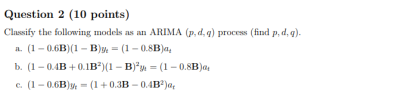 Question 2 (10 points) Classify the following models as an ARIMA (p, d, q) process (find p, d,) a. (1-0.6B) (1- Byt 1- 0.8B)at b. (1 0.4B +0.1B2)(1 - B)2yt (1-0.8B)at c. (1-0.6B)yt = (1 + 0.3B-0.1B*)at
Question 2 (10 points) Classify the following models as an ARIMA (p, d, q) process (find p, d,) a. (1-0.6B) (1- Byt 1- 0.8B)at b. (1 0.4B +0.1B2)(1 - B)2yt (1-0.8B)at c. (1-0.6B)yt = (1 + 0.3B-0.1B*)at
Question 2 (10 points) Classify the following models as an ARIMA (p, d, q) process (find p, d,) a. (1-0.6B) (1- Byt 1- 0.8B)at b. (1 0.4B +0.1B2)(1 - B)2yt (1-0.8B)at c. (1-0.6B)yt = (1 + 0.3B-0.1B*)at
consider the ARIMA model 8. Consider the ARIMA model X,-4 + Xt-1 + W-0.75W,-1, W, ~ WN(0, σ*) a. Identify p, d, and q. Write the corresponding ARMA (p,q) model. b. Find E VX and VarVX 8. Cons...
 consider the ARIMA model
8. Consider the ARIMA model X,-4 + Xt-1 + W-0.75W,-1, W, ~ WN(0, σ*) a. Identify p, d, and q. Write the corresponding ARMA (p,q) model. b. Find E VX and VarVX
8. Consider the ARIMA model X,-4 + Xt-1 + W-0.75W,-1, W, ~ WN(0, σ*) a. Identify p, d, and q. Write the corresponding ARMA (p,q) model. b. Find E VX and VarVX
consider the ARIMA model
8. Consider the ARIMA model X,-4 + Xt-1 + W-0.75W,-1, W, ~ WN(0, σ*) a. Identify p, d, and q. Write the corresponding ARMA (p,q) model. b. Find E VX and VarVX
8. Consider the ARIMA model X,-4 + Xt-1 + W-0.75W,-1, W, ~ WN(0, σ*) a. Identify p, d, and q. Write the corresponding ARMA (p,q) model. b. Find E VX and VarVX
1. Which test is used for the following a. omission of relevant variables b. parameter stability...
1. Which test is used for the following a. omission of relevant variables b. parameter stability 2. when can we introduce dummies in models? 3. What is stationarity and Why is it desired to run a model? 4. how do you determine the order of Lags in ARMA model? 5. List and explain the Box - Jenkins model adequacy test for the ARMA/ARIMA
Complete Time Series Models
I only need assistance with the problems in bold. So, you can choose whichever you want as I just need to check my answers. Write the complete model for each the following:(a) AR(P = 2)d=12(b) MA(Q = 2)d=12(c) ARMA(P = 1, Q = 2)d=12(d) ARMA(P = 2, Q = 0)d=12(e) ARMA(p = 0, q = 2) × (P = 1, Q = 2)d=4(f) SARIMA(p = 1, d = 1, q = 1) × (P = 2, D = 1, Q =...
True or false? You do not have to provide explanations. (a) Any moving average (MA) process is co...
True or false? You do not have to provide explanations. (a) Any moving average (MA) process is covariance stationary. (b) Any autoregressive (AR) process is invertible. (c) The autocorrelation function of an MA process decays gradually while the partial autocorrelation function exhibits a sharp cut-off. (d) Suppose yt is a general linear process. The optimal 2-step-ahead prediction error follows MA(2) process. (e) Any autoregressive moving average (ARMA) process is invertible because any moving average (MA) process is invertible. (f) The...
Q1. (10 points total) Consider an ARMA(1,1) model X4 = 0.9X-1 + Z+ +0.527-1, {Z4}~ IID...
 Q1. (10 points total) Consider an ARMA(1,1) model X4 = 0.9X-1 + Z+ +0.527-1, {Z4}~ IID N(0,1). 1. (2 points) (i) Generate n = 200 observations from this ARMA model. (ii) Find the maximum likelihood (ML) estimates of the three parameters o, e, and o2. 2. (8 points) Repeat (i) and (ii) in part 1 nine more times using all different seed numbers. Compare the estimates to their true values. Are the average of 10 estimates for each parameter close...
find the values of the parameter p for which the series converges. (1-p/k)^k My g Find...
 find the values of the parameter p for which the
series converges. (1-p/k)^k
My g Find the values of the parameter p for which the series converges. Cour È ( - )" Assig k=1 Stud Select the correct choice below and, if necessary, fill in any answer boxes in your choice Grad A. The series converges for < p < (Simplify your answers.) OB. The series converges for p > Inter (Simplify your answer.) OC. The series converges for p...
find the values of the parameter p for which the
series converges. (1-p/k)^k
My g Find the values of the parameter p for which the series converges. Cour È ( - )" Assig k=1 Stud Select the correct choice below and, if necessary, fill in any answer boxes in your choice Grad A. The series converges for < p < (Simplify your answers.) OB. The series converges for p > Inter (Simplify your answer.) OC. The series converges for p...
7. Determine the values for the following ECG tracings (Pages 521). Use Figure 19.7 (Page 579) to identify the wave...
 7. Determine the values for the following ECG tracings (Pages 521). Use Figure 19.7 (Page 579) to identify the waves and measurements Tracing 1 Tracing 2 Values for ECG periods. See the examples in bold font Normal values Tracing 2 Tracing 1 Value Heart Rate R-R interval QRS duration P-R interval 0.38 sec 0.40 sec 0.42-0.44 sec Q-T interval Find normal values on Table 19.5 Page 520 Explain how do you determine the heart rate in an EKG. Provide the...
QUESTION 2 (a) For each of the ARIMA models below, give the values for E(VY) and...
 QUESTION 2 (a) For each of the ARIMA models below, give the values for E(VY) and Var(VY) 0.Tet-1 (ii) Yt = 10 + 1.25%-1-0.25Yt-2 et-0.14-i (b) Show that the function Z, a t-1 not stationary, but the first difference of Z, is stationary QUESTION 5 (a) From a series Y, of length 100, the sample autocorrelations at lags 1-3 are 0.8, 0.5 and 0.4, respectively. Furthermore, the respective sample mean and sample variance of the series are 2 and s-5....
Find the values of the parameter p for which the series converges. (1-2) k= 1 Select...
 Find the values of the parameter p for which the series converges. (1-2) k= 1 Select the correct choice below and, if necessary, fill in any answer boxes in your choice. A. The series converges for <p<. (Simplify your answers.) B. The series converges for p > (Simplify your answer.) C. The series converges for p< (Simplify your answer.) D. The series converges for all p. E. The series diverges for all p.
 Question 2 (10 points) Classify the following models as an ARIMA (p, d, q) process (find p, d,) a. (1-0.6B) (1- Byt 1- 0.8B)at b. (1 0.4B +0.1B2)(1 - B)2yt (1-0.8B)at c. (1-0.6B)yt = (1 + 0.3B-0.1B*)at
Question 2 (10 points) Classify the following models as an ARIMA (p, d, q) process (find p, d,) a. (1-0.6B) (1- Byt 1- 0.8B)at b. (1 0.4B +0.1B2)(1 - B)2yt (1-0.8B)at c. (1-0.6B)yt = (1 + 0.3B-0.1B*)at
Question 2 (10 points) Classify the following models as an ARIMA (p, d, q) process (find p, d,) a. (1-0.6B) (1- Byt 1- 0.8B)at b. (1 0.4B +0.1B2)(1 - B)2yt (1-0.8B)at c. (1-0.6B)yt = (1 + 0.3B-0.1B*)at
 consider the ARIMA model
8. Consider the ARIMA model X,-4 + Xt-1 + W-0.75W,-1, W, ~ WN(0, σ*) a. Identify p, d, and q. Write the corresponding ARMA (p,q) model. b. Find E VX and VarVX
8. Consider the ARIMA model X,-4 + Xt-1 + W-0.75W,-1, W, ~ WN(0, σ*) a. Identify p, d, and q. Write the corresponding ARMA (p,q) model. b. Find E VX and VarVX
consider the ARIMA model
8. Consider the ARIMA model X,-4 + Xt-1 + W-0.75W,-1, W, ~ WN(0, σ*) a. Identify p, d, and q. Write the corresponding ARMA (p,q) model. b. Find E VX and VarVX
8. Consider the ARIMA model X,-4 + Xt-1 + W-0.75W,-1, W, ~ WN(0, σ*) a. Identify p, d, and q. Write the corresponding ARMA (p,q) model. b. Find E VX and VarVX
 Q1. (10 points total) Consider an ARMA(1,1) model X4 = 0.9X-1 + Z+ +0.527-1, {Z4}~ IID N(0,1). 1. (2 points) (i) Generate n = 200 observations from this ARMA model. (ii) Find the maximum likelihood (ML) estimates of the three parameters o, e, and o2. 2. (8 points) Repeat (i) and (ii) in part 1 nine more times using all different seed numbers. Compare the estimates to their true values. Are the average of 10 estimates for each parameter close...
 find the values of the parameter p for which the
series converges. (1-p/k)^k
My g Find the values of the parameter p for which the series converges. Cour È ( - )" Assig k=1 Stud Select the correct choice below and, if necessary, fill in any answer boxes in your choice Grad A. The series converges for < p < (Simplify your answers.) OB. The series converges for p > Inter (Simplify your answer.) OC. The series converges for p...
find the values of the parameter p for which the
series converges. (1-p/k)^k
My g Find the values of the parameter p for which the series converges. Cour È ( - )" Assig k=1 Stud Select the correct choice below and, if necessary, fill in any answer boxes in your choice Grad A. The series converges for < p < (Simplify your answers.) OB. The series converges for p > Inter (Simplify your answer.) OC. The series converges for p...
 7. Determine the values for the following ECG tracings (Pages 521). Use Figure 19.7 (Page 579) to identify the waves and measurements Tracing 1 Tracing 2 Values for ECG periods. See the examples in bold font Normal values Tracing 2 Tracing 1 Value Heart Rate R-R interval QRS duration P-R interval 0.38 sec 0.40 sec 0.42-0.44 sec Q-T interval Find normal values on Table 19.5 Page 520 Explain how do you determine the heart rate in an EKG. Provide the...
 QUESTION 2 (a) For each of the ARIMA models below, give the values for E(VY) and Var(VY) 0.Tet-1 (ii) Yt = 10 + 1.25%-1-0.25Yt-2 et-0.14-i (b) Show that the function Z, a t-1 not stationary, but the first difference of Z, is stationary QUESTION 5 (a) From a series Y, of length 100, the sample autocorrelations at lags 1-3 are 0.8, 0.5 and 0.4, respectively. Furthermore, the respective sample mean and sample variance of the series are 2 and s-5....
 Find the values of the parameter p for which the series converges. (1-2) k= 1 Select the correct choice below and, if necessary, fill in any answer boxes in your choice. A. The series converges for <p<. (Simplify your answers.) B. The series converges for p > (Simplify your answer.) C. The series converges for p< (Simplify your answer.) D. The series converges for all p. E. The series diverges for all p.
Most questions answered within 3 hours.
-
Where is the error in this code sequence?
String s1 = "Hello";
String s2 = "ello";...
asked 10 months ago -
Financial data for Joel de Paris, Inc., for last year
follow:
Joel de Paris, Inc.
Balance...
asked 10 months ago -
Consider this reaction:
Al2(SO4)3 (aq)+ BaCl3
(aq) Al2Cl6 (aq)- +
3BaSO4(s) . What is the...
asked 10 months ago -
Suppose that Savneet is considering increasing her
recent random sample from 20 car rentals to 40...
asked 10 months ago -
Trucks arrive at an unloading terminal at an average rate of 120
per hour.
Trucks arrive...
asked 10 months ago -
Why are methanol and ethanol completely soluble in water while
octanol is not very little soluble....
asked 10 months ago -
A facilities manager at a university reads in a research report
that the mean amount of...
asked 10 months ago -
When the CuSO4 is rehydrated by adding water to the anhydrous
compound, is this an endothermic...
asked 10 months ago -
A ray of sunlight is passing from diamond into crown glass; the
angle of incidence is...
asked 10 months ago -
A block of mass 0.249 kg is placed on top of a light, vertical
spring of...
asked 10 months ago -
how do the kidneys compensate in the presences of acidosis
a) trigger hyperventilate
b) reserve acid...
asked 10 months ago -
Question 501 pts
The rental rate of capital to the firm increases. Which of the
following...
asked 10 months ago