
Homework Answers


Add Answer to:
An unstable particle is at rest and suddenly breaks up into two fragments. No external forces...
An unstable particle is at rest and suddenly decays into two fragments. No external forces act...
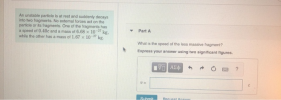 An unstable particle is at rest and suddenly decays into two fragments. No external forces act on the particle or its fragments. One of the fragments has a speed of 0.40c and a mass of 6.68 x 10⁻²⁷ kg. while the other has a mass of 1.67 x 10⁻²⁷ kg Part A What is the speed of the loss massive fragment? Express your answer using two significant figures. VAXD O ? Submit Rani
An unstable particle at rest breaks up into two fragments of unequal mass. The mass of...
An unstable particle at rest breaks up into two fragments of unequal mass. The mass of the lighter fragment is equal to 2.30 10-28 kg and that of the heavier fragment is 1.65 10-27 kg. If the lighter fragment has a speed of 0.893c after the breakup, what is the speed of the heavier fragment?
An unstable particle at rest breaks up into two fragments of unequal mass. The mass of...
An unstable particle at rest breaks up into two fragments of unequal mass. The mass of the lighter fragment is equal to 4.00 ✕ 10−28 kg and that of the heavier fragment is 1.71 ✕ 10−27 kg. If the lighter fragment has a speed of 0.893c after the breakup, what is the speed of the heavier fragment? =__c
round all calculation to 4 signicant figures An unstable particle at rest spontaneously breaks into two...
 round all calculation to 4 signicant figures
An unstable particle at rest spontaneously breaks into two fragments of unequal mass. The mass of the first fragment is 2.80 x 10 kg, and that of the other is 1.61 X 10" ko. If the lighter fragment has a speed of 0.854c after the breakup, what is the speed of the heavier fragment? (Assume the speeds are measured in a frame at rest with respect to the original particle.)
round all calculation to 4 signicant figures
An unstable particle at rest spontaneously breaks into two fragments of unequal mass. The mass of the first fragment is 2.80 x 10 kg, and that of the other is 1.61 X 10" ko. If the lighter fragment has a speed of 0.854c after the breakup, what is the speed of the heavier fragment? (Assume the speeds are measured in a frame at rest with respect to the original particle.)
- An unstable particle with a mass equal to 3.34 ✕ 10−27 kg is initially at...
- An unstable particle with a mass equal to 3.34 ✕ 10−27 kg is initially at rest. The particle decays into two fragments that fly off with velocities of 0.981c and −0.861c, respectively. Find the masses of the fragments. (Hint: Conserve both mass–energy and momentum.) m(0.981c) = kg m(-0.861c) = kg - An unstable particle at rest breaks up into two fragments of unequal mass. The mass of the lighter fragment is equal to 2.30 ✕ 10−28 kg and that...
T-Mobile LTE 1:29 PM 81% 26.15.PNG 15. An unstable particle at rest breaks up into two...
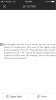 T-Mobile LTE 1:29 PM 81% 26.15.PNG 15. An unstable particle at rest breaks up into two frag- ments of unequal mass. The mass of the lighter frag- ment is equal to 2.50 × 10⁻²⁸ kg and that of the heavier fragment is 1.67 × 10⁻²⁷ kg. If the lighter fragment has a speed of 0.893c after the breakup, what is the speed of the heavier fragment? Open With Print
An unstable particle with a equal to 3.34 times 10^-27 kg is initially at rest. The...
 An unstable particle with a equal to 3.34 times 10^-27 kg is initially at rest. The particle decays to two fragments that fly off with velocities of 0.970c and mass -0.65sc, respectively, Find the masses of the fragment. m(0.070c) = kg m(0.855c) = kg
1. An unstable particle with mass 2.81 x 10⁻²⁷ kg is initially at rest. The particle...
 1. An unstable particle with mass 2.81 x 10⁻²⁷ kg is initially at rest. The particle decays into two fragments that fly off along the x axis with velocity components u, 0.987c and u, --0.898c. From this information, we wish to determine the masses of fragments 1 and 2 (a) Is the initial system of the unstable particle, which becomes the system of the two fragments, isolated or nonisolated? [i.e. Are there external forces on the system?] (b) Based on...
Chapter 39, Problem 62. An unstable particle with mass m = 2.81 * 10 ^ -27...
Chapter 39, Problem 62. An unstable particle with mass m = 2.81 * 10 ^ -27 kg is initially at rest. The particle decays into two fragments that fly off along the x axis with velocity components u1 = 0.987c and u2 = -0.898c. From this information, we wish to determine the masses of fragments 1 and 2. (a) Is the initial system of the unstable particle, which becomes the system of the two fragments, isolated or nonisolated? [i.e. Are...
An unstable nucleus of mass 1.7 ✕ 10−26 kg, initially at rest at the origin of...
An unstable nucleus of mass 1.7 ✕ 10−26 kg, initially at rest at the origin of a coordinate system, disintegrates into three particles. One particle, having a mass of m1 = 1.0 ✕ 10−27 kg, moves in the positive y-direction with speed v1 = 5.0 ✕ 106 m/s. Another particle, of mass m2 = 8.0 ✕ 10−27 kg, moves in the positive x-direction with speed v2 = 3.8 ✕ 106 m/s. Find the magnitude and direction of the velocity of...
 An unstable particle is at rest and suddenly decays into two fragments. No external forces act on the particle or its fragments. One of the fragments has a speed of 0.40c and a mass of 6.68 x 10⁻²⁷ kg. while the other has a mass of 1.67 x 10⁻²⁷ kg Part A What is the speed of the loss massive fragment? Express your answer using two significant figures. VAXD O ? Submit Rani
 round all calculation to 4 signicant figures
An unstable particle at rest spontaneously breaks into two fragments of unequal mass. The mass of the first fragment is 2.80 x 10 kg, and that of the other is 1.61 X 10" ko. If the lighter fragment has a speed of 0.854c after the breakup, what is the speed of the heavier fragment? (Assume the speeds are measured in a frame at rest with respect to the original particle.)
round all calculation to 4 signicant figures
An unstable particle at rest spontaneously breaks into two fragments of unequal mass. The mass of the first fragment is 2.80 x 10 kg, and that of the other is 1.61 X 10" ko. If the lighter fragment has a speed of 0.854c after the breakup, what is the speed of the heavier fragment? (Assume the speeds are measured in a frame at rest with respect to the original particle.)
 T-Mobile LTE 1:29 PM 81% 26.15.PNG 15. An unstable particle at rest breaks up into two frag- ments of unequal mass. The mass of the lighter frag- ment is equal to 2.50 × 10⁻²⁸ kg and that of the heavier fragment is 1.67 × 10⁻²⁷ kg. If the lighter fragment has a speed of 0.893c after the breakup, what is the speed of the heavier fragment? Open With Print
 An unstable particle with a equal to 3.34 times 10^-27 kg is initially at rest. The particle decays to two fragments that fly off with velocities of 0.970c and mass -0.65sc, respectively, Find the masses of the fragment. m(0.070c) = kg m(0.855c) = kg
 1. An unstable particle with mass 2.81 x 10⁻²⁷ kg is initially at rest. The particle decays into two fragments that fly off along the x axis with velocity components u, 0.987c and u, --0.898c. From this information, we wish to determine the masses of fragments 1 and 2 (a) Is the initial system of the unstable particle, which becomes the system of the two fragments, isolated or nonisolated? [i.e. Are there external forces on the system?] (b) Based on...
Most questions answered within 3 hours.
-
Where is the error in this code sequence?
String s1 = "Hello";
String s2 = "ello";...
asked 10 months ago -
Financial data for Joel de Paris, Inc., for last year
follow:
Joel de Paris, Inc.
Balance...
asked 10 months ago -
Consider this reaction:
Al2(SO4)3 (aq)+ BaCl3
(aq) Al2Cl6 (aq)- +
3BaSO4(s) . What is the...
asked 10 months ago -
Suppose that Savneet is considering increasing her
recent random sample from 20 car rentals to 40...
asked 10 months ago -
Trucks arrive at an unloading terminal at an average rate of 120
per hour.
Trucks arrive...
asked 10 months ago -
Why are methanol and ethanol completely soluble in water while
octanol is not very little soluble....
asked 10 months ago -
A facilities manager at a university reads in a research report
that the mean amount of...
asked 10 months ago -
When the CuSO4 is rehydrated by adding water to the anhydrous
compound, is this an endothermic...
asked 10 months ago -
A ray of sunlight is passing from diamond into crown glass; the
angle of incidence is...
asked 10 months ago -
A block of mass 0.249 kg is placed on top of a light, vertical
spring of...
asked 10 months ago -
how do the kidneys compensate in the presences of acidosis
a) trigger hyperventilate
b) reserve acid...
asked 10 months ago -
Question 501 pts
The rental rate of capital to the firm increases. Which of the
following...
asked 10 months ago