Show all work. Define the following: 1. Bit 2. Byte 3. ASCII 4. Binary 5. Octal...
Show all work. Define the following:
1. Bit
2. Byte
3. ASCII
4. Binary
5. Octal
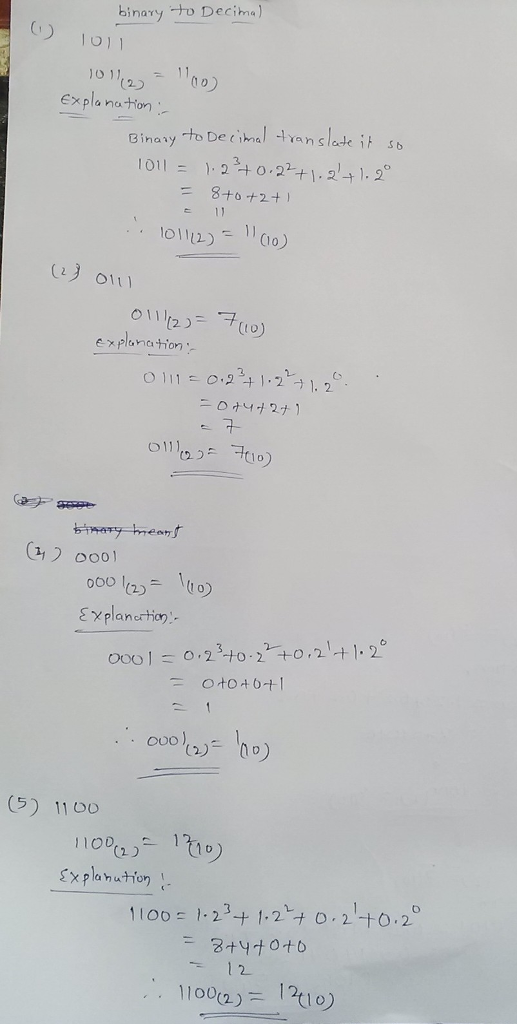
Convert the following binary numbers to decimal numbers:
1011
0111
0000
0001
1100
1000
0101
Convert the following numbers from decimal to binary:
0
4
9
3
17
8
7
Decode the following Binary ASCII text. Show your work.
01001001
00100000
01101100
01101111
01110110
01100101
00100000
01111001
01101111
01110101
Homework Answers
Answer:
1)bit:
A binary digit, or bit, is the smallest unit of information in a computer. It is used for storing information and has a value of true/false, or on/off. An individual bit has a value of either 0 or 1, which is generally used to store data and implement instructions in groups of bytes. A computer is often classified by the number of bits it can process at one time or by the number of bits in a memory address. Many systems use four eight-bit bytes to form a 32-bit word.
The value of a bit is typically stored above or below an allocated level of an electrical charge within a capacitor inside a memory module. For devices that use positive logic, value 1 (true value or high) is positive voltage relative to the electrical ground and value 0 (false value or low) is 0 voltage.
2)Byte:
A byte is a storage unit capable of representing a single character, such as a letter, number or symbol. Technically speaking, a byte is a sequence of binary bits in a serialized data stream in data transmission systems. In most computers, one byte is equated to eight smaller units called bits, although the size of a byte has always been dependent on hardware.
As specified in IEC80000-13 and IEEE 1541, the symbol for byte is an upper-case "B".
3)ASCII:
ASCII (American Standard Code for Information Interchange) is the most common format for text files in computers and on the Internet. In an ASCII file, each alphabetic, numeric, or special character is represented with a 7-bit binary number (a string of seven 0s or 1s). 128 possible characters are defined.
American Standard Code for Information Interchange. Pronounced ask-ee, ASCII is a code for representing English characters as numbers, with each letter assigned a number from 0 to 127. For example, the ASCII code for uppercaseM is 77. Most computers use ASCII codes to represent text, which makes it possible to transfer datafrom one computer to another.
For a list of commonly used characters and their ASCII equivalents, refer to the ASCII page in the Quick Reference section.
Text files stored in ASCII format are sometimes called ASCII files. Text editors and word processors are usually capable of storing data in ASCII format, although ASCII format is not always the default storage format. Most data files, particularly if they contain numeric data, are not stored in ASCII format. Executable programsare never stored in ASCII format.
4)Binary:
Binary (or "base-2") a numeric system that only uses two digits — 0 and 1. Computers operate in binary, meaning they store dataand perform calculations using only zeros and ones.
While a single binary digit can be used to represent True (1) or False (0) in boolean logic, multiple binary digits can be used to store large numbers and perform complex functions. In fact, any number can be represented in binary.
5)Octal:
The number system whose base is 8 is known as the octal number system. The base 8 means the system uses eight digits from 0 to 7. All the eight digits from 0 to 8 have same physical meaning as that of decimal numbers. The next digit in octal number is represented by 10, 11, 12, 13, 14, 15, 16, 17 which represents the decimal digits 8, 9, 10, 11, 12, 13, 14, 15. In this manner the octal number 20 represents the decimal number 16 and subsequently 21, 22, 23….octal numbers will show the decimal digits 17, 18, 19…etc and so on base-8 number system, which uses just eight unique symbols (0, 1, 2, 3, 4, 5, 6, and 7). Programs often display data in octal format because it is relatively easy for humans to read and can easily be translated into binary format, which is the most important format for computers. By contrast, decimal format is the easiest format for humans to read because it is the one we use in everyday life, but translating between decimal and binary formatsis relatively difficult.

Add Answer to:
Show all work. Define the following:
1. Bit
2. Byte
3. ASCII
4. Binary
5. Octal...
4) Decode the binary message and show what it is in ASCII characters. (Note: There are...
4) Decode the binary message and show what it is in ASCII characters. (Note: There are Typos, so don't make assumptions...) You mightfind it easier to convert to Hexadecimal first. (10 Points) 01010100 01101000 01100101 00100000 01100010 01100101 01100110 01110100 00100000 01100011 01101100 01100001 01110011 01010011 00100000 01110100 01101111 00100000 01110100 01100001 01001011 01100101 00100000 01100001 01110100 00100000 01000111 01001101 01010101 00100000 01101001 01011010 00100000 01000011 01010011 00110001 00110001 00110000 00100001 00111111 Message in ASCII:
Please show work! 2. Now, give it a try by converting the binary number 01110110 to...
 Please show work!
2. Now, give it a try by converting the binary number 01110110 to decimal by filling in the same table in step 1 r of 2 Pov 128 64 32 16 Cumulative Amount 4. Now, you give it a try by converting the decimal number 131 to binary by filling in the table Power of 2 128 32 16 Bit Amount Remaining 6. Use the binary to hexadecimal table to convert the binary number 01101111 to hexadecimal...
Please show work!
2. Now, give it a try by converting the binary number 01110110 to decimal by filling in the same table in step 1 r of 2 Pov 128 64 32 16 Cumulative Amount 4. Now, you give it a try by converting the decimal number 131 to binary by filling in the table Power of 2 128 32 16 Bit Amount Remaining 6. Use the binary to hexadecimal table to convert the binary number 01101111 to hexadecimal...
I need the following problems worked out (show work). Thee answers are provided, I just need...
I need the following problems worked out (show work). Thee answers are provided, I just need the work explained briefly for each one. 4 - What is the decimal representation of each of the following unsigned binary integers? a. 00110101 (53) b. 10010110 (150) c. 11001100 (204) 6 - What is the sum of each pair of binary numbers? a. 10101111 + 11011011 (110001010) b. 10010111 + 11111111 (110010110) c. 01110101 + 10101100 (100100001) 8 - How many bits are...
Question 12 1 pts What is the decimal for the 2's Complement Binary addition of the...
 Question 12 1 pts What is the decimal for the 2's Complement Binary addition of the following 8 Bit numbers (Assume 8 Bit full adder i.e. overflow is possible) 1000 0001 + 1000 0010 Question 13 1 pts What is the 2's complement binary number for the 2's complement operation of the following 8 bit numbers (Assume 8 Bit full adder i.e. overflow is possible) 0010 1111 - 0011 0000 Question 14 1 pts What is the 2's complement binary...
Convert each of the following 32 IEEE 754 single precision bit patterns to its corresponding decimal...
 Convert each of the following 32 IEEE 754 single precision bit patterns to its corresponding decimal value (the bits are separated into groups of 4 to make interpretation easier). Show all of your work and include a few comments as to what you are doing at each step. 1100 0100 1011 1010 0100 1000 0000 0000 a. b. 0100 0101 1110 0010 0110 1101 0000 0000
Convert each of the following 32 IEEE 754 single precision bit patterns to its...
Convert each of the following 32 IEEE 754 single precision bit patterns to its corresponding decimal value (the bits are separated into groups of 4 to make interpretation easier). Show all of your work and include a few comments as to what you are doing at each step. 1100 0100 1011 1010 0100 1000 0000 0000 a. b. 0100 0101 1110 0010 0110 1101 0000 0000
Convert each of the following 32 IEEE 754 single precision bit patterns to its...
1. Convert the binary number 10101102 to octal, decimal, and hexadecimal numbers. 2. Convert the decimal...
 1. Convert the binary number 10101102 to octal, decimal, and hexadecimal numbers. 2. Convert the decimal number 236.7510 to binary,octal, and hexadecimal numbers. 3. Add the following two binary numbers: 100111102 and 011110112. Remember to show any carries that are generated along the way. 4. Repeat the previous question, but this time subtract the second binary number from the first. Remember to show any borrows that are required along the way. 5. Determine the encoding of the decimal number 28610...
question 1 part 2 and 3 thank you (47) Naruto Notone C Sign In er Sign...
 question 1 part 2 and 3 thank you
(47) Naruto Notone C Sign In er Sign Up | Ch ® UFC & MMA × Secure I https://piazza-resourcess3.amazonaws.com/jgopch0cb93d8/j .pdfAWSAccessKeyld-AKAILDNRL/4ALKBWOHA8lexpires-15200435/2&Signature-ol9aXG9 /UAKIHS0QUwMeyBX.. ☆ ミ quations must be properly tyne-set including superscript-s expunents, Always watch the course websile for updates on the assignments. Question 1 (4 points) Show you work I. Convert 2727 into a 32-bit two's complement binary number 2. Convert -5795 into a 16-bit two's complement binary number 3. Add the above...
question 1 part 2 and 3 thank you
(47) Naruto Notone C Sign In er Sign Up | Ch ® UFC & MMA × Secure I https://piazza-resourcess3.amazonaws.com/jgopch0cb93d8/j .pdfAWSAccessKeyld-AKAILDNRL/4ALKBWOHA8lexpires-15200435/2&Signature-ol9aXG9 /UAKIHS0QUwMeyBX.. ☆ ミ quations must be properly tyne-set including superscript-s expunents, Always watch the course websile for updates on the assignments. Question 1 (4 points) Show you work I. Convert 2727 into a 32-bit two's complement binary number 2. Convert -5795 into a 16-bit two's complement binary number 3. Add the above...
Please show work/explanation too! 34. Subtract the following signed binary numbers as shown using 2's complement...
 Please show work/explanation too!
34. Subtract the following signed binary numbers as shown using 2's complement arithmetic. a) 01110101 - 00111011 b ) 00110101 - 00001011 C) 01101111 - 00010001
Please show work/explanation too!
34. Subtract the following signed binary numbers as shown using 2's complement arithmetic. a) 01110101 - 00111011 b ) 00110101 - 00001011 C) 01101111 - 00010001
(3 pts) This problem tests your knowledge about coding schemes. What is the binary bit pattern for...
(3 pts) This problem tests your knowledge about coding schemes. What is the binary bit pattern for the letter 'h' using? The answers should give the whole bit string (including leading 0s). ASCII encoding (7-bits) EBCDIC encoding (8-bits) UNICODE encoding (16 bits) ______________________________________________________________________________ (3 pts) Show how each of the following floating point values would be stored using IEEE-754 single precision (be sure to indicate the sign bit, the exponent, and the significand fields): (show your work) 12.5 −1.5 0.75 26.625...
6. Convert .3710 to a binary fraction of 10 binary digits. 7. Use two's compliment arithmetic to perform the following 8 bit binary operations. a. 0010 1110 + 0001 1011 b. 0101 1101 – 0011 1010 c....
6. Convert .3710 to a binary fraction of 10 binary digits. 7. Use two's compliment arithmetic to perform the following 8 bit binary operations. a. 0010 1110 + 0001 1011 b. 0101 1101 – 0011 1010 c. 1011 1000 – 1000 1011 d. 1000 1100 – 1111 0111 8. Convert 150.8476562510 to IEEE Floating Point Standard. 9. Simplify the following Boolean expressions. a. xy + xy + xz b. (w + x)(x + y)(w + x + y + z)...
 Please show work!
2. Now, give it a try by converting the binary number 01110110 to decimal by filling in the same table in step 1 r of 2 Pov 128 64 32 16 Cumulative Amount 4. Now, you give it a try by converting the decimal number 131 to binary by filling in the table Power of 2 128 32 16 Bit Amount Remaining 6. Use the binary to hexadecimal table to convert the binary number 01101111 to hexadecimal...
Please show work!
2. Now, give it a try by converting the binary number 01110110 to decimal by filling in the same table in step 1 r of 2 Pov 128 64 32 16 Cumulative Amount 4. Now, you give it a try by converting the decimal number 131 to binary by filling in the table Power of 2 128 32 16 Bit Amount Remaining 6. Use the binary to hexadecimal table to convert the binary number 01101111 to hexadecimal...
 Question 12 1 pts What is the decimal for the 2's Complement Binary addition of the following 8 Bit numbers (Assume 8 Bit full adder i.e. overflow is possible) 1000 0001 + 1000 0010 Question 13 1 pts What is the 2's complement binary number for the 2's complement operation of the following 8 bit numbers (Assume 8 Bit full adder i.e. overflow is possible) 0010 1111 - 0011 0000 Question 14 1 pts What is the 2's complement binary...
 Convert each of the following 32 IEEE 754 single precision bit patterns to its corresponding decimal value (the bits are separated into groups of 4 to make interpretation easier). Show all of your work and include a few comments as to what you are doing at each step. 1100 0100 1011 1010 0100 1000 0000 0000 a. b. 0100 0101 1110 0010 0110 1101 0000 0000
Convert each of the following 32 IEEE 754 single precision bit patterns to its...
Convert each of the following 32 IEEE 754 single precision bit patterns to its corresponding decimal value (the bits are separated into groups of 4 to make interpretation easier). Show all of your work and include a few comments as to what you are doing at each step. 1100 0100 1011 1010 0100 1000 0000 0000 a. b. 0100 0101 1110 0010 0110 1101 0000 0000
Convert each of the following 32 IEEE 754 single precision bit patterns to its...
 1. Convert the binary number 10101102 to octal, decimal, and hexadecimal numbers. 2. Convert the decimal number 236.7510 to binary,octal, and hexadecimal numbers. 3. Add the following two binary numbers: 100111102 and 011110112. Remember to show any carries that are generated along the way. 4. Repeat the previous question, but this time subtract the second binary number from the first. Remember to show any borrows that are required along the way. 5. Determine the encoding of the decimal number 28610...
 question 1 part 2 and 3 thank you
(47) Naruto Notone C Sign In er Sign Up | Ch ® UFC & MMA × Secure I https://piazza-resourcess3.amazonaws.com/jgopch0cb93d8/j .pdfAWSAccessKeyld-AKAILDNRL/4ALKBWOHA8lexpires-15200435/2&Signature-ol9aXG9 /UAKIHS0QUwMeyBX.. ☆ ミ quations must be properly tyne-set including superscript-s expunents, Always watch the course websile for updates on the assignments. Question 1 (4 points) Show you work I. Convert 2727 into a 32-bit two's complement binary number 2. Convert -5795 into a 16-bit two's complement binary number 3. Add the above...
question 1 part 2 and 3 thank you
(47) Naruto Notone C Sign In er Sign Up | Ch ® UFC & MMA × Secure I https://piazza-resourcess3.amazonaws.com/jgopch0cb93d8/j .pdfAWSAccessKeyld-AKAILDNRL/4ALKBWOHA8lexpires-15200435/2&Signature-ol9aXG9 /UAKIHS0QUwMeyBX.. ☆ ミ quations must be properly tyne-set including superscript-s expunents, Always watch the course websile for updates on the assignments. Question 1 (4 points) Show you work I. Convert 2727 into a 32-bit two's complement binary number 2. Convert -5795 into a 16-bit two's complement binary number 3. Add the above...
 Please show work/explanation too!
34. Subtract the following signed binary numbers as shown using 2's complement arithmetic. a) 01110101 - 00111011 b ) 00110101 - 00001011 C) 01101111 - 00010001
Please show work/explanation too!
34. Subtract the following signed binary numbers as shown using 2's complement arithmetic. a) 01110101 - 00111011 b ) 00110101 - 00001011 C) 01101111 - 00010001
Most questions answered within 3 hours.
-
Where is the error in this code sequence?
String s1 = "Hello";
String s2 = "ello";...
asked 10 months ago -
Financial data for Joel de Paris, Inc., for last year
follow:
Joel de Paris, Inc.
Balance...
asked 10 months ago -
Consider this reaction:
Al2(SO4)3 (aq)+ BaCl3
(aq) Al2Cl6 (aq)- +
3BaSO4(s) . What is the...
asked 10 months ago -
Suppose that Savneet is considering increasing her
recent random sample from 20 car rentals to 40...
asked 10 months ago -
Trucks arrive at an unloading terminal at an average rate of 120
per hour.
Trucks arrive...
asked 10 months ago -
Why are methanol and ethanol completely soluble in water while
octanol is not very little soluble....
asked 10 months ago -
A facilities manager at a university reads in a research report
that the mean amount of...
asked 10 months ago -
When the CuSO4 is rehydrated by adding water to the anhydrous
compound, is this an endothermic...
asked 10 months ago -
A ray of sunlight is passing from diamond into crown glass; the
angle of incidence is...
asked 10 months ago -
A block of mass 0.249 kg is placed on top of a light, vertical
spring of...
asked 10 months ago -
how do the kidneys compensate in the presences of acidosis
a) trigger hyperventilate
b) reserve acid...
asked 10 months ago -
Question 501 pts
The rental rate of capital to the firm increases. Which of the
following...
asked 10 months ago