
Homework Answers

Add Answer to:
Problem 5 Determine the fraction of the energy radiated by the Sun in the visible region...
Our sun's 5800 K surface temperature gives a peak wavelength in the middle of the visible...
Our sun's 5800 K surface temperature gives a peak wavelength in the middle of the visible spectrum. 1. What is the minimum surface temperature for a star whose emission peaks at some wavelength less than 400 nm− that is, in the ultraviolet?
Construct plots that show the wavelength-dependent energy spectrum of a blackbody at a temperature of 5800...
 Construct plots that show the wavelength-dependent energy spectrum of a blackbody at a temperature of 5800 K (approx. temperature of the Sun) using both the Planck distribution and the Raleigh-Jeans distribution. Confirm agreement between the two at long wavelength. a. What is the maximum emission wavelength at this temperature? b. What is the total power output (W/m^2) ? c. Using the Planck distribution, estimate what fraction of the Sun's total power output is emitted in visible wavelengths (400-750 nm)
Electromagnetic Wave Questions 2. Our sun has a power output of roughly 3.87 1026 watts (W)....
 Electromagnetic Wave Questions
2. Our sun has a power output of roughly 3.87 1026 watts (W). This energy is transmitted essentially uniformly in all directions. By the time this radiation reaches the Earth, which has an average distance from the sun of 1.50 x 10" m, what is the intensity? (Recall that intensity is defined to be power per unit area). 3. The energy from the sun is primarily in the infrared and visual wavelengths. The following table gives the...
Electromagnetic Wave Questions
2. Our sun has a power output of roughly 3.87 1026 watts (W). This energy is transmitted essentially uniformly in all directions. By the time this radiation reaches the Earth, which has an average distance from the sun of 1.50 x 10" m, what is the intensity? (Recall that intensity is defined to be power per unit area). 3. The energy from the sun is primarily in the infrared and visual wavelengths. The following table gives the...
Assume that most of the electromagnetic energy from the sun is in the visible region near...
 Assume that most of the electromagnetic energy from the sun is in the visible region near 500 nm. Calculate the maximum value of the work function for a metal to be used in photovoltaic cells to convert solar energy into electricity Then identify which of the following metals could be used in such a capacity. The maximum value is: The following metals could be used in the photovoltaic cel described above (mark all that could be used):
The surface of the sun has a temperature of approximately 5800 K. To good approximation we...
The surface of the sun has a temperature of approximately 5800 K. To good approximation we can treat it as a blackbody. (a) What is the peak-intensity wavelength λm? (b) What is the total radiated power per unit area? (c) Find the power per unit area radiated from the surface of the sun in the wavelength range 600.0 to 605.0 nm.
80. The sun is a sphere with a radius of 6.96 X 10a m and an...
 80. The sun is a sphere with a radius of 6.96 X 10a m and an av- erage surface temperature of 5800 K. Determine the amount by which the sun's thermal radiation increases the entropy of the entire universe each second. Assume that the sun is a perfect blackbody, and that the average temperature of the rest of the universe is 2.73 K. Do not con- sider the thermal radiation absorbed by the sun from the rest of the universe.
4. (5pt) Below is the spectrum of our sun measured at the earth's surface: 14 1.2...
 4. (5pt) Below is the spectrum of our sun measured at the earth's surface: 14 1.2 1.0 0.8 0.6 0.4 0.2 0.0 400 600 800 1000 Wavelength (nm) a. At approximately what wavelength is the sun's irradiance at a maximum? Human eyesight is centered in the green region of the spectrum; is this a coincidence? Spectral Irradiance re-Laboratory Assignment, continued b. There is still a significant amount of light past 1000 nm. Calculate the energy of a photon at this...
The figure below shows the spectral irradiance of a hypothetical source. Find the illuminance in the visible region...
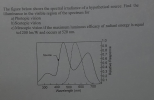 The figure below shows the spectral irradiance of a hypothetical source. Find the illuminance in the visible region of the spectrum for a) Photopic vision b) Scotopic vision c) Mescopic vision if the maximum luminous efficacy of radiant energy is equal to 1200 lm/W and occurs at 520 nm 0.9 g 10.8 0.7 & 0.6 3 0.5 0.4 Source 0.3 a 0.2 0.1 300 400 500 600 700 Wavelength (nm)
The figure below shows the spectral irradiance of a hypothetical...
The figure below shows the spectral irradiance of a hypothetical source. Find the illuminance in the visible region of the spectrum for a) Photopic vision b) Scotopic vision c) Mescopic vision if the maximum luminous efficacy of radiant energy is equal to 1200 lm/W and occurs at 520 nm 0.9 g 10.8 0.7 & 0.6 3 0.5 0.4 Source 0.3 a 0.2 0.1 300 400 500 600 700 Wavelength (nm)
The figure below shows the spectral irradiance of a hypothetical...
According to Einstein’s formula, E=mc^2, the energy radiated away from the Sun (or any star for...
According to Einstein’s formula, E=mc^2, the energy radiated away from the Sun (or any star for that matter) represents a loss in mass. That is, every Joule of energy radiated away from the Sun diminishes its mass by m=E/c^2. Assume that the Sun’s luminosity is 3.8X10^26 J/s. a) Determine the amount of mass (in kg) that the Sun would lose by shining at that same luminosity for 10 billion years. b) Sirius A will last about 90 million years as a...
9.26. (a) Use Wien displacement law to determine the lambda max of the Sun if its...
 9.26. (a) Use Wien displacement law to determine the lambda max of the Sun if its surface temperature is 5800 K. (b) The human eye sees light most efficiently if the light has a wavelength of 5000 � (1 � = 10^ - 10 m), which is in the green - blue portion of the spectrum. To what blackbody temperature does that correspond? (c) Compare your answers from the first two parts and comment.
 Construct plots that show the wavelength-dependent energy spectrum of a blackbody at a temperature of 5800 K (approx. temperature of the Sun) using both the Planck distribution and the Raleigh-Jeans distribution. Confirm agreement between the two at long wavelength. a. What is the maximum emission wavelength at this temperature? b. What is the total power output (W/m^2) ? c. Using the Planck distribution, estimate what fraction of the Sun's total power output is emitted in visible wavelengths (400-750 nm)
 Electromagnetic Wave Questions
2. Our sun has a power output of roughly 3.87 1026 watts (W). This energy is transmitted essentially uniformly in all directions. By the time this radiation reaches the Earth, which has an average distance from the sun of 1.50 x 10" m, what is the intensity? (Recall that intensity is defined to be power per unit area). 3. The energy from the sun is primarily in the infrared and visual wavelengths. The following table gives the...
Electromagnetic Wave Questions
2. Our sun has a power output of roughly 3.87 1026 watts (W). This energy is transmitted essentially uniformly in all directions. By the time this radiation reaches the Earth, which has an average distance from the sun of 1.50 x 10" m, what is the intensity? (Recall that intensity is defined to be power per unit area). 3. The energy from the sun is primarily in the infrared and visual wavelengths. The following table gives the...
 Assume that most of the electromagnetic energy from the sun is in the visible region near 500 nm. Calculate the maximum value of the work function for a metal to be used in photovoltaic cells to convert solar energy into electricity Then identify which of the following metals could be used in such a capacity. The maximum value is: The following metals could be used in the photovoltaic cel described above (mark all that could be used):
 80. The sun is a sphere with a radius of 6.96 X 10a m and an av- erage surface temperature of 5800 K. Determine the amount by which the sun's thermal radiation increases the entropy of the entire universe each second. Assume that the sun is a perfect blackbody, and that the average temperature of the rest of the universe is 2.73 K. Do not con- sider the thermal radiation absorbed by the sun from the rest of the universe.
 4. (5pt) Below is the spectrum of our sun measured at the earth's surface: 14 1.2 1.0 0.8 0.6 0.4 0.2 0.0 400 600 800 1000 Wavelength (nm) a. At approximately what wavelength is the sun's irradiance at a maximum? Human eyesight is centered in the green region of the spectrum; is this a coincidence? Spectral Irradiance re-Laboratory Assignment, continued b. There is still a significant amount of light past 1000 nm. Calculate the energy of a photon at this...
 The figure below shows the spectral irradiance of a hypothetical source. Find the illuminance in the visible region of the spectrum for a) Photopic vision b) Scotopic vision c) Mescopic vision if the maximum luminous efficacy of radiant energy is equal to 1200 lm/W and occurs at 520 nm 0.9 g 10.8 0.7 & 0.6 3 0.5 0.4 Source 0.3 a 0.2 0.1 300 400 500 600 700 Wavelength (nm)
The figure below shows the spectral irradiance of a hypothetical...
The figure below shows the spectral irradiance of a hypothetical source. Find the illuminance in the visible region of the spectrum for a) Photopic vision b) Scotopic vision c) Mescopic vision if the maximum luminous efficacy of radiant energy is equal to 1200 lm/W and occurs at 520 nm 0.9 g 10.8 0.7 & 0.6 3 0.5 0.4 Source 0.3 a 0.2 0.1 300 400 500 600 700 Wavelength (nm)
The figure below shows the spectral irradiance of a hypothetical...
 9.26. (a) Use Wien displacement law to determine the lambda max of the Sun if its surface temperature is 5800 K. (b) The human eye sees light most efficiently if the light has a wavelength of 5000 � (1 � = 10^ - 10 m), which is in the green - blue portion of the spectrum. To what blackbody temperature does that correspond? (c) Compare your answers from the first two parts and comment.
Most questions answered within 3 hours.
-
Where is the error in this code sequence?
String s1 = "Hello";
String s2 = "ello";...
asked 11 months ago -
Financial data for Joel de Paris, Inc., for last year
follow:
Joel de Paris, Inc.
Balance...
asked 11 months ago -
Consider this reaction:
Al2(SO4)3 (aq)+ BaCl3
(aq) Al2Cl6 (aq)- +
3BaSO4(s) . What is the...
asked 11 months ago -
Suppose that Savneet is considering increasing her
recent random sample from 20 car rentals to 40...
asked 11 months ago -
Trucks arrive at an unloading terminal at an average rate of 120
per hour.
Trucks arrive...
asked 11 months ago -
Why are methanol and ethanol completely soluble in water while
octanol is not very little soluble....
asked 11 months ago -
A facilities manager at a university reads in a research report
that the mean amount of...
asked 11 months ago -
When the CuSO4 is rehydrated by adding water to the anhydrous
compound, is this an endothermic...
asked 11 months ago -
A ray of sunlight is passing from diamond into crown glass; the
angle of incidence is...
asked 11 months ago -
A block of mass 0.249 kg is placed on top of a light, vertical
spring of...
asked 11 months ago -
how do the kidneys compensate in the presences of acidosis
a) trigger hyperventilate
b) reserve acid...
asked 11 months ago -
Question 501 pts
The rental rate of capital to the firm increases. Which of the
following...
asked 11 months ago