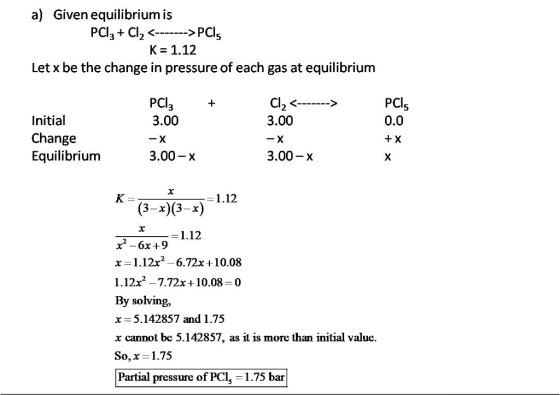
a.) Calculate the partial pressure in bar of phosphorus pentachloride produced in a system in which...
a.) Calculate the partial pressure in bar of phosphorus pentachloride produced in a system in which phosphorus trichloride and chlorine gases are initially each at a partial pressure of 3.00 bar and allowed to reach equilibrium. The reaction is run at a temperature in which the equilibrium constant = 1.12. Note: This K value is for the reaction written as: PCl3(g) + Cl2(g) ----> PCl5(g)
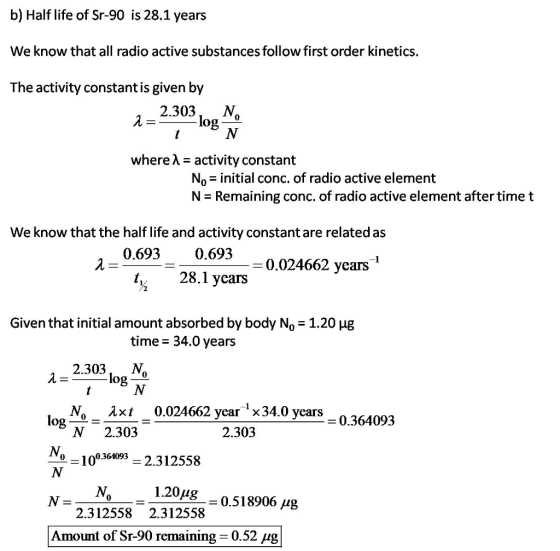
b.) Strontium-90 is a radionuclide that is a legacy of nuclear weapons development and testing. It is particularly dangerous because it takes the place of calcium in bone marrow, and has a half life of 28.1 years. Suppose 1.20 micrograms were absorbed by a human. How many micrograms will remain after 34.0 years?
c.) The chemical decomposition of reactant species A is followed in a spectrophotometer to determine its decreasing concentration with time. The following data is taken:
time(min)      [A] mmol/L
---------------------------
  0              90.0
  10             66.58
  20             49.26
  30             36.44
  40             26.96
---------------------------
Determine the order of the reaction and the rate constant. If the
reaction turns out to be first order, report its half-life in
minutes. If it turns out to be second order, report its rate
constant in L/mmol-min.
Homework Answers
![time [A] InA 1/[A] C) 10 20 30 40 90 66.584.198 0.01502 49.263.897 0.0203 36.44 3.596 0.027442 26.963.294 0.037092 Test for z](http://img.homeworklib.com/questions/ab42bde0-b515-11eb-b543-574a146346ea.png?x-oss-process=image/resize,w_560)
![Test for First order: In[A] vs time 5.000 4.500 4.000 3.500 3.000 2.500 2.000 1.500 1.000 0.500 0.000 yー-0.030x + 4.499 10 20](http://img.homeworklib.com/questions/abbb6710-b515-11eb-a023-3bce50a4406e.png?x-oss-process=image/resize,w_560)
![First order rate equation is A straight line will be obtained if we plot a graph between In[A] on Y-axis and time on X-axis.](http://img.homeworklib.com/questions/ac427940-b515-11eb-b1d1-a5feda6e5de3.png?x-oss-process=image/resize,w_560)
Add Answer to:
a.) Calculate the partial pressure in bar of phosphorus
pentachloride produced in a system in which...
Phosphorus pentachloride is formed when phosphorus trichloride and chlorine react. PCl3(g) + Cl2(g) ⇌ PCl5(g) The...
Phosphorus pentachloride is formed when phosphorus trichloride and chlorine react. PCl3(g) + Cl2(g) ⇌ PCl5(g) The equilibrium constant for the reaction is KC = 38.0 at 233 °C. If 0.510 mol of phosphorus trichloride is added to 0.238 mol of chlorine in a 1.11-L reaction vessel at this temperature, what is the equilibrium concentration (in mol/L) of phosphorus pentachloride? Report your answer to THREE significant figures.
Phosphorus pentachloride is formed when phosphorus trichloride and chlorine react. PCl3(g) + Cl2(g) ⇌ PCl5(g) The...
Phosphorus pentachloride is formed when phosphorus trichloride and chlorine react. PCl3(g) + Cl2(g) ⇌ PCl5(g) The equilibrium constant for the reaction is KC = 40.3 at 256 °C. If 0.486 mol of phosphorus trichloride is added to 0.221 mol of chlorine in a 1.34-L reaction vessel at this temperature, what is the equilibrium concentration (in mol/L) of chlorine? Report your answer to THREE significant figures.
Phosphorus pentachloride can dissociate into phosphorus trichloride and chlorine: PCs (8) PC13(8) + Cl2(8) At 250.°C,...
 Phosphorus pentachloride can dissociate into phosphorus trichloride and chlorine: PCs (8) PC13(8) + Cl2(8) At 250.°C, the equilibrium constant for this dissociation reaction is 2.15. (a) If 12.00 g of phosphorus pentachloride is placed in a 11.90-L vessel and heated to 250°C, what is the partial pressure of phosphorus trichloride when equilibrium is attained? (Enter your answer to 3 significant figures.) atm (b) What fraction of phosphorus pentachloride is dissociated at equilibrium? (Enter your answer to 3 significant figures.)
Consider the following reaction between phosphorus trichloride and chlorine gases to make phosphorus pentachloride gas: PCl3(g)...
Consider the following reaction between phosphorus trichloride and chlorine gases to make phosphorus pentachloride gas: PCl3(g) + Cl2(g) --> PCl5(g) Kp = 24.2 at 250 Celsius If the initial partial pressures of PCl3 and Cl2 are 0.43 and o.87 atm, respectively, and no PCl5 is initially present, what is partial pressure of the Cl2 when equilibrium is achieved? Simplifying assumptions cannot be made; quadratic solution is required. A. 0.00 atm B. 2.30 atm C. 0.47 atm D. 0.03 atm E....
Phosphorus trichloride gas and chlorine gas react to form phosphorus pentachloride according to the following equilibrium:...
Phosphorus trichloride gas and chlorine gas react to form phosphorus pentachloride according to the following equilibrium: PCl3(g)+Cl2(g)⇌PCl5(g) A 7.5-L gas vessel is charged with a mixture of PCl3(g) and Cl2(g), which is allowed to equilibrate at 450 K . At equilibrium, the partial pressures of the three gases are PPCl3 = 0.129 atm , PCl2 = 0.159 atm , and PPCl5 = 1.20 atm . 1. What is the value of Kp at this temperature? Express the equilibrium constant to...
Phosphorus trichloride gas and chlorine gas react to form phosphorus pentachloride gas: PCl3(g)+Cl2(g)?PCl5(g). A 7.5-L gas...
Phosphorus trichloride gas and chlorine gas react to form phosphorus pentachloride gas:PCl3(g)+Cl2(g)→PCl5(g).A 7.5-L gas vessel is charged with a mixture of PCl3(g) and Cl2(g), which is allowed to equilibrate at 450 K. At equilibrium the partial pressures of the three gases are PPCl3 = 0.123atm , PCl2 = 0.158atm , and PPCl5 = 1.20atm .Calculate Kc for this reaction at 450 K.
Phosphorus pentachloride, PCl5, an important reagent in organic chemistry for converting alcohols to alkyl chlorides (ROH...
Phosphorus pentachloride, PCl5, an important reagent in organic chemistry for converting alcohols to alkyl chlorides (ROH ---> RCl), is hydrolyzed in water to form phosphoric acid and hydrogen chloride. In the gaseous state, however, PCl5 can decompose at 250oC according to the following reaction PCl5(g) <---> PCl3(g) + Cl2(g), for which K = 0.0240 If a 2500.-L vessel containing 3250. kg of PCl3(g) with a constant chlorine pressure of 3.525 atm is allowed to reach equilibrium, how many kilograms of...
Question 1. Phosphorous trichloride reacts with chlorine to produce phosphorus pentachloride: PC13(g) + Cl2(8) - PC1s(8)...
 Question 1. Phosphorous trichloride reacts with chlorine to produce phosphorus pentachloride: PC13(g) + Cl2(8) - PC1s(8) The equilibrium constant (Kc) for the reaction is 96 at 400 K If the equilibrium concentration of PC13 is 0.50 M and Cl, is 0.070 M, what is the equilibrium concentration of PCI ? Question 2. Consider the reaction between hydrogen and iodine H2(g) + 12(6) 2 HI(g) Kc = 64 Initially, a container was charged with 0.55 atm of H, and I2, what...
Revie Phosphorus trichloride gas and chlorine gas react to form phosphorus pentachloride according to the following...
 Revie Phosphorus trichloride gas and chlorine gas react to form phosphorus pentachloride according to the following equilibrium: What is the value of Kp at this temperature? Express the equlibrlum constant to three significant figures. PCl3 (9) +Cla (9) PCls (g) A7.5-Lgas vessel is charged with a mixture of PCls(9) equilibrate at 450K. At equilibrium, the partial pressures of the three gases are Ppci, 0.124 atm, Pa, 0.159 atm, and PpcCls 1.40 atm and Cl2 (g), which is allowed to VAXD...
 Phosphorus pentachloride can dissociate into phosphorus trichloride and chlorine: PCs (8) PC13(8) + Cl2(8) At 250.°C, the equilibrium constant for this dissociation reaction is 2.15. (a) If 12.00 g of phosphorus pentachloride is placed in a 11.90-L vessel and heated to 250°C, what is the partial pressure of phosphorus trichloride when equilibrium is attained? (Enter your answer to 3 significant figures.) atm (b) What fraction of phosphorus pentachloride is dissociated at equilibrium? (Enter your answer to 3 significant figures.)
 Question 1. Phosphorous trichloride reacts with chlorine to produce phosphorus pentachloride: PC13(g) + Cl2(8) - PC1s(8) The equilibrium constant (Kc) for the reaction is 96 at 400 K If the equilibrium concentration of PC13 is 0.50 M and Cl, is 0.070 M, what is the equilibrium concentration of PCI ? Question 2. Consider the reaction between hydrogen and iodine H2(g) + 12(6) 2 HI(g) Kc = 64 Initially, a container was charged with 0.55 atm of H, and I2, what...
 Revie Phosphorus trichloride gas and chlorine gas react to form phosphorus pentachloride according to the following equilibrium: What is the value of Kp at this temperature? Express the equlibrlum constant to three significant figures. PCl3 (9) +Cla (9) PCls (g) A7.5-Lgas vessel is charged with a mixture of PCls(9) equilibrate at 450K. At equilibrium, the partial pressures of the three gases are Ppci, 0.124 atm, Pa, 0.159 atm, and PpcCls 1.40 atm and Cl2 (g), which is allowed to VAXD...
Most questions answered within 3 hours.
-
Where is the error in this code sequence?
String s1 = "Hello";
String s2 = "ello";...
asked 10 months ago -
Financial data for Joel de Paris, Inc., for last year
follow:
Joel de Paris, Inc.
Balance...
asked 10 months ago -
Consider this reaction:
Al2(SO4)3 (aq)+ BaCl3
(aq) Al2Cl6 (aq)- +
3BaSO4(s) . What is the...
asked 10 months ago -
Suppose that Savneet is considering increasing her
recent random sample from 20 car rentals to 40...
asked 10 months ago -
Trucks arrive at an unloading terminal at an average rate of 120
per hour.
Trucks arrive...
asked 10 months ago -
Why are methanol and ethanol completely soluble in water while
octanol is not very little soluble....
asked 10 months ago -
A facilities manager at a university reads in a research report
that the mean amount of...
asked 10 months ago -
When the CuSO4 is rehydrated by adding water to the anhydrous
compound, is this an endothermic...
asked 10 months ago -
A ray of sunlight is passing from diamond into crown glass; the
angle of incidence is...
asked 10 months ago -
A block of mass 0.249 kg is placed on top of a light, vertical
spring of...
asked 10 months ago -
how do the kidneys compensate in the presences of acidosis
a) trigger hyperventilate
b) reserve acid...
asked 10 months ago -
Question 501 pts
The rental rate of capital to the firm increases. Which of the
following...
asked 10 months ago