


Homework Answers
Add Answer to:
The symbol N denotes the nonnegative integers, that is, N= {0,1,2,3,...}. The symbol R denotes the...
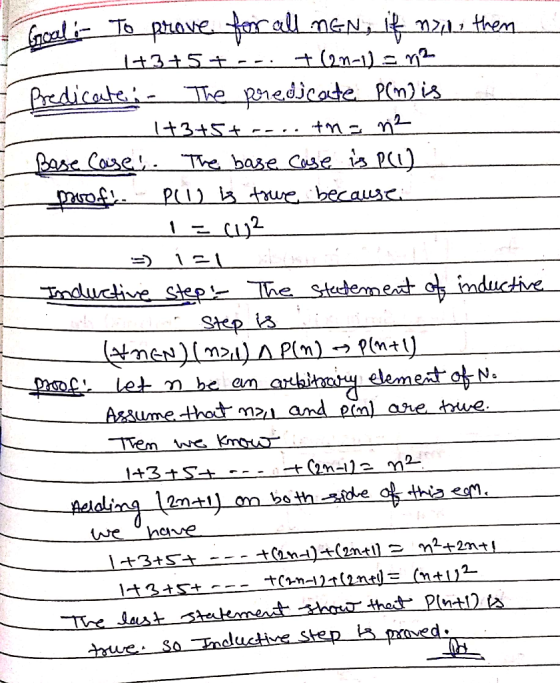
Use induction to show that for all integers n ≥ 1. This is my work so...
 Use induction to show that
for all integers n ≥ 1.
This is my work so far, but I'm getting stuck on the
induction step (highlighted below)
Base Case: n = 1
Inductive Step:
Prove
Use induction to show that
for all integers n ≥ 1.
This is my work so far, but I'm getting stuck on the
induction step (highlighted below)
Base Case: n = 1
Inductive Step:
Prove
11: I can identify the predicate being used in a proof by mathematical induction and use...
 11: I can identify the predicate being used in a proof by mathematical induction and use it to set up a framework of assumptions and conclusions for an induction proof. Below are three statements that can be proven by induction. You do not need to prove these statements! For each one clearly state the predicate involved; state what you would need to prove in the base case; clearly state the induction hypothesis in terms of the language of the proposition...
4. Let P(n) be the statement that a postage of n cents can be formed using just 4-cent stamps and...
 4. Let P(n) be the statement that a postage of n cents can be formed using just 4-cent stamps and 7-cent stamps. The parts of this exercise outline a strong induction proof that P (n) is true forn > 18. a) Show statements P(18), P(19), P (20), and P(21) are true, completing the basis step of the proof. b) What is the inductive hypothesis of the proof? c) What do you need to prove in the inductive step? d) Complete...
10. (10 points) Computational problem solving: Proving correctness: Function g (n: nonnegative integer) if n si...
 10. (10 points) Computational problem solving: Proving correctness: Function g (n: nonnegative integer) if n si then return(n) else return(5*g(n-1) - 6*g(n-2)) Prove by induction that algorithm g is correct, if it is intended to compute the function 3"-2" for all n 20. Base Case Proof: Inductive Hypothesis: Inductive Step:
3. Let P(n) be the statement that a postage of n cents can be formed using...
 3. Let P(n) be the statement that a postage of n cents can be formed using just 3-cent stamps and 5-cent stamps. The 5 / Induction and Recursion parts of this exercise outline a strong induction proof that P(n) is true for n 18. a) Show statements P(18), P(19), P(20), and P(21) are true, completing the basis step of the proof. b) What is the inductive hypothesis of the proof? c) What do you need to prove in the inductive...
Prove that this inequality is true for all integers n > or equal to 2 by...
 Prove that this inequality is true for all integers n > or
equal to 2 by using the Inductive step of mathematical induction.
Please state line by line how you got your answer and explain in
words each step.
1 V2
Prove that this inequality is true for all integers n > or
equal to 2 by using the Inductive step of mathematical induction.
Please state line by line how you got your answer and explain in
words each step.
1 V2
Let S(n) be a statement parameterized by a positive integer n. Consider a proof that uses...
 Let S(n) be a statement parameterized by a positive integer n. Consider a proof that uses strong induction to prove that for all n 4.S(n) is true. The base case proves that S(4), S(5), S(6), S(7), and S(8) are all true. Select the correct expressions to complete the statement of what is assumed and proven in the inductive step. Supposed that for k> (1?),s() is true for everyj in the range 4 through k. Then we will show that (22)...
3 For each positive integer n, define E(n) 2+4++2n (a) Give a recursive definition for E(n)....
 3 For each positive integer n, define E(n) 2+4++2n (a) Give a recursive definition for E(n). (b) Let P(n) be the statement E(n) nn1)." Complete the steps below to give a proof by induction that P(n) holds for every neZ+ i. Verify P(1) is true. (This is the base step.) ii. Let k be some positive integer. We assume P(k) is true. What exactly are we assuming is true? (This is the inductive hypothesis.) iii. What is the statement P(k...
Day 1. Consider the inequality n 10000n. Assume the goal is to prove that inequality is true for ...
 use proof by induction
Day 1. Consider the inequality n 10000n. Assume the goal is to prove that inequality is true for all positive integers n. A common mistake is to think that checking the inequality for numerous cases is enough to prove that statement is true in every case. First, verify that the inequality holds for n-1,2,-.- ,10. Next, analyze the inequality; is there a positive integer n such that the inequality n 10000n is not true!
Day 1....
use proof by induction
Day 1. Consider the inequality n 10000n. Assume the goal is to prove that inequality is true for all positive integers n. A common mistake is to think that checking the inequality for numerous cases is enough to prove that statement is true in every case. First, verify that the inequality holds for n-1,2,-.- ,10. Next, analyze the inequality; is there a positive integer n such that the inequality n 10000n is not true!
Day 1....
Below are three statements that can be proven by induction. You do not need to prove...
 Below are three statements that can be proven by induction. You do not need to prove these statements! For each one: clearly state the predicate involved; state what you would need to prove in the base case; clearly state the induction hypothesis in terms of the language of the proposition (i.e., without using notation to represent the predicate); and then clearly state the inductive step in terms of the language of the proposition. 1. For all positive integers n, 3...
 Use induction to show that
for all integers n ≥ 1.
This is my work so far, but I'm getting stuck on the
induction step (highlighted below)
Base Case: n = 1
Inductive Step:
Prove
Use induction to show that
for all integers n ≥ 1.
This is my work so far, but I'm getting stuck on the
induction step (highlighted below)
Base Case: n = 1
Inductive Step:
Prove
 11: I can identify the predicate being used in a proof by mathematical induction and use it to set up a framework of assumptions and conclusions for an induction proof. Below are three statements that can be proven by induction. You do not need to prove these statements! For each one clearly state the predicate involved; state what you would need to prove in the base case; clearly state the induction hypothesis in terms of the language of the proposition...
 4. Let P(n) be the statement that a postage of n cents can be formed using just 4-cent stamps and 7-cent stamps. The parts of this exercise outline a strong induction proof that P (n) is true forn > 18. a) Show statements P(18), P(19), P (20), and P(21) are true, completing the basis step of the proof. b) What is the inductive hypothesis of the proof? c) What do you need to prove in the inductive step? d) Complete...
 10. (10 points) Computational problem solving: Proving correctness: Function g (n: nonnegative integer) if n si then return(n) else return(5*g(n-1) - 6*g(n-2)) Prove by induction that algorithm g is correct, if it is intended to compute the function 3"-2" for all n 20. Base Case Proof: Inductive Hypothesis: Inductive Step:
 3. Let P(n) be the statement that a postage of n cents can be formed using just 3-cent stamps and 5-cent stamps. The 5 / Induction and Recursion parts of this exercise outline a strong induction proof that P(n) is true for n 18. a) Show statements P(18), P(19), P(20), and P(21) are true, completing the basis step of the proof. b) What is the inductive hypothesis of the proof? c) What do you need to prove in the inductive...
 Prove that this inequality is true for all integers n > or
equal to 2 by using the Inductive step of mathematical induction.
Please state line by line how you got your answer and explain in
words each step.
1 V2
Prove that this inequality is true for all integers n > or
equal to 2 by using the Inductive step of mathematical induction.
Please state line by line how you got your answer and explain in
words each step.
1 V2
 Let S(n) be a statement parameterized by a positive integer n. Consider a proof that uses strong induction to prove that for all n 4.S(n) is true. The base case proves that S(4), S(5), S(6), S(7), and S(8) are all true. Select the correct expressions to complete the statement of what is assumed and proven in the inductive step. Supposed that for k> (1?),s() is true for everyj in the range 4 through k. Then we will show that (22)...
 3 For each positive integer n, define E(n) 2+4++2n (a) Give a recursive definition for E(n). (b) Let P(n) be the statement E(n) nn1)." Complete the steps below to give a proof by induction that P(n) holds for every neZ+ i. Verify P(1) is true. (This is the base step.) ii. Let k be some positive integer. We assume P(k) is true. What exactly are we assuming is true? (This is the inductive hypothesis.) iii. What is the statement P(k...
 use proof by induction
Day 1. Consider the inequality n 10000n. Assume the goal is to prove that inequality is true for all positive integers n. A common mistake is to think that checking the inequality for numerous cases is enough to prove that statement is true in every case. First, verify that the inequality holds for n-1,2,-.- ,10. Next, analyze the inequality; is there a positive integer n such that the inequality n 10000n is not true!
Day 1....
use proof by induction
Day 1. Consider the inequality n 10000n. Assume the goal is to prove that inequality is true for all positive integers n. A common mistake is to think that checking the inequality for numerous cases is enough to prove that statement is true in every case. First, verify that the inequality holds for n-1,2,-.- ,10. Next, analyze the inequality; is there a positive integer n such that the inequality n 10000n is not true!
Day 1....
 Below are three statements that can be proven by induction. You do not need to prove these statements! For each one: clearly state the predicate involved; state what you would need to prove in the base case; clearly state the induction hypothesis in terms of the language of the proposition (i.e., without using notation to represent the predicate); and then clearly state the inductive step in terms of the language of the proposition. 1. For all positive integers n, 3...
Most questions answered within 3 hours.
-
Where is the error in this code sequence?
String s1 = "Hello";
String s2 = "ello";...
asked 10 months ago -
Financial data for Joel de Paris, Inc., for last year
follow:
Joel de Paris, Inc.
Balance...
asked 10 months ago -
Consider this reaction:
Al2(SO4)3 (aq)+ BaCl3
(aq) Al2Cl6 (aq)- +
3BaSO4(s) . What is the...
asked 10 months ago -
Suppose that Savneet is considering increasing her
recent random sample from 20 car rentals to 40...
asked 10 months ago -
Trucks arrive at an unloading terminal at an average rate of 120
per hour.
Trucks arrive...
asked 10 months ago -
Why are methanol and ethanol completely soluble in water while
octanol is not very little soluble....
asked 10 months ago -
A facilities manager at a university reads in a research report
that the mean amount of...
asked 10 months ago -
When the CuSO4 is rehydrated by adding water to the anhydrous
compound, is this an endothermic...
asked 10 months ago -
A ray of sunlight is passing from diamond into crown glass; the
angle of incidence is...
asked 10 months ago -
A block of mass 0.249 kg is placed on top of a light, vertical
spring of...
asked 10 months ago -
how do the kidneys compensate in the presences of acidosis
a) trigger hyperventilate
b) reserve acid...
asked 10 months ago -
Question 501 pts
The rental rate of capital to the firm increases. Which of the
following...
asked 10 months ago