
Homework Answers
Add Answer to:
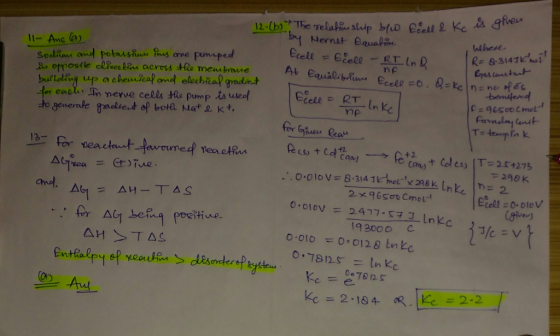
The function of the "ion pump" in nerve chemistry is to transport Na^+ and K^- against...
1. Animal cells have a Na,K pump that couples the energy of ATP hydrolysis to transport 3 Na ions out of the cell and 2 K ions into the cell. Inside astrocytes, the concentration of Na is 20 mM and th...
1. Animal cells have a Na,K pump that couples the energy of ATP hydrolysis to transport 3 Na ions out of the cell and 2 K ions into the cell. Inside astrocytes, the concentration of Na is 20 mM and the concentration of K is 130 mM. The extracellular concentrations of Na and K are 145 mM and 5 mM, respectively. Calculate the energy required for the transport of Na and K , with this stoichiometry; assume that the cell...
Draw/Describe how the Na+/K+ pump functions. Use specific details, present steps in chronological order using a...
Draw/Describe how the Na+/K+ pump functions. Use specific details, present steps in chronological order using a cause/effect - if/then approach: “if ___(cause) occurs, then ____(effect) happens). Include concentrations gradients (before and after), membrane proteins, direction of molecule flow (into/out of, from high to low/low to high, up/down or with/against the gradient). Include any additional details you feel are relevant. What type of transport is this? What is the overall role of the pump?
The Na+/K+ pump transports 2 K+ into the cell and 3 Nat out of the cell...
 The Na+/K+ pump transports 2 K+ into the cell and 3 Nat out of the cell under the use of ATP. Under normal circumstances, the concentration of K+ inside the cell is 140 mm, while the [K] outside of the cell is 6 mM. The concentration of Nat inside the cell is 16 mM, while the [Na] outside the cell is 145 mm. The membranpotential is -0.07 V The temperature is 37°C/310,15K c) Calculate how much energy (kJ/mol it takes...
Roles of the Na+/ K+ pump 1. Maintain the Nat/K+ concentration gradicnt across the plasma membrane....
 Roles of the Na+/ K+ pump 1. Maintain the Nat/K+ concentration gradicnt across the plasma membrane. (That's obvious) 2. It plays a role in maintaining the resting membrane potential. Why? 3. The steep electrochemical gradient of Na+ is used in "coupled active transport" (coupled pumps). If the Nat/K+ pump stops, then these Na+ coupled transport mechanisms will also eventually stop. Explain The apical surface of the epithelial cells that line the lumen of the gut contains a symport that used...
Given these parameters, what is the AG for K ion transport into the frog muscle cell...
 Given these parameters, what is the AG for K ion transport into the frog muscle cell in the presence of Ach? Dr. Knowsalot smiles and nods. "Good," she says. "Now let's see whether K+ ions pass through the open Ach receptors into the cell. As you might remember, these channels are permeable to Na+, K+, and Ca2+. For a typical frog muscle cell, the concentration of K+ is roughly 124 mM inside the cell and 2.30 mM outside the cell."...
help with these please, the standard reduction are provided in the last three pictures What is the calculated v...
 help with these please, the standard reduction are provided in
the last three pictures
What is the calculated value of the cell potential at 298K for an electrochemical cell with the following reaction, when the Pb2+ concentration is 9.05X10 M and the AP concentration is 1.48 M? 3Pb2+(aq) + 2Al(s) 3Pb(s) + 2A13+ (aq) Answer: The cell reaction as written above is spontaneous for the concentrations given: What is the calculated value of the cell potential at 298K for an...
help with these please, the standard reduction are provided in
the last three pictures
What is the calculated value of the cell potential at 298K for an electrochemical cell with the following reaction, when the Pb2+ concentration is 9.05X10 M and the AP concentration is 1.48 M? 3Pb2+(aq) + 2Al(s) 3Pb(s) + 2A13+ (aq) Answer: The cell reaction as written above is spontaneous for the concentrations given: What is the calculated value of the cell potential at 298K for an...
please help the standrad reduction provided down What is the calculated value of the cell potential...
 please help the standrad reduction provided down
What is the calculated value of the cell potential at 298K for an electrochemical cell with the following reaction, when the Cu2+ concentration is 9.24x10 + M and the Cr3+ concentration is 1.47 M? 3Cu2+ (aq) + 2Cr(s) Answer: 3Cu(s) + 2Cr +(aq) v The cell reaction as written above is spontaneous for the concentrations given: What is the calculated value of the cell potential at 298K for an electrochemical cell with the...
please help the standrad reduction provided down
What is the calculated value of the cell potential at 298K for an electrochemical cell with the following reaction, when the Cu2+ concentration is 9.24x10 + M and the Cr3+ concentration is 1.47 M? 3Cu2+ (aq) + 2Cr(s) Answer: 3Cu(s) + 2Cr +(aq) v The cell reaction as written above is spontaneous for the concentrations given: What is the calculated value of the cell potential at 298K for an electrochemical cell with the...
5. The nickel-cadmium battery, despite issues with the toxicity of Cd, is still used in some...
 5. The nickel-cadmium battery, despite issues with the toxicity of Cd, is still used in some rechargeable batteries because it has very consistent voltage over long discharge times. a) Using only half-cell reactions given in Table 16.1, write the overall reaction and give the highest AV° value possible for a NiCd battery. b) The actual half-cell reactions used in a Nicd battery are: Ca(OH)2(8) + 2e → Cds + 2OH(aq) (Vº = -0.86V) NiO(OH)) + H2O) +e Ni(OH)2(s) + OH(aq)...
1) Glucose enters human enterocytes (intestinal epithelial cells) against its concentration gradient. A Na+ ion enters...
1) Glucose enters human enterocytes (intestinal epithelial cells) against its concentration gradient. A Na+ ion enters the cell with each glucose molecule, and while the glucose transporter does not hydrolyze ATP, it depends on a pre-existing gradient of Na+ ions that is created by the Na+/K+ ATPase. This is an example of ____________. A. primary active uniport B. secondary active antiport C. primary active symport D. secondary active symport 2) Which statement is FALSE? A. Acetyl CoA is oxidized to...
METHOD 1- Visual clock reaction. The solutions for each of the kinetic runs are given in...
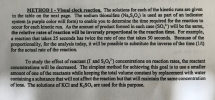 METHOD 1- Visual clock reaction. The solutions for each of the kinetic runs are given in the table on the next page. The sodium thiosulfate (Na S,O,) is used as part of an indicator system (a purple color will form) to enable you to determine the time required for the reaction to occur for each kinetic run. As the amount of product formed in each case (SO) will be the same, the relative rates of reaction will be inversely proportional...
 The Na+/K+ pump transports 2 K+ into the cell and 3 Nat out of the cell under the use of ATP. Under normal circumstances, the concentration of K+ inside the cell is 140 mm, while the [K] outside of the cell is 6 mM. The concentration of Nat inside the cell is 16 mM, while the [Na] outside the cell is 145 mm. The membranpotential is -0.07 V The temperature is 37°C/310,15K c) Calculate how much energy (kJ/mol it takes...
 Roles of the Na+/ K+ pump 1. Maintain the Nat/K+ concentration gradicnt across the plasma membrane. (That's obvious) 2. It plays a role in maintaining the resting membrane potential. Why? 3. The steep electrochemical gradient of Na+ is used in "coupled active transport" (coupled pumps). If the Nat/K+ pump stops, then these Na+ coupled transport mechanisms will also eventually stop. Explain The apical surface of the epithelial cells that line the lumen of the gut contains a symport that used...
 Given these parameters, what is the AG for K ion transport into the frog muscle cell in the presence of Ach? Dr. Knowsalot smiles and nods. "Good," she says. "Now let's see whether K+ ions pass through the open Ach receptors into the cell. As you might remember, these channels are permeable to Na+, K+, and Ca2+. For a typical frog muscle cell, the concentration of K+ is roughly 124 mM inside the cell and 2.30 mM outside the cell."...
 help with these please, the standard reduction are provided in
the last three pictures
What is the calculated value of the cell potential at 298K for an electrochemical cell with the following reaction, when the Pb2+ concentration is 9.05X10 M and the AP concentration is 1.48 M? 3Pb2+(aq) + 2Al(s) 3Pb(s) + 2A13+ (aq) Answer: The cell reaction as written above is spontaneous for the concentrations given: What is the calculated value of the cell potential at 298K for an...
help with these please, the standard reduction are provided in
the last three pictures
What is the calculated value of the cell potential at 298K for an electrochemical cell with the following reaction, when the Pb2+ concentration is 9.05X10 M and the AP concentration is 1.48 M? 3Pb2+(aq) + 2Al(s) 3Pb(s) + 2A13+ (aq) Answer: The cell reaction as written above is spontaneous for the concentrations given: What is the calculated value of the cell potential at 298K for an...
 please help the standrad reduction provided down
What is the calculated value of the cell potential at 298K for an electrochemical cell with the following reaction, when the Cu2+ concentration is 9.24x10 + M and the Cr3+ concentration is 1.47 M? 3Cu2+ (aq) + 2Cr(s) Answer: 3Cu(s) + 2Cr +(aq) v The cell reaction as written above is spontaneous for the concentrations given: What is the calculated value of the cell potential at 298K for an electrochemical cell with the...
please help the standrad reduction provided down
What is the calculated value of the cell potential at 298K for an electrochemical cell with the following reaction, when the Cu2+ concentration is 9.24x10 + M and the Cr3+ concentration is 1.47 M? 3Cu2+ (aq) + 2Cr(s) Answer: 3Cu(s) + 2Cr +(aq) v The cell reaction as written above is spontaneous for the concentrations given: What is the calculated value of the cell potential at 298K for an electrochemical cell with the...
 5. The nickel-cadmium battery, despite issues with the toxicity of Cd, is still used in some rechargeable batteries because it has very consistent voltage over long discharge times. a) Using only half-cell reactions given in Table 16.1, write the overall reaction and give the highest AV° value possible for a NiCd battery. b) The actual half-cell reactions used in a Nicd battery are: Ca(OH)2(8) + 2e → Cds + 2OH(aq) (Vº = -0.86V) NiO(OH)) + H2O) +e Ni(OH)2(s) + OH(aq)...
 METHOD 1- Visual clock reaction. The solutions for each of the kinetic runs are given in the table on the next page. The sodium thiosulfate (Na S,O,) is used as part of an indicator system (a purple color will form) to enable you to determine the time required for the reaction to occur for each kinetic run. As the amount of product formed in each case (SO) will be the same, the relative rates of reaction will be inversely proportional...
Most questions answered within 3 hours.
-
Where is the error in this code sequence?
String s1 = "Hello";
String s2 = "ello";...
asked 10 months ago -
Financial data for Joel de Paris, Inc., for last year
follow:
Joel de Paris, Inc.
Balance...
asked 10 months ago -
Consider this reaction:
Al2(SO4)3 (aq)+ BaCl3
(aq) Al2Cl6 (aq)- +
3BaSO4(s) . What is the...
asked 10 months ago -
Suppose that Savneet is considering increasing her
recent random sample from 20 car rentals to 40...
asked 10 months ago -
Trucks arrive at an unloading terminal at an average rate of 120
per hour.
Trucks arrive...
asked 10 months ago -
Why are methanol and ethanol completely soluble in water while
octanol is not very little soluble....
asked 10 months ago -
A facilities manager at a university reads in a research report
that the mean amount of...
asked 10 months ago -
When the CuSO4 is rehydrated by adding water to the anhydrous
compound, is this an endothermic...
asked 10 months ago -
A ray of sunlight is passing from diamond into crown glass; the
angle of incidence is...
asked 10 months ago -
A block of mass 0.249 kg is placed on top of a light, vertical
spring of...
asked 10 months ago -
how do the kidneys compensate in the presences of acidosis
a) trigger hyperventilate
b) reserve acid...
asked 10 months ago -
Question 501 pts
The rental rate of capital to the firm increases. Which of the
following...
asked 10 months ago