

Homework Answers

Add Answer to:
2. A short metal cylinder of radius 24.0 cm, height 5.5 cm, and mass 4.25 kg...
Problem 2; The 15.0 kg mass on a 40.0° frictionless inclined plane is tied to a...
 Problem 2; The 15.0 kg mass on a 40.0° frictionless inclined plane is tied to a string that is wrapped around a frictionless pulley (disk, I = MR2) of mass 12.0 kg and radius 9.00 cm. What is the angular acceleration of the disk after the 15.0 kg mass is released?
A light string is wrapped around the outside of a 2.0-kg-wheel whose radius is 75 cm....
 A light string is wrapped
around the outside of a 2.0-kg-wheel whose radius is 75 cm. The
wheel has a frictionless axel that allows it to rotate but prevents
its center of mass from moving. Assume the moment of inertia of the
wheel is the same as that of a point particle of equal mass at the
same radius from the axel. The string is then attached to a 3.0-kg
hanging mass that is released from rest. While the mass...
A light string is wrapped
around the outside of a 2.0-kg-wheel whose radius is 75 cm. The
wheel has a frictionless axel that allows it to rotate but prevents
its center of mass from moving. Assume the moment of inertia of the
wheel is the same as that of a point particle of equal mass at the
same radius from the axel. The string is then attached to a 3.0-kg
hanging mass that is released from rest. While the mass...
Two metal disks, one with radius R1 = 2.50 cm and mass M1 = 0.800 kg and the other with radius R2 = 5.10 cm and mass M2 = 1.70 kg
 Two metal disks, one with radius R1 = 2.50 cm and mass M1 = 0.800 kg and the other with radius R2 = 5.10 cm and mass M2 = 1.70 kg, are welded together and mounted on a frictionless axis through their common center (Figure 1). Part A What is the total moment of inertia of the two disks? Part B A light string is wrapped around the edge of the smaller disk, and a 1.50 kg block is suspended from the free end...
A uniform cylinder of mass 3.0 kg and radius 10.0 cm has a rope wrapped around...
 A uniform cylinder of mass 3.0 kg and radius 10.0 cm
has a rope wrapped around its edge; a tension of 5.0 N
is
exerted on the rope. The cylinder rotates at a
constantly
increasing rate, starting from rest.
10DCH 1. A uniform cylinder of mass 3.0 kg and radius 10.0 cm has a rope wrapped around its edge; a tension of 5.0 N is exerted on the rope. The cylinder rotates at a constantly increasing rate, starting from rest....
A uniform cylinder of mass 3.0 kg and radius 10.0 cm
has a rope wrapped around its edge; a tension of 5.0 N
is
exerted on the rope. The cylinder rotates at a
constantly
increasing rate, starting from rest.
10DCH 1. A uniform cylinder of mass 3.0 kg and radius 10.0 cm has a rope wrapped around its edge; a tension of 5.0 N is exerted on the rope. The cylinder rotates at a constantly increasing rate, starting from rest....
Thanks so much ahead of time! A spherical shell of radius 0.43 m and mass 27...
 Thanks so much ahead of time!
A spherical shell of radius 0.43 m and mass 27 kg initially rolls without slipping towards an incline at a linear speed of 9.1 m/s. If the ball rolls up an incline (inclined 35 degrees above the horizontal) without sliding. How high will it go? A professor holding a spinning wheel used for a demonstration brings the wheel to a stop by applying a constant, tangential friction force to the edge (his hand). The...
Thanks so much ahead of time!
A spherical shell of radius 0.43 m and mass 27 kg initially rolls without slipping towards an incline at a linear speed of 9.1 m/s. If the ball rolls up an incline (inclined 35 degrees above the horizontal) without sliding. How high will it go? A professor holding a spinning wheel used for a demonstration brings the wheel to a stop by applying a constant, tangential friction force to the edge (his hand). The...
A thick walled cylinder has a light string wrapped around its outer radius and rotates about...
 A thick walled cylinder has a light string
wrapped around its outer radius and rotates
about a horizontal axis. The string then goes
vertically straight up and over a massive
pulley that also rotates about a horizontal
axis, and finally connects to a mass m =
0.900 kg on a rough incline (μk = 0.200) that
is angled at 25.0° to the horizontal.
When the system is released from rest the mass slides down the ramp
a distance of 1.80...
A thick walled cylinder has a light string
wrapped around its outer radius and rotates
about a horizontal axis. The string then goes
vertically straight up and over a massive
pulley that also rotates about a horizontal
axis, and finally connects to a mass m =
0.900 kg on a rough incline (μk = 0.200) that
is angled at 25.0° to the horizontal.
When the system is released from rest the mass slides down the ramp
a distance of 1.80...
A frictionless pulley has the shape of a uniform solid disk of mass 2.40 kg and radius 10 cm
 A frictionless pulley has the shape of a uniform solid disk of mass 2.40 kg and radius 10 cm. A 1.20 kg stone is attached to a very light wire that is wrapped around the rim of the pulley (the figure ), and the system is released from rest. Part A How far must the stone fall so that the pulley has 4.80 J of kinetic energy? Part B What percent of the total kinetic energy does the pulley have?
The figure shows a cylinder of mass 1 kg, radius 4.2 cm and length 5.2 cm...
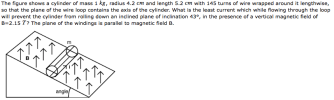 The figure shows a cylinder of mass 1 kg, radius 4.2 cm and length 5.2 cm with 145 turns of wire wrapped around it lengthwise, so that the plane of the wire loop contains the axis of the cylinder. What is the least current which while flowing through the loop will prevent the cylinder from rolling down an inclined plane of inclination 43 degree, in the presence of a vertical magnetic field of B = 2.15 T? The plane of...
A frictionless pulley has the shape of a uniform solid disk of mass 2.60 kg and radius 10 cm
 A frictionless pulley has the shape of a uniform solid disk of mass 2.60 kg and radius 10 cm. A 1.90 kg stone is attached to a very light wire that is wrapped around the rim of the pulley (the figure (Figure 1)), and the system is released from rest. Part A How far must the stone fall so that the pulley has 4.20 J of kinetic energy? Part B What percent of the total kinetic energy does the pulley have?...
A solid disc of mass 16-kg and radius 50 cm has a mass of 4-kg hanging...
 A solid disc of mass 16-kg and radius 50 cm has a mass of 4-kg hanging from one side by a massless string. The disc acts like a frictionless pulley and rotates freely about its center. Once released from rest, how much time does it take for the wheel to rotate through 20 revolutions? (A) 2 Squareroot 2 pi seconds (B) Squareroot 2 pi seconds (c) 2 Squareroot pi seconds) D) Squareroot pi/2 seconds
 Problem 2; The 15.0 kg mass on a 40.0° frictionless inclined plane is tied to a string that is wrapped around a frictionless pulley (disk, I = MR2) of mass 12.0 kg and radius 9.00 cm. What is the angular acceleration of the disk after the 15.0 kg mass is released?
 A light string is wrapped
around the outside of a 2.0-kg-wheel whose radius is 75 cm. The
wheel has a frictionless axel that allows it to rotate but prevents
its center of mass from moving. Assume the moment of inertia of the
wheel is the same as that of a point particle of equal mass at the
same radius from the axel. The string is then attached to a 3.0-kg
hanging mass that is released from rest. While the mass...
A light string is wrapped
around the outside of a 2.0-kg-wheel whose radius is 75 cm. The
wheel has a frictionless axel that allows it to rotate but prevents
its center of mass from moving. Assume the moment of inertia of the
wheel is the same as that of a point particle of equal mass at the
same radius from the axel. The string is then attached to a 3.0-kg
hanging mass that is released from rest. While the mass...
 A uniform cylinder of mass 3.0 kg and radius 10.0 cm
has a rope wrapped around its edge; a tension of 5.0 N
is
exerted on the rope. The cylinder rotates at a
constantly
increasing rate, starting from rest.
10DCH 1. A uniform cylinder of mass 3.0 kg and radius 10.0 cm has a rope wrapped around its edge; a tension of 5.0 N is exerted on the rope. The cylinder rotates at a constantly increasing rate, starting from rest....
A uniform cylinder of mass 3.0 kg and radius 10.0 cm
has a rope wrapped around its edge; a tension of 5.0 N
is
exerted on the rope. The cylinder rotates at a
constantly
increasing rate, starting from rest.
10DCH 1. A uniform cylinder of mass 3.0 kg and radius 10.0 cm has a rope wrapped around its edge; a tension of 5.0 N is exerted on the rope. The cylinder rotates at a constantly increasing rate, starting from rest....
 Thanks so much ahead of time!
A spherical shell of radius 0.43 m and mass 27 kg initially rolls without slipping towards an incline at a linear speed of 9.1 m/s. If the ball rolls up an incline (inclined 35 degrees above the horizontal) without sliding. How high will it go? A professor holding a spinning wheel used for a demonstration brings the wheel to a stop by applying a constant, tangential friction force to the edge (his hand). The...
Thanks so much ahead of time!
A spherical shell of radius 0.43 m and mass 27 kg initially rolls without slipping towards an incline at a linear speed of 9.1 m/s. If the ball rolls up an incline (inclined 35 degrees above the horizontal) without sliding. How high will it go? A professor holding a spinning wheel used for a demonstration brings the wheel to a stop by applying a constant, tangential friction force to the edge (his hand). The...
 A thick walled cylinder has a light string
wrapped around its outer radius and rotates
about a horizontal axis. The string then goes
vertically straight up and over a massive
pulley that also rotates about a horizontal
axis, and finally connects to a mass m =
0.900 kg on a rough incline (μk = 0.200) that
is angled at 25.0° to the horizontal.
When the system is released from rest the mass slides down the ramp
a distance of 1.80...
A thick walled cylinder has a light string
wrapped around its outer radius and rotates
about a horizontal axis. The string then goes
vertically straight up and over a massive
pulley that also rotates about a horizontal
axis, and finally connects to a mass m =
0.900 kg on a rough incline (μk = 0.200) that
is angled at 25.0° to the horizontal.
When the system is released from rest the mass slides down the ramp
a distance of 1.80...
 The figure shows a cylinder of mass 1 kg, radius 4.2 cm and length 5.2 cm with 145 turns of wire wrapped around it lengthwise, so that the plane of the wire loop contains the axis of the cylinder. What is the least current which while flowing through the loop will prevent the cylinder from rolling down an inclined plane of inclination 43 degree, in the presence of a vertical magnetic field of B = 2.15 T? The plane of...
 A solid disc of mass 16-kg and radius 50 cm has a mass of 4-kg hanging from one side by a massless string. The disc acts like a frictionless pulley and rotates freely about its center. Once released from rest, how much time does it take for the wheel to rotate through 20 revolutions? (A) 2 Squareroot 2 pi seconds (B) Squareroot 2 pi seconds (c) 2 Squareroot pi seconds) D) Squareroot pi/2 seconds
Most questions answered within 3 hours.
-
Where is the error in this code sequence?
String s1 = "Hello";
String s2 = "ello";...
asked 11 months ago -
Financial data for Joel de Paris, Inc., for last year
follow:
Joel de Paris, Inc.
Balance...
asked 11 months ago -
Consider this reaction:
Al2(SO4)3 (aq)+ BaCl3
(aq) Al2Cl6 (aq)- +
3BaSO4(s) . What is the...
asked 11 months ago -
Suppose that Savneet is considering increasing her
recent random sample from 20 car rentals to 40...
asked 11 months ago -
Trucks arrive at an unloading terminal at an average rate of 120
per hour.
Trucks arrive...
asked 11 months ago -
Why are methanol and ethanol completely soluble in water while
octanol is not very little soluble....
asked 11 months ago -
A facilities manager at a university reads in a research report
that the mean amount of...
asked 11 months ago -
When the CuSO4 is rehydrated by adding water to the anhydrous
compound, is this an endothermic...
asked 11 months ago -
A ray of sunlight is passing from diamond into crown glass; the
angle of incidence is...
asked 11 months ago -
A block of mass 0.249 kg is placed on top of a light, vertical
spring of...
asked 11 months ago -
how do the kidneys compensate in the presences of acidosis
a) trigger hyperventilate
b) reserve acid...
asked 11 months ago -
Question 501 pts
The rental rate of capital to the firm increases. Which of the
following...
asked 11 months ago