
Homework Answers

Add Answer to:
1. If a circuit element absorbs O W real power and O VAR reactive power, then...
Enter the value of real power in W and reactive power in VAR A naval in-board...
 Enter the value of real power in W and reactive power in
VAR
A naval in-board synchronous generator has an apparent power of 75 kVA and supplies a three-phase network of 310 V. Compute the phase currents, the real power, and the reactive power for a power factor of 0.8 Note: The given value of voltage refers to the phase voltage.
Enter the value of real power in W and reactive power in
VAR
A naval in-board synchronous generator has an apparent power of 75 kVA and supplies a three-phase network of 310 V. Compute the phase currents, the real power, and the reactive power for a power factor of 0.8 Note: The given value of voltage refers to the phase voltage.
True power for an inductor is measured in VAR rather than watts Select one: O True...
 True power for an inductor is measured in VAR rather than watts Select one: O True O False The power factor is equal to one for purely reactive loads. Select one OTrue O False Energy dissipation occurs only in the resistive part of a circuit since ideal inductors and capacitors merely store and release energy Select one OTrue O False The unit of apparent power is the volt-ampere Select one True O False
Given the circuit below, determine the reactive power Q supplied by the circuit. Give your answer...
 Given the circuit below, determine the reactive power Q
supplied by the circuit. Give your answer as positive and in units
of VAR.
Given the circuit below, determine the reactive power Q supplied by the circuit. Give your answer as positive and in units of VAR. Use the following quantities: w = 9,043 rad/sec and Vin = 28 20° + Vout HH m 3 mH 5 F 400 Vin 2002
Given the circuit below, determine the reactive power Q
supplied by the circuit. Give your answer as positive and in units
of VAR.
Given the circuit below, determine the reactive power Q supplied by the circuit. Give your answer as positive and in units of VAR. Use the following quantities: w = 9,043 rad/sec and Vin = 28 20° + Vout HH m 3 mH 5 F 400 Vin 2002
real power and reactive power at the node
 Derive the expression for real power and reactive power at the node A considering the circuit shown in Fig. 6. The voltages at the two nodes A and B as well as impedance between them are denoted in the figure.Capture.PNG
IW_L05_ELE211 Q.1. Determine the reactive power, true power, PF & apparent power in the following circuit...
 IW_L05_ELE211 Q.1. Determine the reactive power, true power, PF & apparent power in the following circuit RMS f 10 kHz Q.2. Determine the series element or elements that must be installed in the block of the figure below to meet the following requirements Ptrur-400W and there's a leading PF rms 10020 V 1 kHz
Given the circuit below, determine the reactive power Q supplied by the circuit. Give your answer...
 Given the circuit below, determine the reactive power Q supplied by the circuit. Give your answer as positive and in units of VAR. Use the following quantities: w = 100 rad/sec and Vin = 1220°V + 20 mH Vout(t) + Vin(t) 4 mF 292
For the following voltage and current phasors, calculate the complex power, apparent power, real power, and...
 For the following voltage and current phasors, calculate the complex power, apparent power, real power, and reactive power. Determine whether the power factor is leading or lagging. V = 260 230 Vrms, I0.5260 Arms The value of apparent power is VA The value of real power is W. VAR. The value of reactive power is The power factor is Click to select B
Consider the two loads in the circuit in (Figure 1). Load #1 (L1) absorbs S =...
 Consider the two loads in the
circuit in (Figure 1). Load #1 (L1) absorbs S = 56 VA at a lagging
power factor of pf = 0.61. Load #2 (L2) absorbs P2 = 56 W and Q2 =
1 VAR of power. If these loads are powered by a V = 425 V−rms ,
60-Hz source, what impedance needs to be added to the circuit in
order to raise the source's power factor to unity? Express your
answer in rectangular...
Consider the two loads in the
circuit in (Figure 1). Load #1 (L1) absorbs S = 56 VA at a lagging
power factor of pf = 0.61. Load #2 (L2) absorbs P2 = 56 W and Q2 =
1 VAR of power. If these loads are powered by a V = 425 V−rms ,
60-Hz source, what impedance needs to be added to the circuit in
order to raise the source's power factor to unity? Express your
answer in rectangular...
Consider the three-phase circuit below. Calculate the total active power, apparent power, S and the power...
 Consider the three-phase circuit below. Calculate the total active power, apparent power, S and the power factor, PF points) a reactive power o. 480V ->/V2 W 302 12/A Active power: Reactive power: Apparent power: Power factor: VAR VA % - - 3 332 neutral Also draw a phasor diagram with is, ic and iz
In the figure, the section of circuit AB absorbs 60 W of power when a current...
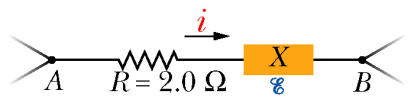 In the figure, the section of circuit AB absorbs 60 W
of power when a current i = 1.1A passes through it in the
indicated direction.
What is the potential difference between A and B?
Emf device C does not have internal resistance. What is its
emf?
In the figure, the section of circuit AB absorbs 60 W
of power when a current i = 1.1A passes through it in the
indicated direction.
What is the potential difference between A and B?
Emf device C does not have internal resistance. What is its
emf?
 Enter the value of real power in W and reactive power in
VAR
A naval in-board synchronous generator has an apparent power of 75 kVA and supplies a three-phase network of 310 V. Compute the phase currents, the real power, and the reactive power for a power factor of 0.8 Note: The given value of voltage refers to the phase voltage.
Enter the value of real power in W and reactive power in
VAR
A naval in-board synchronous generator has an apparent power of 75 kVA and supplies a three-phase network of 310 V. Compute the phase currents, the real power, and the reactive power for a power factor of 0.8 Note: The given value of voltage refers to the phase voltage.
 True power for an inductor is measured in VAR rather than watts Select one: O True O False The power factor is equal to one for purely reactive loads. Select one OTrue O False Energy dissipation occurs only in the resistive part of a circuit since ideal inductors and capacitors merely store and release energy Select one OTrue O False The unit of apparent power is the volt-ampere Select one True O False
 Given the circuit below, determine the reactive power Q
supplied by the circuit. Give your answer as positive and in units
of VAR.
Given the circuit below, determine the reactive power Q supplied by the circuit. Give your answer as positive and in units of VAR. Use the following quantities: w = 9,043 rad/sec and Vin = 28 20° + Vout HH m 3 mH 5 F 400 Vin 2002
Given the circuit below, determine the reactive power Q
supplied by the circuit. Give your answer as positive and in units
of VAR.
Given the circuit below, determine the reactive power Q supplied by the circuit. Give your answer as positive and in units of VAR. Use the following quantities: w = 9,043 rad/sec and Vin = 28 20° + Vout HH m 3 mH 5 F 400 Vin 2002
 IW_L05_ELE211 Q.1. Determine the reactive power, true power, PF & apparent power in the following circuit RMS f 10 kHz Q.2. Determine the series element or elements that must be installed in the block of the figure below to meet the following requirements Ptrur-400W and there's a leading PF rms 10020 V 1 kHz
 Given the circuit below, determine the reactive power Q supplied by the circuit. Give your answer as positive and in units of VAR. Use the following quantities: w = 100 rad/sec and Vin = 1220°V + 20 mH Vout(t) + Vin(t) 4 mF 292
 For the following voltage and current phasors, calculate the complex power, apparent power, real power, and reactive power. Determine whether the power factor is leading or lagging. V = 260 230 Vrms, I0.5260 Arms The value of apparent power is VA The value of real power is W. VAR. The value of reactive power is The power factor is Click to select B
 Consider the two loads in the
circuit in (Figure 1). Load #1 (L1) absorbs S = 56 VA at a lagging
power factor of pf = 0.61. Load #2 (L2) absorbs P2 = 56 W and Q2 =
1 VAR of power. If these loads are powered by a V = 425 V−rms ,
60-Hz source, what impedance needs to be added to the circuit in
order to raise the source's power factor to unity? Express your
answer in rectangular...
Consider the two loads in the
circuit in (Figure 1). Load #1 (L1) absorbs S = 56 VA at a lagging
power factor of pf = 0.61. Load #2 (L2) absorbs P2 = 56 W and Q2 =
1 VAR of power. If these loads are powered by a V = 425 V−rms ,
60-Hz source, what impedance needs to be added to the circuit in
order to raise the source's power factor to unity? Express your
answer in rectangular...
 Consider the three-phase circuit below. Calculate the total active power, apparent power, S and the power factor, PF points) a reactive power o. 480V ->/V2 W 302 12/A Active power: Reactive power: Apparent power: Power factor: VAR VA % - - 3 332 neutral Also draw a phasor diagram with is, ic and iz
 In the figure, the section of circuit AB absorbs 60 W
of power when a current i = 1.1A passes through it in the
indicated direction.
What is the potential difference between A and B?
Emf device C does not have internal resistance. What is its
emf?
In the figure, the section of circuit AB absorbs 60 W
of power when a current i = 1.1A passes through it in the
indicated direction.
What is the potential difference between A and B?
Emf device C does not have internal resistance. What is its
emf?
Most questions answered within 3 hours.
-
Where is the error in this code sequence?
String s1 = "Hello";
String s2 = "ello";...
asked 10 months ago -
Financial data for Joel de Paris, Inc., for last year
follow:
Joel de Paris, Inc.
Balance...
asked 10 months ago -
Consider this reaction:
Al2(SO4)3 (aq)+ BaCl3
(aq) Al2Cl6 (aq)- +
3BaSO4(s) . What is the...
asked 10 months ago -
Suppose that Savneet is considering increasing her
recent random sample from 20 car rentals to 40...
asked 10 months ago -
Trucks arrive at an unloading terminal at an average rate of 120
per hour.
Trucks arrive...
asked 10 months ago -
Why are methanol and ethanol completely soluble in water while
octanol is not very little soluble....
asked 10 months ago -
A facilities manager at a university reads in a research report
that the mean amount of...
asked 10 months ago -
When the CuSO4 is rehydrated by adding water to the anhydrous
compound, is this an endothermic...
asked 10 months ago -
A ray of sunlight is passing from diamond into crown glass; the
angle of incidence is...
asked 10 months ago -
A block of mass 0.249 kg is placed on top of a light, vertical
spring of...
asked 10 months ago -
how do the kidneys compensate in the presences of acidosis
a) trigger hyperventilate
b) reserve acid...
asked 10 months ago -
Question 501 pts
The rental rate of capital to the firm increases. Which of the
following...
asked 10 months ago