
Homework Answers
Add Answer to:
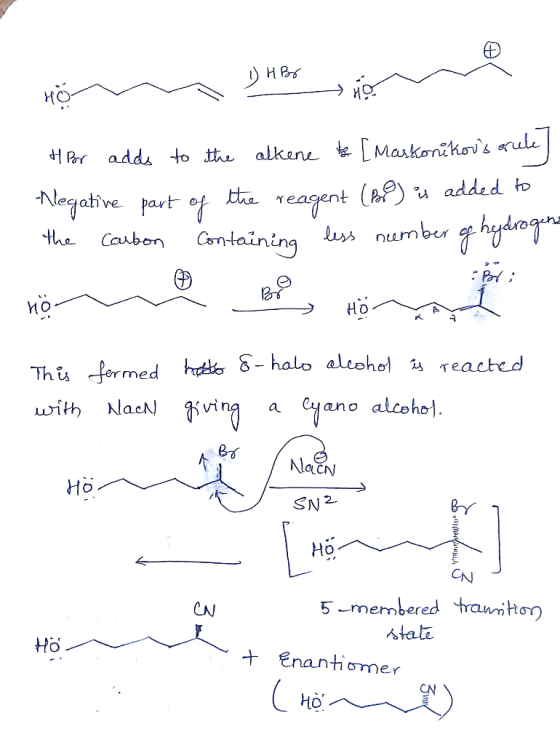
6. Chemists tried to brominate the alkene shown below and do a
SN2 with cyanide. Why...
Draw the major organic product of the reaction shown below. Draw the major organic product of...
 Draw the major organic product of the reaction shown below. Draw the major organic product of the reaction shown below. CH H2SO4 + HBr You do not have to consider stereochemistry, • You do not have to explicitly draw Hatoms. • You do not have to consider stereochemistry • You do not have to explicitly draw Hatoms • In cases where there is more than one answer, just draw one. -O0O-P - OOO 90 The two reactants shown below are...
5. Explain why the followi ng E2 reaction proceeds to give the single alkene product shown....
 5. Explain why the followi ng E2 reaction proceeds to give the single alkene product shown. * HOCH,CH 6. There are two configurational isomers of 1-tert-butyl-4-chlorocyclohexane. (a) Provide bond line structures, with dashed and wedged bonds, of each isomer below (b) One isomer reacts with CHiCH:O'in an E2 reaction that is 500 times faster than the reaction of the other isomer. Identify the isomer that reacts faster and explain the difference in rate. Chair conformations will be helpful in solving...
5. [14 pts) Provide the major products of reacting the alkene shown in the middle of...
 5. [14 pts) Provide the major products of reacting the alkene shown in the middle of the scheme below with all the reagents independently. Draw the products' structures in the corresponding table below showing whether it is a Syn or Anti addition when applicable. No mechanism required! (3 points cach organic product and 2 points for the stereochemistry. Adding the stereochemistry when it is not needed will be penalized) HO Acidic Medium 1) BH, THE 2) H2O2, KOH с HCI...
6. 104 pts. What alkene gives the product shown after reaction first with ozone and then...
 6. 104 pts. What alkene gives the product shown after reaction first with ozone and then with dimethyl methyl sulfide? 2. [03 pts.] What is the maximum number of water molecules that, in theory, the following molecule could hydrogen bond with? 0:2 0:2 . [03 pts.) How many carbons are in planar double bond system? poleg omegn (8 0 7 02 to 4 Tor 2 16. [03 pts.] What is the specific rotation of a sample of carvone that is...
1)Discuss two things you could do in a lab setting to determine which type of substitution...
 1)Discuss two things you could do in a lab setting to
determine which type of substitution reaction took place. Be
specific and explain each experiment. Discuss what outcomes you
would expect from your design.
Consider the reaction scheme shown below. Sn1 or SN2 + Nuc Substitution Product (S) solvent rate single enantiomer (optically active) Discuss two things you could do in a typical undergraduate lab to experimentally determine which type of substitution reaction took place. Be specific and briefly explain...
1)Discuss two things you could do in a lab setting to
determine which type of substitution reaction took place. Be
specific and explain each experiment. Discuss what outcomes you
would expect from your design.
Consider the reaction scheme shown below. Sn1 or SN2 + Nuc Substitution Product (S) solvent rate single enantiomer (optically active) Discuss two things you could do in a typical undergraduate lab to experimentally determine which type of substitution reaction took place. Be specific and briefly explain...
(4) 6 points) Benzylic Carbocations. Reaction #1 shown below illustrates the acid catalyzed electrophilic addition of...
 (4) 6 points) Benzylic Carbocations. Reaction #1 shown below illustrates the acid catalyzed electrophilic addition of H20 to an alkene. This reaction goes through a Benzylic Carbocation Intermediate: HO. Reaction #1 H2SO4 - -- (a) Which one of the following structures is the most reasonable benzylic carbocation intermediate for Reaction #1? ANSWER: answer: он (A) (b) Based on your answer to (a), how many total resonance structures are there for this benzylic carbocation? ANSWER:
6. When the alkene shown below is treated with NBS, two isomeric products (ignoring R/S stereoisomers)...
 6. When the alkene shown below is treated with NBS, two isomeric products (ignoring R/S stereoisomers) are formed. A. (4 points) Draw the structures of these two products. (Hint: do part "B" first) NBS hv/CCl4 (4 points) Draw the structure of the allylic radical that is formed at the beginning of the propagation step, and then draw its resonance structure. B. C. (4 points) Draw the structure of the MAIOR product and give reasons for your choice.
10.54 (...) The addition of H-X alkenes has been shown to add predominately via syn-addition, as...
 10.54 (...) The addition of H-X alkenes has been shown to add predominately via syn-addition, as shown below. н Br H-Br Two chemists disagreed on whether or not syn-addition would happen on terminal alkenes as well. Suggest an experiment through which you could resolve this dispute. H HCI syn or anti? 10.56 (...) When alkynes are treated with water and bromide, a bromoketone is produced. Provide a plausible arrow pushing mechanism, which accounts for the formation of this product. z...
Hi I have to do an mechanism and tell witch reaction type it is (SN1 or SN2?)...
 Hi
I have to do an mechanism and tell witch reaction
type it is (SN1 or SN2?)
I had to prepared Methyl
2,3-di-O-benzoyl-4,6-O-benzyliden-α-D-glucopyranosid from methyl
α-D-glucopyranosid.
I have tried to make the mechanisme, Can you see and it is
correct? It is down below.
Is this correct?
4.1 SIMPLE PROTECTION OF MONOSACCHARIDES PH HOEKOMe HOOH O SOME HOOH Methyl 4,6-0-benzylidene-a-D-glucopyranoside: Methyl a-D-glucopyranoside (3.00 g, 15.5 mmol) is dissolved in dry acetonitrile (150 ml) in an oven-dried 250-ml round-bottomed flask, which immediately...
Hi
I have to do an mechanism and tell witch reaction
type it is (SN1 or SN2?)
I had to prepared Methyl
2,3-di-O-benzoyl-4,6-O-benzyliden-α-D-glucopyranosid from methyl
α-D-glucopyranosid.
I have tried to make the mechanisme, Can you see and it is
correct? It is down below.
Is this correct?
4.1 SIMPLE PROTECTION OF MONOSACCHARIDES PH HOEKOMe HOOH O SOME HOOH Methyl 4,6-0-benzylidene-a-D-glucopyranoside: Methyl a-D-glucopyranoside (3.00 g, 15.5 mmol) is dissolved in dry acetonitrile (150 ml) in an oven-dried 250-ml round-bottomed flask, which immediately...
Help on all parts of question 3 would be greatly appreciated! 3. Treating alkene "A" below...
 Help on all parts of question 3 would be greatly
appreciated!
3. Treating alkene "A" below with HBr can lead to a number of products. "A" + H-Br A bunch of products. For real, hella products. 3.A. Label the stereocenters in compound "A" as R or S and label the alkene as E or Z. 3.B. Draw the curved arrow mechanism leading to the most stabilized carbo- cation intermediate. (don't do any rearrangements, just acid/base with the alkene) H-Br most...
Help on all parts of question 3 would be greatly
appreciated!
3. Treating alkene "A" below with HBr can lead to a number of products. "A" + H-Br A bunch of products. For real, hella products. 3.A. Label the stereocenters in compound "A" as R or S and label the alkene as E or Z. 3.B. Draw the curved arrow mechanism leading to the most stabilized carbo- cation intermediate. (don't do any rearrangements, just acid/base with the alkene) H-Br most...
 Draw the major organic product of the reaction shown below. Draw the major organic product of the reaction shown below. CH H2SO4 + HBr You do not have to consider stereochemistry, • You do not have to explicitly draw Hatoms. • You do not have to consider stereochemistry • You do not have to explicitly draw Hatoms • In cases where there is more than one answer, just draw one. -O0O-P - OOO 90 The two reactants shown below are...
 5. Explain why the followi ng E2 reaction proceeds to give the single alkene product shown. * HOCH,CH 6. There are two configurational isomers of 1-tert-butyl-4-chlorocyclohexane. (a) Provide bond line structures, with dashed and wedged bonds, of each isomer below (b) One isomer reacts with CHiCH:O'in an E2 reaction that is 500 times faster than the reaction of the other isomer. Identify the isomer that reacts faster and explain the difference in rate. Chair conformations will be helpful in solving...
 5. [14 pts) Provide the major products of reacting the alkene shown in the middle of the scheme below with all the reagents independently. Draw the products' structures in the corresponding table below showing whether it is a Syn or Anti addition when applicable. No mechanism required! (3 points cach organic product and 2 points for the stereochemistry. Adding the stereochemistry when it is not needed will be penalized) HO Acidic Medium 1) BH, THE 2) H2O2, KOH с HCI...
 6. 104 pts. What alkene gives the product shown after reaction first with ozone and then with dimethyl methyl sulfide? 2. [03 pts.] What is the maximum number of water molecules that, in theory, the following molecule could hydrogen bond with? 0:2 0:2 . [03 pts.) How many carbons are in planar double bond system? poleg omegn (8 0 7 02 to 4 Tor 2 16. [03 pts.] What is the specific rotation of a sample of carvone that is...
 1)Discuss two things you could do in a lab setting to
determine which type of substitution reaction took place. Be
specific and explain each experiment. Discuss what outcomes you
would expect from your design.
Consider the reaction scheme shown below. Sn1 or SN2 + Nuc Substitution Product (S) solvent rate single enantiomer (optically active) Discuss two things you could do in a typical undergraduate lab to experimentally determine which type of substitution reaction took place. Be specific and briefly explain...
1)Discuss two things you could do in a lab setting to
determine which type of substitution reaction took place. Be
specific and explain each experiment. Discuss what outcomes you
would expect from your design.
Consider the reaction scheme shown below. Sn1 or SN2 + Nuc Substitution Product (S) solvent rate single enantiomer (optically active) Discuss two things you could do in a typical undergraduate lab to experimentally determine which type of substitution reaction took place. Be specific and briefly explain...
 (4) 6 points) Benzylic Carbocations. Reaction #1 shown below illustrates the acid catalyzed electrophilic addition of H20 to an alkene. This reaction goes through a Benzylic Carbocation Intermediate: HO. Reaction #1 H2SO4 - -- (a) Which one of the following structures is the most reasonable benzylic carbocation intermediate for Reaction #1? ANSWER: answer: он (A) (b) Based on your answer to (a), how many total resonance structures are there for this benzylic carbocation? ANSWER:
 6. When the alkene shown below is treated with NBS, two isomeric products (ignoring R/S stereoisomers) are formed. A. (4 points) Draw the structures of these two products. (Hint: do part "B" first) NBS hv/CCl4 (4 points) Draw the structure of the allylic radical that is formed at the beginning of the propagation step, and then draw its resonance structure. B. C. (4 points) Draw the structure of the MAIOR product and give reasons for your choice.
 10.54 (...) The addition of H-X alkenes has been shown to add predominately via syn-addition, as shown below. н Br H-Br Two chemists disagreed on whether or not syn-addition would happen on terminal alkenes as well. Suggest an experiment through which you could resolve this dispute. H HCI syn or anti? 10.56 (...) When alkynes are treated with water and bromide, a bromoketone is produced. Provide a plausible arrow pushing mechanism, which accounts for the formation of this product. z...
 Hi
I have to do an mechanism and tell witch reaction
type it is (SN1 or SN2?)
I had to prepared Methyl
2,3-di-O-benzoyl-4,6-O-benzyliden-α-D-glucopyranosid from methyl
α-D-glucopyranosid.
I have tried to make the mechanisme, Can you see and it is
correct? It is down below.
Is this correct?
4.1 SIMPLE PROTECTION OF MONOSACCHARIDES PH HOEKOMe HOOH O SOME HOOH Methyl 4,6-0-benzylidene-a-D-glucopyranoside: Methyl a-D-glucopyranoside (3.00 g, 15.5 mmol) is dissolved in dry acetonitrile (150 ml) in an oven-dried 250-ml round-bottomed flask, which immediately...
Hi
I have to do an mechanism and tell witch reaction
type it is (SN1 or SN2?)
I had to prepared Methyl
2,3-di-O-benzoyl-4,6-O-benzyliden-α-D-glucopyranosid from methyl
α-D-glucopyranosid.
I have tried to make the mechanisme, Can you see and it is
correct? It is down below.
Is this correct?
4.1 SIMPLE PROTECTION OF MONOSACCHARIDES PH HOEKOMe HOOH O SOME HOOH Methyl 4,6-0-benzylidene-a-D-glucopyranoside: Methyl a-D-glucopyranoside (3.00 g, 15.5 mmol) is dissolved in dry acetonitrile (150 ml) in an oven-dried 250-ml round-bottomed flask, which immediately...
 Help on all parts of question 3 would be greatly
appreciated!
3. Treating alkene "A" below with HBr can lead to a number of products. "A" + H-Br A bunch of products. For real, hella products. 3.A. Label the stereocenters in compound "A" as R or S and label the alkene as E or Z. 3.B. Draw the curved arrow mechanism leading to the most stabilized carbo- cation intermediate. (don't do any rearrangements, just acid/base with the alkene) H-Br most...
Help on all parts of question 3 would be greatly
appreciated!
3. Treating alkene "A" below with HBr can lead to a number of products. "A" + H-Br A bunch of products. For real, hella products. 3.A. Label the stereocenters in compound "A" as R or S and label the alkene as E or Z. 3.B. Draw the curved arrow mechanism leading to the most stabilized carbo- cation intermediate. (don't do any rearrangements, just acid/base with the alkene) H-Br most...
Most questions answered within 3 hours.
-
Where is the error in this code sequence?
String s1 = "Hello";
String s2 = "ello";...
asked 11 months ago -
Financial data for Joel de Paris, Inc., for last year
follow:
Joel de Paris, Inc.
Balance...
asked 11 months ago -
Consider this reaction:
Al2(SO4)3 (aq)+ BaCl3
(aq) Al2Cl6 (aq)- +
3BaSO4(s) . What is the...
asked 11 months ago -
Suppose that Savneet is considering increasing her
recent random sample from 20 car rentals to 40...
asked 11 months ago -
Trucks arrive at an unloading terminal at an average rate of 120
per hour.
Trucks arrive...
asked 11 months ago -
Why are methanol and ethanol completely soluble in water while
octanol is not very little soluble....
asked 11 months ago -
A facilities manager at a university reads in a research report
that the mean amount of...
asked 11 months ago -
When the CuSO4 is rehydrated by adding water to the anhydrous
compound, is this an endothermic...
asked 11 months ago -
A ray of sunlight is passing from diamond into crown glass; the
angle of incidence is...
asked 11 months ago -
A block of mass 0.249 kg is placed on top of a light, vertical
spring of...
asked 11 months ago -
how do the kidneys compensate in the presences of acidosis
a) trigger hyperventilate
b) reserve acid...
asked 11 months ago -
Question 501 pts
The rental rate of capital to the firm increases. Which of the
following...
asked 11 months ago