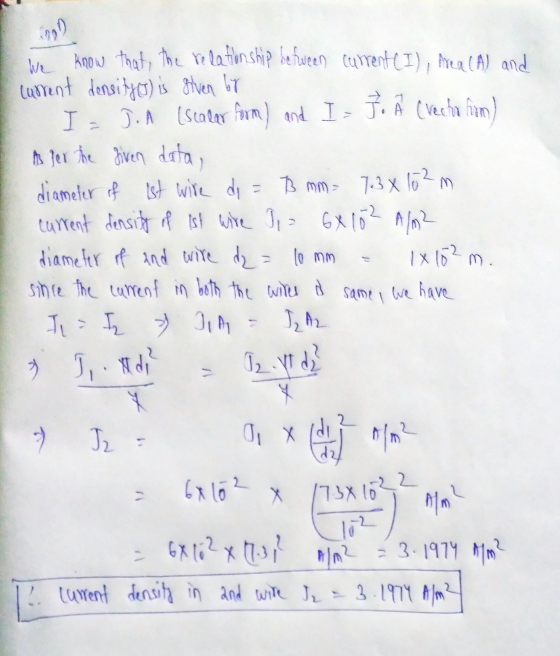
 D = 73 mm and d= 10 mm the electric current I is assumed to be the
same in both wires the current density in section 1 is 6x10^-2
A.m^-2 find the current density in section 2
D = 73 mm and d= 10 mm the electric current I is assumed to be the
same in both wires the current density in section 1 is 6x10^-2
A.m^-2 find the current density in section 2Homework Answers
A d = 3.71 mm diameter wire carries an electric current of I = 18.2 A...
 A d = 3.71 mm diameter wire carries an electric current of I = 18.2 A when the electric field is E = 5.72 times 10^-2 V/m along the wire. What is the current density? What is the conductivity of the wire? What is the resistivity of the wire?
I am in University Physics II and I am lost with this HW problem. Please show...
 I am in University Physics II and I am lost with this HW
problem. Please show all the steps to solve it. Thank you!
2. A resistor is made to connect two wires of circular cross-section with radii of 1.00 mm and 2.54 mm. The resistor is made 5.25 cm in length and has a linearly varying radius between the ends that meet the wires (that is, dr/dx is constant). It carries a current of 36.3 μA under a potential...
I am in University Physics II and I am lost with this HW
problem. Please show all the steps to solve it. Thank you!
2. A resistor is made to connect two wires of circular cross-section with radii of 1.00 mm and 2.54 mm. The resistor is made 5.25 cm in length and has a linearly varying radius between the ends that meet the wires (that is, dr/dx is constant). It carries a current of 36.3 μA under a potential...
Wires A and B, having equal lengths of 40.9 m and equal diameters of 2.65 mm,...
 Wires A and B, having equal lengths of 40.9 m
and equal diameters of 2.65 mm, are connected in series. A
potential difference of 63.0 V is applied between the ends of the
composite wire. The resistances are RA = 0.125
Ω and RB = 0.718 Ω. For wire A, what
are (a) magnitude J of the current
density and (b) potential difference V?
(c) Of what type material is wire A made
(see the table below)? For wire B,...
Wires A and B, having equal lengths of 40.9 m
and equal diameters of 2.65 mm, are connected in series. A
potential difference of 63.0 V is applied between the ends of the
composite wire. The resistances are RA = 0.125
Ω and RB = 0.718 Ω. For wire A, what
are (a) magnitude J of the current
density and (b) potential difference V?
(c) Of what type material is wire A made
(see the table below)? For wire B,...
18[E]) When a power source like a battery is connected to a circuit, an electric field...
18[E]) When a power source like a battery is connected to a circuit, an electric field pushes electrons within the conducting wires causing them to flow. The electric field exists due to an uneven build up of charge on the surfaces of the wires (called a surface charge gradient). In this set of problems we will explore a simple model of how this all comes about and emphasize the connection between source charges, electric fields, and voltage differences in the...
5) The force between two parallel wires carrying electric current is repulsive when: A) The magnitude...
 5) The force between two parallel wires carrying electric current is repulsive when: A) The magnitude of the current of both wires are the same. B) The direction of current in wires are opposite C) One of the wires is carrying no current D) The direction of the currents in wires are the same. E) Wires carrying different current values. 6) Ampere's law provides a convenient way of calculating: A) Electric field due to current distribution. B) Magnetic field due...
4) A wire is carrying a current of I and it is placed in a magnetic...
 4) A wire is carrying a current of I and it is placed in a magnetic field of B, the force on the wire is zero if: A) The length of wire is infinite. B) If there is a non-zero angle between magnetic field B and current I. C) The direction of the current and magnetic field are perpendicular. D) The current and magnetic field are parallel. E) There is a 90 degree angle between current direction and magnetic field...
4) A wire is carrying a current of I and it is placed in a magnetic...
 4) A wire is carrying a current of I and it is placed in a magnetic field of B, the force on the wire is zero if: A) The length of wire is infinite. B) If there is a non-zero angle between magnetic field B and current I. C) The direction of the current and magnetic field are perpendicular. D) The current and magnetic field are parallel. E) There is a 90 degree angle between current direction and magnetic field...
please do both of them asap 4) A wire is carrying a current of I and...
 please do both of them asap
4) A wire is carrying a current of I and it is placed in a magnetic field of B, the force on the wire is zero if: A) The length of wire is infinite. B) If there is a non-zero angle between magnetic field B and current I. C) The direction of the current and magnetic field are perpendicular. D) The current and magnetic field are parallel. E) There is a 90 degree angle...
please do both of them asap
4) A wire is carrying a current of I and it is placed in a magnetic field of B, the force on the wire is zero if: A) The length of wire is infinite. B) If there is a non-zero angle between magnetic field B and current I. C) The direction of the current and magnetic field are perpendicular. D) The current and magnetic field are parallel. E) There is a 90 degree angle...
The figure shows a transmission shaft. The steel solid shaft is 200 mm long between self-aligning...
 The figure shows a transmission shaft. The steel solid shaft is 200 mm long between self-aligning bearings at A and B. Belt forces in the same horizontal direction) are applied to a 120-mm diameter sheave at C. The left end of the shaft is connected to an electric motor attached to a clutch by means of a flexible coupling. Nothing is attached to the right end (it is free). Assuming the shaft has a constant diameter, d. (a) Perform the...
1. (20 points) Consider a toroid of made of N square loops of wires (side length a) with current i. The mean radius...
 1. (20 points) Consider a toroid of made of N square loops of wires (side length a) with current i. The mean radius of the toroid is R. You may express your results in terms ofN, R,a, i, and natural constants. Use Ampere's Law, prove that the magnetic field at a point inside the toroid and a distance r from the center is given by ue Ni/ (2 r). Find the magnetic flux through the cross section of the toroid....
 A d = 3.71 mm diameter wire carries an electric current of I = 18.2 A when the electric field is E = 5.72 times 10^-2 V/m along the wire. What is the current density? What is the conductivity of the wire? What is the resistivity of the wire?
 I am in University Physics II and I am lost with this HW
problem. Please show all the steps to solve it. Thank you!
2. A resistor is made to connect two wires of circular cross-section with radii of 1.00 mm and 2.54 mm. The resistor is made 5.25 cm in length and has a linearly varying radius between the ends that meet the wires (that is, dr/dx is constant). It carries a current of 36.3 μA under a potential...
I am in University Physics II and I am lost with this HW
problem. Please show all the steps to solve it. Thank you!
2. A resistor is made to connect two wires of circular cross-section with radii of 1.00 mm and 2.54 mm. The resistor is made 5.25 cm in length and has a linearly varying radius between the ends that meet the wires (that is, dr/dx is constant). It carries a current of 36.3 μA under a potential...
 5) The force between two parallel wires carrying electric current is repulsive when: A) The magnitude of the current of both wires are the same. B) The direction of current in wires are opposite C) One of the wires is carrying no current D) The direction of the currents in wires are the same. E) Wires carrying different current values. 6) Ampere's law provides a convenient way of calculating: A) Electric field due to current distribution. B) Magnetic field due...
 4) A wire is carrying a current of I and it is placed in a magnetic field of B, the force on the wire is zero if: A) The length of wire is infinite. B) If there is a non-zero angle between magnetic field B and current I. C) The direction of the current and magnetic field are perpendicular. D) The current and magnetic field are parallel. E) There is a 90 degree angle between current direction and magnetic field...
 4) A wire is carrying a current of I and it is placed in a magnetic field of B, the force on the wire is zero if: A) The length of wire is infinite. B) If there is a non-zero angle between magnetic field B and current I. C) The direction of the current and magnetic field are perpendicular. D) The current and magnetic field are parallel. E) There is a 90 degree angle between current direction and magnetic field...
 please do both of them asap
4) A wire is carrying a current of I and it is placed in a magnetic field of B, the force on the wire is zero if: A) The length of wire is infinite. B) If there is a non-zero angle between magnetic field B and current I. C) The direction of the current and magnetic field are perpendicular. D) The current and magnetic field are parallel. E) There is a 90 degree angle...
please do both of them asap
4) A wire is carrying a current of I and it is placed in a magnetic field of B, the force on the wire is zero if: A) The length of wire is infinite. B) If there is a non-zero angle between magnetic field B and current I. C) The direction of the current and magnetic field are perpendicular. D) The current and magnetic field are parallel. E) There is a 90 degree angle...
 The figure shows a transmission shaft. The steel solid shaft is 200 mm long between self-aligning bearings at A and B. Belt forces in the same horizontal direction) are applied to a 120-mm diameter sheave at C. The left end of the shaft is connected to an electric motor attached to a clutch by means of a flexible coupling. Nothing is attached to the right end (it is free). Assuming the shaft has a constant diameter, d. (a) Perform the...
 1. (20 points) Consider a toroid of made of N square loops of wires (side length a) with current i. The mean radius of the toroid is R. You may express your results in terms ofN, R,a, i, and natural constants. Use Ampere's Law, prove that the magnetic field at a point inside the toroid and a distance r from the center is given by ue Ni/ (2 r). Find the magnetic flux through the cross section of the toroid....
Most questions answered within 3 hours.
-
Where is the error in this code sequence?
String s1 = "Hello";
String s2 = "ello";...
asked 11 months ago -
Financial data for Joel de Paris, Inc., for last year
follow:
Joel de Paris, Inc.
Balance...
asked 11 months ago -
Consider this reaction:
Al2(SO4)3 (aq)+ BaCl3
(aq) Al2Cl6 (aq)- +
3BaSO4(s) . What is the...
asked 11 months ago -
Suppose that Savneet is considering increasing her
recent random sample from 20 car rentals to 40...
asked 11 months ago -
Trucks arrive at an unloading terminal at an average rate of 120
per hour.
Trucks arrive...
asked 11 months ago -
Why are methanol and ethanol completely soluble in water while
octanol is not very little soluble....
asked 11 months ago -
A facilities manager at a university reads in a research report
that the mean amount of...
asked 11 months ago -
When the CuSO4 is rehydrated by adding water to the anhydrous
compound, is this an endothermic...
asked 11 months ago -
A ray of sunlight is passing from diamond into crown glass; the
angle of incidence is...
asked 11 months ago -
A block of mass 0.249 kg is placed on top of a light, vertical
spring of...
asked 11 months ago -
how do the kidneys compensate in the presences of acidosis
a) trigger hyperventilate
b) reserve acid...
asked 11 months ago -
Question 501 pts
The rental rate of capital to the firm increases. Which of the
following...
asked 11 months ago