
Homework Answers
Peak ground acceleration = 0.3g
Actual Depth of water table = 1.5 m
Assumed Depth of water table during earthquake = 0 m
Magnitude of earthquake = 7.0
Depth of Soil layer = 6 m
Field SPT N = 5
Percentage of fines = 5 %
i) Cyclic Stress Ratio induced by Design Earthquakes (CSR)
Cyclic stress ratio caused by earthquake, CSR =
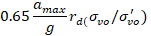
Where,
amax = maximum acceleration during earthquake
z = depth below ground surface = 6.0 m
rd = stress reduction factor = 1.0 - 0.00765z, for z ≤ 9.15 m = 0.9541
g = acceleration due to gravity
σvo' = Total vertical overburden stress
= 18.0 x 1.5+ 4.5 x 19 = 112.5 kN/m2
σvo' = Effective vertical overburden stress considering GWT at ground surface
= (18.0-10) x 1.5 +(19.0 -10) x 4.5 = 52.50 kN/m2
σvo' = Effective vertical overburden stress considering actual GWT
= (18.0) x 1.5 +(19.0 -10) x 4.5 = 67.5 kN/m2
Therefore, cyclic stress ratio during earthquake, CSR = 0.65*0.3*0.9541*112.552.50 = 0.399
ii) Cyclic Resistance Ratio (CRR7.5)
CRR7.5 = 134-N160+N160135+5010N160+452 -1200
σvo' = Total vertical overburden stress
= 18.0 x 1.5+ 4.5 x 19 = 112.5 kN/m2
σvo' = Effective vertical overburden stress considering GWT at ground surface
= (18.0-10) x 1.5 +(19.0 -10) x 4.5 = 52.50 kN/m2
σvo' = Effective vertical overburden stress considering actual GWT
= (18.0) x 1.5 +(19.0 -10) x 4.5 = 67.5 kN/m2
Therefore, cyclic stress ratio during earthquake, CSR = 0.65*0.3*0.9541*112.552.50 = 0.399
ii) Cyclic Resistance Ratio (CRR7.5)
CRR7.5 = 134-N160+N160135+5010N160+452 -1200
 =
Total vertical
overburden stress
=
Total vertical
overburden stress
= 18.0 x 1.5+ 4.5 x 19 = 112.5 kN/m2
 = Effective
vertical overburden stress considering GWT at ground
surface
= Effective
vertical overburden stress considering GWT at ground
surface
= (18.0-10) x 1.5 +(19.0 -10) x 4.5 = 52.50 kN/m2
 = Effective
vertical overburden stress considering actual GWT
= Effective
vertical overburden stress considering actual GWT
= (18.0) x 1.5 +(19.0 -10) x 4.5 = 67.5 kN/m2
Therefore, cyclic stress
ratio during earthquake, CSR =  = 0.399
ii) Cyclic Resistance Ratio (CRR7.5)
CRR7.5 = 
(N1)60 = N60 x CN
Where,
CN = Overburden correction factor
=  =
=  =1.21 <1.7 so
CN = 1.21
=1.21 <1.7 so
CN = 1.21
(N1)60 = 5 x 1.21 = 6.08
At 6m depth, Percentage of fines, FC = 5 %
SPT correction for fines, (N1)60cs = α + β (N1)60
α
= ![10, exp [1.76 - (229)], for 5% < FC <35% for FC < 5% for 5% <FC < 35% for FC > 35%](http://img.homeworklib.com/questions/17bb6110-b6ca-11eb-a044-eda1b36e02bc.png?x-oss-process=image/resize,w_560)
= 0
β
= 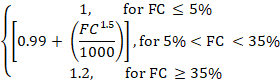
= 1
(N1)60cs = 0 + 1 x 6.08 = 6.08 ~ 6
CRR7.5
=  = 0.080
Magnitude Scaling Factor, MSF
= 
=
= 1.19
Factor of safety against liquefaction,
FoS = (CRR 7.5 /CSR) x MSF
= (0.08/0.399) x 1.19
= 0.24 <1
The soil is showing liquefaction Potential which necessitates the ground improvement.
Based on the above calculation, the target SPT is 24 based on trial and error.
Design :
| Dia. of bulbs | = | 0.9 | m | |
| Area of bulbs, As | = | 0.636 | m2 | |
| Field SPT N value, Ni | = | 5 | ||
| Target SPT value after improvement, Nt | = | 24 | ||
| Fines Content, FC | = | 5 | % | |
| Max void ratio, emax | = | 0.980 | ||
| Min void ratio, emin | = | 0.450 | ||
| Effective Overburden Pressure, σvo' | = | 67.500 | kPa | |
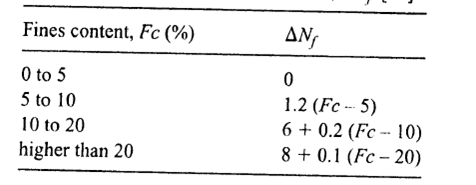
| ΔNf | = | 0.000 | ||
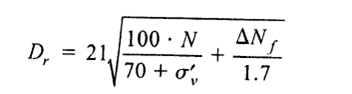
| Relative Density, Dr (Before Densification) | = | 40.045 | % | |
| Initial Void ratio, e1 | = | 0.768 | ||
| Relative Density, Dr1 (After Densification) | = | 87.735 | % | |
| Target Void ratio , et | = | 0.515 | ||
| Effective compaction ratio ,Rc | = | 0.728 | ||
| Area replacement ratio, as | = | 0.196 | ||
| Spacing for square pattern , S | = | 1.80 |
Add Answer to:
8.33. A site consists of uniform medium sand with 5% fine content (D5o = 1.4 mm)....
1. (25 points) The soil profile at a site consists of a layer of fine sand...
 1. (25 points) The soil profile at a site consists of a layer of fine sand 5 m thick above a layer of clay 4 m thick. Below the clay is a layer of impermeable rock. The groundwater table was observed at 2 m below ground level. The unit weight of the sand above and below the water table is 20 KN/m'. The water content of the clay is 25% and its dry unit weight is 15 KN/m'. The compression...
Question 2 The soil profile at a level site consists of a 3-m thick layer of...
 Question 2 The soil profile at a level site consists of a 3-m thick layer of sandy clay, overlaying an 8-m thick layer of loose sand, overlaying stiff gravelly clays that extend to depths greater than 20 m. The water table is at a depth of 2 m and the ground water is initially hydrostatic. The total unit weight of the upper sandy clay, above or below the water table, is 18 kN/m3. The total unit weight of the loose...
The ground profile of a construction site consists of a 3 m thick layer of sand...
The ground profile of a construction site consists of a 3 m thick layer of sand followed by a 2 m thick layer of clay lying on impervious bedrock. The water table is at a depth of 2 m below the ground surface. The sand has a dry unit weight of 16 kN/m3 and a saturated unit weight of 18 kN/m3. The capillary rise in the sand is 0.5 m. The clay has a bulk unit weight of 19 kN/m3....
The ground profile of a construction site consists of a 3 m thick layer of sand...
 The ground profile of a construction site consists of a 3 m thick layer of sand followed by a 2 m thick layer of clay lying on impervious bedrock. The watertable is at a depth of 2 m below the ground surface. The sand has a dry unit weight of 16 kN/m and a saturated unit weight of 18 kN/m3. The capillary rise in sand is 0.5 m. The clay has a bulk unit weight of 19 kN/m 1. One...
 1. (25 points) The soil profile at a site consists of a layer of fine sand 5 m thick above a layer of clay 4 m thick. Below the clay is a layer of impermeable rock. The groundwater table was observed at 2 m below ground level. The unit weight of the sand above and below the water table is 20 KN/m'. The water content of the clay is 25% and its dry unit weight is 15 KN/m'. The compression...
 Question 2 The soil profile at a level site consists of a 3-m thick layer of sandy clay, overlaying an 8-m thick layer of loose sand, overlaying stiff gravelly clays that extend to depths greater than 20 m. The water table is at a depth of 2 m and the ground water is initially hydrostatic. The total unit weight of the upper sandy clay, above or below the water table, is 18 kN/m3. The total unit weight of the loose...
 The ground profile of a construction site consists of a 3 m thick layer of sand followed by a 2 m thick layer of clay lying on impervious bedrock. The watertable is at a depth of 2 m below the ground surface. The sand has a dry unit weight of 16 kN/m and a saturated unit weight of 18 kN/m3. The capillary rise in sand is 0.5 m. The clay has a bulk unit weight of 19 kN/m 1. One...
Most questions answered within 3 hours.
-
Where is the error in this code sequence?
String s1 = "Hello";
String s2 = "ello";...
asked 11 months ago -
Financial data for Joel de Paris, Inc., for last year
follow:
Joel de Paris, Inc.
Balance...
asked 11 months ago -
Consider this reaction:
Al2(SO4)3 (aq)+ BaCl3
(aq) Al2Cl6 (aq)- +
3BaSO4(s) . What is the...
asked 11 months ago -
Suppose that Savneet is considering increasing her
recent random sample from 20 car rentals to 40...
asked 11 months ago -
Trucks arrive at an unloading terminal at an average rate of 120
per hour.
Trucks arrive...
asked 11 months ago -
Why are methanol and ethanol completely soluble in water while
octanol is not very little soluble....
asked 11 months ago -
A facilities manager at a university reads in a research report
that the mean amount of...
asked 11 months ago -
When the CuSO4 is rehydrated by adding water to the anhydrous
compound, is this an endothermic...
asked 11 months ago -
A ray of sunlight is passing from diamond into crown glass; the
angle of incidence is...
asked 11 months ago -
A block of mass 0.249 kg is placed on top of a light, vertical
spring of...
asked 11 months ago -
how do the kidneys compensate in the presences of acidosis
a) trigger hyperventilate
b) reserve acid...
asked 11 months ago -
Question 501 pts
The rental rate of capital to the firm increases. Which of the
following...
asked 11 months ago