
Homework Answers
Since the plate is hit by different wavelength light on the both
sides so stopping potential will also be different but since the
plate is same therefore the threshold frequency will be the same so
we get the two equations and then we can find out the wavelength of
the the right hand side.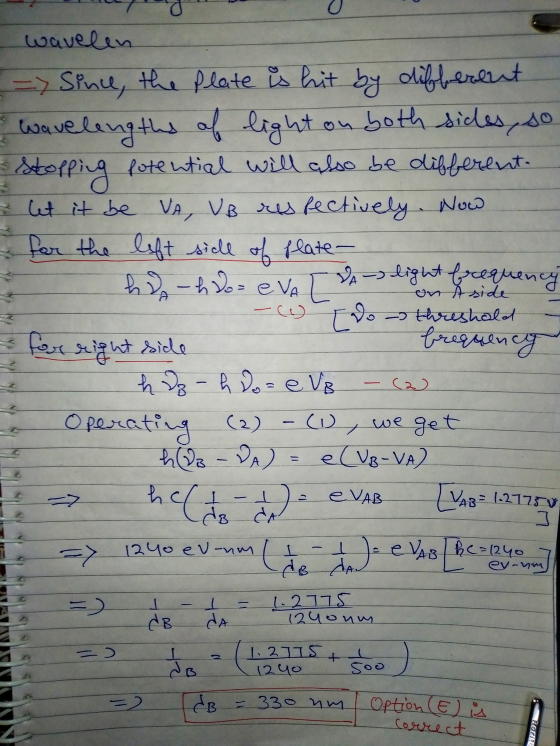
Add Answer to:
Each side of a metal plate is illuminated by light of different wavelengths. The left side...
Each side of a metal plate is illuminated by light of different wavelengths. The left side...
Each side of a metal plate is illuminated by light of different wavelengths. The left side is illuminated by light with λ0 = 500 nm and the right side by light of unknown λ. Two electrodes A and B provide the stopping potential for the ejected electrons. If the voltage across AB is VAB=1.2775 V, what is the unknown λ?
When sodium is illuminated with light of wavelength 420 nm, the electrons are ejected with 0.65...
When sodium is illuminated with light of wavelength 420 nm, the electrons are ejected with 0.65 eV of energy. When illuminated with light of wavelength 310 nm, the electrons are ejected with 1.71 eV of energy. (a) Use these data to find the work function of sodium. Find a percent difference between this and the accepted value of 2.28 eV. (b) What is the threshold frequency of sodium? (c) If we illuminated sodium with light of wavelength 150 nm, what...
Electromagnetic radiation is incident on a metallic surface. Electrons are emitted from the surface when the...
Electromagnetic radiation is incident on a metallic surface. Electrons are emitted from the surface when the wavelength is 450 nm or less. a) What is the work function of the metal? b) What is the maximum kinetic energy of photo-electrons if the incident light has a wavelength of 400 nm? c) What is the stopping voltage required to stop photo-electrons ejected by the plate when the incident light has a wavelength of 300 nm? d)If the stopping voltage is 5...
***Please help fill in the table finding KE...& the following questions Metal Wavelength (nm) Frequency (Hz)...
 ***Please help fill in the table finding KE...& the
following questions
Metal Wavelength (nm) Frequency (Hz) f Stopping Voltage (V) KE (J) Sodium 125 2.4*1015 -7.58 Sodium 300 1.0*1015 -1.79 Sodium 450 6.7*1014 -0.45 Sodium 538 5.57 1014 -0.01 Sodium 540 5.55*1014 0 a. Describe what happens to the stopping voltage for wavelengths greater than or equal to 540 nm. Based upon your knowledge of the atom, hypothesize an explanation for such behavior. b. At 540nm no electrons are ejected....
***Please help fill in the table finding KE...& the
following questions
Metal Wavelength (nm) Frequency (Hz) f Stopping Voltage (V) KE (J) Sodium 125 2.4*1015 -7.58 Sodium 300 1.0*1015 -1.79 Sodium 450 6.7*1014 -0.45 Sodium 538 5.57 1014 -0.01 Sodium 540 5.55*1014 0 a. Describe what happens to the stopping voltage for wavelengths greater than or equal to 540 nm. Based upon your knowledge of the atom, hypothesize an explanation for such behavior. b. At 540nm no electrons are ejected....
1) Light of wavelength 310nm is shined on a metal with work function = 1 eV....
1) Light of wavelength 310nm is shined on a metal with work function = 1 eV. What will be the maximum kinetic energy of the emitted electrons? 2) Light is shined on a metal with work function 2.0 eV, and electrons are emitted creating a photocurrent. When a decelerating voltage of magnitude 1.0 V is applied, the current goes to zero (i.e. the magnitude of the stopping voltage is 1V). What is the wavelength (in nm) of the incoming light?...
(1 point) A Silver surface (work function = 4.26 eV) is illuminated with 270 nm light...
 (1 point) A Silver surface (work function = 4.26 eV) is illuminated with 270 nm light from a 3 mW laser. How many photons per second are emitted by the laser? 4.0909E15 photons/s Only a small fraction of these photons can interact with electrons at the surface. Suppose this fractional efficiency is 0.00031%. What is the current in the detector assuming all the emitted electrons are captured? пA Note that current is charge(in Coulombs) per second. The charge of one...
Question 1 (1 point) If light with a frequency below the cutoff frequency for a certain...
Question 1 (1 point) If light with a frequency below the cutoff frequency for a certain metal hits that metal: Question 1 options: electrons will be ejected after the intensity of the light reaches a certain value no electrons will be ejected electrons will be ejected, but will fall back to the metal the light will be re-radiated by the metal I don't know. Question 2 (1 point) One electron-volt is equivalent to Question 2 options: 1 J 1 V...
Light of wavelength 400 nm is incident on a metal surface. The stopping potential for the...
 Light of wavelength 400 nm is incident on a metal
surface. The stopping
potential for the resulting electrons is 0.91 V.
a) What is the work function of the metal?
b) Identify the metal. (Use the Table)
c) What is the cut-off frequency for this target?
76 Chapter 3 Waves and Particles 1: Electromagnetic Radia TABLE 3.1 Metal Work Function in eV) Cesium Potassium Sodium Magnesium 19 2.2 2.3 3.7 are ejected if the intensi surable time might be ne...
Light of wavelength 400 nm is incident on a metal
surface. The stopping
potential for the resulting electrons is 0.91 V.
a) What is the work function of the metal?
b) Identify the metal. (Use the Table)
c) What is the cut-off frequency for this target?
76 Chapter 3 Waves and Particles 1: Electromagnetic Radia TABLE 3.1 Metal Work Function in eV) Cesium Potassium Sodium Magnesium 19 2.2 2.3 3.7 are ejected if the intensi surable time might be ne...
1. If light with a frequency below the cutoff frequency for a certain metal hits that...
1. If light with a frequency below the cutoff frequency for a certain metal hits that metal: Question 1 options: electrons will be ejected after the intensity of the light reaches a certain value no electrons will be ejected electrons will be ejected, but will fall back to the metal the light will be re-radiated by the metal I don't know. 2. One electron-volt is equivalent to Question 2 options: 1 J 1 V 1.6 x 10^-19 J 1.6 x...
PHYS-1200/1250 Lab Manual Section Name 2) Return the simulation to (400 nm, Sodium target, Intensity 100%,...
 PHYS-1200/1250 Lab Manual Section Name 2) Return the simulation to (400 nm, Sodium target, Intensity 100%, Voltage=0V). Click on the box to enable graphing of the current vs battery voltage. Sweep the battery voltage from -8 to +8 V. Rescale the plot on the screen so you can clearly see the behavior, a) Sketch the plot in the box to the right. b) Circle the point that corresponds to the stopping potential c) Why do you think the current stops...
 ***Please help fill in the table finding KE...& the
following questions
Metal Wavelength (nm) Frequency (Hz) f Stopping Voltage (V) KE (J) Sodium 125 2.4*1015 -7.58 Sodium 300 1.0*1015 -1.79 Sodium 450 6.7*1014 -0.45 Sodium 538 5.57 1014 -0.01 Sodium 540 5.55*1014 0 a. Describe what happens to the stopping voltage for wavelengths greater than or equal to 540 nm. Based upon your knowledge of the atom, hypothesize an explanation for such behavior. b. At 540nm no electrons are ejected....
***Please help fill in the table finding KE...& the
following questions
Metal Wavelength (nm) Frequency (Hz) f Stopping Voltage (V) KE (J) Sodium 125 2.4*1015 -7.58 Sodium 300 1.0*1015 -1.79 Sodium 450 6.7*1014 -0.45 Sodium 538 5.57 1014 -0.01 Sodium 540 5.55*1014 0 a. Describe what happens to the stopping voltage for wavelengths greater than or equal to 540 nm. Based upon your knowledge of the atom, hypothesize an explanation for such behavior. b. At 540nm no electrons are ejected....
 (1 point) A Silver surface (work function = 4.26 eV) is illuminated with 270 nm light from a 3 mW laser. How many photons per second are emitted by the laser? 4.0909E15 photons/s Only a small fraction of these photons can interact with electrons at the surface. Suppose this fractional efficiency is 0.00031%. What is the current in the detector assuming all the emitted electrons are captured? пA Note that current is charge(in Coulombs) per second. The charge of one...
 Light of wavelength 400 nm is incident on a metal
surface. The stopping
potential for the resulting electrons is 0.91 V.
a) What is the work function of the metal?
b) Identify the metal. (Use the Table)
c) What is the cut-off frequency for this target?
76 Chapter 3 Waves and Particles 1: Electromagnetic Radia TABLE 3.1 Metal Work Function in eV) Cesium Potassium Sodium Magnesium 19 2.2 2.3 3.7 are ejected if the intensi surable time might be ne...
Light of wavelength 400 nm is incident on a metal
surface. The stopping
potential for the resulting electrons is 0.91 V.
a) What is the work function of the metal?
b) Identify the metal. (Use the Table)
c) What is the cut-off frequency for this target?
76 Chapter 3 Waves and Particles 1: Electromagnetic Radia TABLE 3.1 Metal Work Function in eV) Cesium Potassium Sodium Magnesium 19 2.2 2.3 3.7 are ejected if the intensi surable time might be ne...
 PHYS-1200/1250 Lab Manual Section Name 2) Return the simulation to (400 nm, Sodium target, Intensity 100%, Voltage=0V). Click on the box to enable graphing of the current vs battery voltage. Sweep the battery voltage from -8 to +8 V. Rescale the plot on the screen so you can clearly see the behavior, a) Sketch the plot in the box to the right. b) Circle the point that corresponds to the stopping potential c) Why do you think the current stops...
Most questions answered within 3 hours.
-
Where is the error in this code sequence?
String s1 = "Hello";
String s2 = "ello";...
asked 11 months ago -
Financial data for Joel de Paris, Inc., for last year
follow:
Joel de Paris, Inc.
Balance...
asked 11 months ago -
Consider this reaction:
Al2(SO4)3 (aq)+ BaCl3
(aq) Al2Cl6 (aq)- +
3BaSO4(s) . What is the...
asked 11 months ago -
Suppose that Savneet is considering increasing her
recent random sample from 20 car rentals to 40...
asked 11 months ago -
Trucks arrive at an unloading terminal at an average rate of 120
per hour.
Trucks arrive...
asked 11 months ago -
Why are methanol and ethanol completely soluble in water while
octanol is not very little soluble....
asked 11 months ago -
A facilities manager at a university reads in a research report
that the mean amount of...
asked 11 months ago -
When the CuSO4 is rehydrated by adding water to the anhydrous
compound, is this an endothermic...
asked 11 months ago -
A ray of sunlight is passing from diamond into crown glass; the
angle of incidence is...
asked 11 months ago -
A block of mass 0.249 kg is placed on top of a light, vertical
spring of...
asked 11 months ago -
how do the kidneys compensate in the presences of acidosis
a) trigger hyperventilate
b) reserve acid...
asked 11 months ago -
Question 501 pts
The rental rate of capital to the firm increases. Which of the
following...
asked 11 months ago