Can check my answrs as well if it's correct and help me out with the last part of the question.
Homework Answers

Add Answer to:
Can check my answrs as well if it's correct and help me out with
the last...
Step 1: NO(g) + O2(g) ---> NO2(g) + O(g) rate= k1 Step 2: NO(g) + )...
Step 1: NO(g) + O2(g) ---> NO2(g) + O(g) rate= k1 Step 2: NO(g) + ) --> NO2 (g) rate = k2 suppose that k1<<k2, That is the first step is much slower than the second. Write the balanced chem equation for the overall chemical rxn Write the experimentally observable rate law for the overall reaction. (no reaction concentrations) rate=k() Express the rate constant k for the overall reaction in terms of k1, k2 and (if necessary) the rate constant...
Suppose the reaction between nitric oxide and oxygen proceeds by the following mechanism: rate constant elementary...
 Suppose the reaction between nitric oxide and oxygen proceeds by the following mechanism: rate constant elementary reaction step NO(g)+ 02(g) NO2(9) 0(g) 1 NO(g) O(g) NO2(9) k2 2 Suppose also k,»k,. That is, the first step is much faster than the second. 2* Write the balanced chemical equation for the overall chemical reaction: Write the experimentally observable rate law for the overall chemical reaction rate k Note: your answer should not contain the concentrations of any intermediates. Express the rate...
— O KINETICS AND EQUILIBRIUM Writing the rate law implied by a simple mechanism Suppose the...
 — O KINETICS AND EQUILIBRIUM Writing the rate law implied by a simple mechanism Suppose the formation of nitrosyl chloride proceeds by the following mechanism: step elementary reaction rate constant 1 NO(g) + Cl2(9) ► NOCI (9) km 2 NOCI (9) + NO(g) → 2 NOCI (9) kz Suppose also k«k. That is, the first slower than the second 0-0 Write the balanced chemical equation for the overall chemical reaction: Write the experimentally- observable rate law for the overall chemical...
step Suppose the reaction between nitric oxide and oxygen proceeds by the following mechanism: elementary reaction...
 step Suppose the reaction between nitric oxide and oxygen proceeds by the following mechanism: elementary reaction rate constant NO(g) +0,() ► NO,()+(2) ky 2 NO(g) +0 (2) NOG) kz Suppose also , ekz. That is, the first step is much slower than the second. Write the balanced chemical equation for the overall chemical reaction. Write the experimentally observable rate law for the overall chemical reaction. Note: your answer should not contain the concentrations of any intermediates x 5 ?
Suppose the synthesis of ethylene dichloride proceeds by the following mechanism: step rate constant elementary reaction...
 Suppose the synthesis of ethylene dichloride proceeds by the following mechanism: step rate constant elementary reaction CH,CH, (g)+ci, (g) → CH,CH,ci* (g)+ciº (9) CH,CH,CI* (g)+C1 (g) → CH,CH,C1, (g) Suppose also kq «k2. That is, the first step is much slower than the second. Write the balanced chemical equation for the overall chemical reaction. Write the experimentally- observable rate law for the overall chemical reaction. Note: your answer should not contain the concentrations of any intermediates. rate = % 0
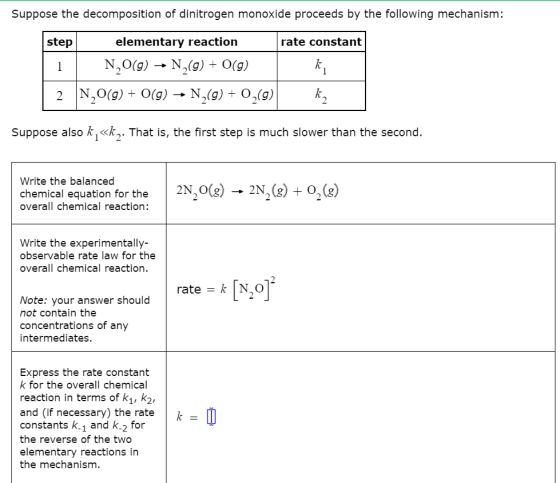
1A. The decomposition of dinitrogen monoxide (nitrous oxide) occurs in two steps. The mechanism that has...
1A. The decomposition of dinitrogen monoxide (nitrous oxide) occurs in two steps. The mechanism that has been proposed is as follows: Step 1: N2O (g) à N2(g) + O(g) Step 2: N2O (g) + O(g) à N2(g) + O2(g) Write the chemical equation for the overall reaction and identify any reaction intermediates (spectators). What is the molecularity of each of the elementary (steps) reactions?
The nitrogen-monoxide-catalyzed decomposition of dinitrogen monoxide is thought to proceed by a two-step mechanism: NO(g) +...
The nitrogen-monoxide-catalyzed decomposition of dinitrogen monoxide is thought to proceed by a two-step mechanism: NO(g) + N2O(g) --> N2(g) + NO2(g) (slow) 2 NO2(g) --> 2 NO(g) + O2(g) (a) If the first step of this mechanism is rate-determining (slow), choose the correct rate law for the overall process. Rate = k [N2O]2 Rate = k [NO] [NO2] Rate = k [N2O]2 [N2O] Rate = k [NO2] [N2O] Rate = k [N2O] [N2O] Rate = k [NO] [N2O] (b) Choose...
The following mechanism has been proposed for the gas-phase reaction of H2 with ICl: H2(g)+ICl(g)→HI(g)+HCl(g)HI(g)+ICl(g)→I2(g)+HCl(g) c)...
The following mechanism has been proposed for the gas-phase reaction of H2 with ICl: H2(g)+ICl(g)→HI(g)+HCl(g)HI(g)+ICl(g)→I2(g)+HCl(g) c) Write rate laws for each elementary reaction in the mechanism?Use a for [H2], b for [ICl] and k1 for the rate constant. d) Use c for [HI], d for [ICl] and k2 for the rate constant? e) If the first step is slow and the second one is fast, what rate law do you expect to be observed for the overall reaction? Use a...
a. Calculate Ea if k1 = 4.62 x 10 -7 1/Ms at 315 oC and k2...
a. Calculate Ea if k1 = 4.62 x 10 -7 1/Ms at 315 oC and k2 is 2.31 x 10 -4 1/Ms at 678 oC. b. Based on your answer to a, what’s k at 400 oC? 16. The following 2 step mechanism has been proposed. Step 1 : A (g) + B (g) -> X (g) + Y (g) k1 = fast Step 2: X (g) + C (g) -> Y (g) + Z (g) k2 = slow a....
Can somebody help me please with these 4 questions. They are related and I cannot post...
 Can somebody help me please with these 4 questions. They are
related and I cannot post them separately. I posted them before but
nobody helped. I REALLY NEED NUMBER 3 AND 4
Ozone Formation: NO2(g), is formed by chemical reactions involving N2(g) and O2(g) at the high temperatures Inside internal combustion engines in our cars. In the presence of sunlight, NO2(g) reacts with O2(g) to generate Os(s) as described by the following overall reaction: NO2(g) + O2(g) = NO(g) +...
Can somebody help me please with these 4 questions. They are
related and I cannot post them separately. I posted them before but
nobody helped. I REALLY NEED NUMBER 3 AND 4
Ozone Formation: NO2(g), is formed by chemical reactions involving N2(g) and O2(g) at the high temperatures Inside internal combustion engines in our cars. In the presence of sunlight, NO2(g) reacts with O2(g) to generate Os(s) as described by the following overall reaction: NO2(g) + O2(g) = NO(g) +...
 Suppose the reaction between nitric oxide and oxygen proceeds by the following mechanism: rate constant elementary reaction step NO(g)+ 02(g) NO2(9) 0(g) 1 NO(g) O(g) NO2(9) k2 2 Suppose also k,»k,. That is, the first step is much faster than the second. 2* Write the balanced chemical equation for the overall chemical reaction: Write the experimentally observable rate law for the overall chemical reaction rate k Note: your answer should not contain the concentrations of any intermediates. Express the rate...
 — O KINETICS AND EQUILIBRIUM Writing the rate law implied by a simple mechanism Suppose the formation of nitrosyl chloride proceeds by the following mechanism: step elementary reaction rate constant 1 NO(g) + Cl2(9) ► NOCI (9) km 2 NOCI (9) + NO(g) → 2 NOCI (9) kz Suppose also k«k. That is, the first slower than the second 0-0 Write the balanced chemical equation for the overall chemical reaction: Write the experimentally- observable rate law for the overall chemical...
 step Suppose the reaction between nitric oxide and oxygen proceeds by the following mechanism: elementary reaction rate constant NO(g) +0,() ► NO,()+(2) ky 2 NO(g) +0 (2) NOG) kz Suppose also , ekz. That is, the first step is much slower than the second. Write the balanced chemical equation for the overall chemical reaction. Write the experimentally observable rate law for the overall chemical reaction. Note: your answer should not contain the concentrations of any intermediates x 5 ?
 Suppose the synthesis of ethylene dichloride proceeds by the following mechanism: step rate constant elementary reaction CH,CH, (g)+ci, (g) → CH,CH,ci* (g)+ciº (9) CH,CH,CI* (g)+C1 (g) → CH,CH,C1, (g) Suppose also kq «k2. That is, the first step is much slower than the second. Write the balanced chemical equation for the overall chemical reaction. Write the experimentally- observable rate law for the overall chemical reaction. Note: your answer should not contain the concentrations of any intermediates. rate = % 0
 Can somebody help me please with these 4 questions. They are
related and I cannot post them separately. I posted them before but
nobody helped. I REALLY NEED NUMBER 3 AND 4
Ozone Formation: NO2(g), is formed by chemical reactions involving N2(g) and O2(g) at the high temperatures Inside internal combustion engines in our cars. In the presence of sunlight, NO2(g) reacts with O2(g) to generate Os(s) as described by the following overall reaction: NO2(g) + O2(g) = NO(g) +...
Can somebody help me please with these 4 questions. They are
related and I cannot post them separately. I posted them before but
nobody helped. I REALLY NEED NUMBER 3 AND 4
Ozone Formation: NO2(g), is formed by chemical reactions involving N2(g) and O2(g) at the high temperatures Inside internal combustion engines in our cars. In the presence of sunlight, NO2(g) reacts with O2(g) to generate Os(s) as described by the following overall reaction: NO2(g) + O2(g) = NO(g) +...
Most questions answered within 3 hours.
-
Where is the error in this code sequence?
String s1 = "Hello";
String s2 = "ello";...
asked 11 months ago -
Financial data for Joel de Paris, Inc., for last year
follow:
Joel de Paris, Inc.
Balance...
asked 11 months ago -
Consider this reaction:
Al2(SO4)3 (aq)+ BaCl3
(aq) Al2Cl6 (aq)- +
3BaSO4(s) . What is the...
asked 11 months ago -
Suppose that Savneet is considering increasing her
recent random sample from 20 car rentals to 40...
asked 11 months ago -
Trucks arrive at an unloading terminal at an average rate of 120
per hour.
Trucks arrive...
asked 11 months ago -
Why are methanol and ethanol completely soluble in water while
octanol is not very little soluble....
asked 11 months ago -
A facilities manager at a university reads in a research report
that the mean amount of...
asked 11 months ago -
When the CuSO4 is rehydrated by adding water to the anhydrous
compound, is this an endothermic...
asked 11 months ago -
A ray of sunlight is passing from diamond into crown glass; the
angle of incidence is...
asked 11 months ago -
A block of mass 0.249 kg is placed on top of a light, vertical
spring of...
asked 11 months ago -
how do the kidneys compensate in the presences of acidosis
a) trigger hyperventilate
b) reserve acid...
asked 11 months ago -
Question 501 pts
The rental rate of capital to the firm increases. Which of the
following...
asked 11 months ago