
Homework Answers
To fundamentally understand the operational mechanism of the monetary policy by Fed, it would be helpful to focus on the money equation which states that M*V=P*Y or M*V/Y=P where M,V, P, and Y represent the money supply, velocity of money, the overall price level of goods and services, and the aggregate output or nominal GDP in the economy. Now, based on the money equation, note that if the Fed changes the money supply M the money velocity V and/or the aggregate output level Y have to adjust accordingly to keep the price level of goods and services at its initial or original position. For example, considering a recessionary phase in the economy, if Fed intends to increase M or money supply then the money supply curve in the money or loanable funds market would shift to the right thereby causing a decrease in the interest rate and inducing aggregate investment expenditure by firms or companies and aggregate consumption expenditure on goods and services by individuals and households, holding everything else constant and especially the money demand in the market. Now, based on the money equation, if there is no change in V and/or Y, an increase in M would lead to a consequent increase in P or implying an inflationary effect or impact in the economy. Hence, in this case, the Fed has to ensure that either V has to decrease proportionately or Y has to increase in the equivalent proportion to keep P constant at its erstwhile level. If there is any change in either V or Y following the expansion in M, then again one of them(V or Y) has to adjust accordingly to compensate for the change in the other to keep the P unchanged or stable.
Similarly, during economic expansion or growth, if Fed intends to undertake or implement a contractionary monetary policy by reducing the money supply or M in the economy, it would eventually cause a leftward shift of the money supply curve thereby increase the interest rate in the money or loanable funds market. This would essentially reduce or decrease the aggregate investment expenditure by firms or companies and aggregate consumption expenditure by individuals and households on goods and services as well. Now, in this case, in order to keep the P stable or constant, the Fed somehow has to ascertain that the money velocity V increases proportionately or nominal GDP Y decreases commensurately to avoid any downward pressure on the price level of goods and services in the economy or P thereby causing a deflationary effect or impact in the economy. In this regard, if there is any individual change in V or Y following any change in M by the Fed, then either one(V or Y) would have to adjust to adjust or compensate for the change in the other to ensure the constancy of P. Therefore, a separate and /or simultaneous adjustments in both V and Y are required to support any monetary policy by Fed with the inherent motive to keep the price level of goods and services or P constant in the economy.
Hence, based on the possible impact of the Fed's monetary policy on P with reference to the money equation, the Fed has to be carefully observant about the prevailing V and Y in the economy as well as the monetary policy is the main policy tool that it can use to establish long-term equilibrium in the market or loanable funds market. Therefore, for example, if the V is excessively high, then holding Y constant, the Fed can proportionately reduce the M or if Y is too high, then again keeping V constant, the Fed can increase M and vise versa to achieve the desired P in the economy. However, it is also important to note that such adjustments or changes in the monetary policy by the Fed to stabilize the P has to be in conjunction with the long-run money market equilibrium, in this particular instance.
Add Answer to:
Question 16 5 pts Assuming that the Fed wants to keep the price level constant, what...
Question 43 072 pts Consider the Equation of Exchange in its form that shows changes in...
 Question 43 072 pts Consider the Equation of Exchange in its form that shows changes in the variables over time. If we assume velocity is constant over the long term and the long-term average rate of growth in the real economy that is sustainable is around 3%, what is the implication for the relationship between the long run average growth in the money supply and changes in the average price level in the economy? the money subo per year the...
4. Suppose the central bank wants to keep the real interest rate constant at some level,...
 4. Suppose the central bank wants to keep the real interest rate constant at some level, ř. Describe whether it needs to increase, decrease, or not change the money supply to do this in response to each of the following developments. Except in part (d), assume that P is permanently fixed at some exogenous level, P. a. The demand for money at a given P, i, and Y increases. b. There is an upward shift of the consumption function. c....
Suppose that money supply is $4 trillion, nominal GDP is $20 trillion, and real GDP is...
Suppose that money supply is $4 trillion, nominal GDP is $20 trillion, and real GDP is $16 trillion. a. What is the price level? What is the velocity of money? Suppose that velocity is constant and the economy’s output of goods and services rises by 3 percent each year. b. What will happen to nominal GDP and the price level next year if the Fed increases the money supply by 5 percent? c. What money supply should the Fed set...
QUESTION 10 0.36 points Save Answer LRAS Aggregate price level P, AD, Real GDP In response to the high unemployment rate and low level of real GDP at point El in the diagram above, the Federal Op...
 QUESTION 10 0.36 points Save Answer LRAS Aggregate price level P, AD, Real GDP In response to the high unemployment rate and low level of real GDP at point El in the diagram above, the Federal Open Market Committee (the decision-making body of the Federal Reserve) decides to engineer a decrease in interest rates. If no other disturbances occurred, and the Fed calibrated its policy perfectly so that full employment equilibrium was restored, what price level would prevail at the...
Question 10 1 pts Assume that velocity is stable during a particular year. If the Fed...
 Question 10 1 pts Assume that velocity is stable during a particular year. If the Fed increases the money supply by 2.5% and real GDP changes by 2.5%, the price level will change by: O approximately 21%. O approximately 4%. O approximately 10%. O approximately 2%. exactly 0%. Question 11 1 pts Suppose that the reserve requirement is 10%, and Jane Doe makes a deposit of $800,000 at her local bank. The maximum possible change in checkable deposits is and...
Fill in the Value of Money column in the following table. Price Level (P) Value of...
 Fill in the Value of Money column in the following table. Price Level (P) Value of Money 0.80 1.25 1.00 1.00 1.33 0.75 2.00 0.50 Quantity of Money Demanded (Billions of dollars) 2.0 2.5 4.0 8.0 Now consider the relationship between the price level and the quantity of money that people demand. The lower the price level, the money the typical transaction requires, and the money people will wish to hold in the form of currency or demand deposits. Assume...
Question 28 (5 points) Saved Suppose full employment real GDP is $2,000 billion and the money...
 Question 28 (5 points) Saved Suppose full employment real GDP is $2,000 billion and the money supply is $1,000 billion. Suppose also that the monetary velocity is constant and equal to 4. What is the price level? 2 Now suppose the Fed increases the money supply by 6% and potential real GDP rises by 3%. In the long run, the inflation rate would be .00% Previous Page Next Page Page 28 of 31 Submit Quiz 29 of 31 questions saved
Thank you in advance! Question 5 -- 12 In the long run, money demand and money...
 Thank you in advance!
Question 5 -- 12 In the long run, money demand and money supply determine (1) the value of money but not the real interest rate. (2) the value of money and the real interest rate. (3) neither the value of money nor the real interest rate. (4) the real interest rate but not the value of money. Question 6 (-/2 ) When the money market is drawn with the value of money on the vertical axis,...
Thank you in advance!
Question 5 -- 12 In the long run, money demand and money supply determine (1) the value of money but not the real interest rate. (2) the value of money and the real interest rate. (3) neither the value of money nor the real interest rate. (4) the real interest rate but not the value of money. Question 6 (-/2 ) When the money market is drawn with the value of money on the vertical axis,...
Question 20 (6 points) Suppose full employment real GDP is $1,000 billion and the money supply...
 Question 20 (6 points) Suppose full employment real GDP is $1,000 billion and the money supply is $800 billion. Suppose also that the monetary velocity is constant and equal to 5. What is the price level? _.00 Now suppose the Fed increases the money supply by 4% and potential real GDP rises by 3%. In the long run, the inflation rate would be _.00% A/
This Question: 3 pts 26 of 30 (25 complete) Assuming the economy is initially at full...
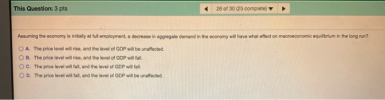 This Question: 3 pts 26 of 30 (25 complete) Assuming the economy is initially at full employment, a decrease in aggregate demand in the economy will have what effect on macroeconomic equilibrium in the long run? OA. The price level will rise, and the level of GDP will be unaffected. OB. The price level will rise, and the level of GDP will fall OC. The price level will fall, and the level of GDP will fall, OD. The price level...
 Question 43 072 pts Consider the Equation of Exchange in its form that shows changes in the variables over time. If we assume velocity is constant over the long term and the long-term average rate of growth in the real economy that is sustainable is around 3%, what is the implication for the relationship between the long run average growth in the money supply and changes in the average price level in the economy? the money subo per year the...
 4. Suppose the central bank wants to keep the real interest rate constant at some level, ř. Describe whether it needs to increase, decrease, or not change the money supply to do this in response to each of the following developments. Except in part (d), assume that P is permanently fixed at some exogenous level, P. a. The demand for money at a given P, i, and Y increases. b. There is an upward shift of the consumption function. c....
 QUESTION 10 0.36 points Save Answer LRAS Aggregate price level P, AD, Real GDP In response to the high unemployment rate and low level of real GDP at point El in the diagram above, the Federal Open Market Committee (the decision-making body of the Federal Reserve) decides to engineer a decrease in interest rates. If no other disturbances occurred, and the Fed calibrated its policy perfectly so that full employment equilibrium was restored, what price level would prevail at the...
 Question 10 1 pts Assume that velocity is stable during a particular year. If the Fed increases the money supply by 2.5% and real GDP changes by 2.5%, the price level will change by: O approximately 21%. O approximately 4%. O approximately 10%. O approximately 2%. exactly 0%. Question 11 1 pts Suppose that the reserve requirement is 10%, and Jane Doe makes a deposit of $800,000 at her local bank. The maximum possible change in checkable deposits is and...
 Fill in the Value of Money column in the following table. Price Level (P) Value of Money 0.80 1.25 1.00 1.00 1.33 0.75 2.00 0.50 Quantity of Money Demanded (Billions of dollars) 2.0 2.5 4.0 8.0 Now consider the relationship between the price level and the quantity of money that people demand. The lower the price level, the money the typical transaction requires, and the money people will wish to hold in the form of currency or demand deposits. Assume...
 Question 28 (5 points) Saved Suppose full employment real GDP is $2,000 billion and the money supply is $1,000 billion. Suppose also that the monetary velocity is constant and equal to 4. What is the price level? 2 Now suppose the Fed increases the money supply by 6% and potential real GDP rises by 3%. In the long run, the inflation rate would be .00% Previous Page Next Page Page 28 of 31 Submit Quiz 29 of 31 questions saved
 Thank you in advance!
Question 5 -- 12 In the long run, money demand and money supply determine (1) the value of money but not the real interest rate. (2) the value of money and the real interest rate. (3) neither the value of money nor the real interest rate. (4) the real interest rate but not the value of money. Question 6 (-/2 ) When the money market is drawn with the value of money on the vertical axis,...
Thank you in advance!
Question 5 -- 12 In the long run, money demand and money supply determine (1) the value of money but not the real interest rate. (2) the value of money and the real interest rate. (3) neither the value of money nor the real interest rate. (4) the real interest rate but not the value of money. Question 6 (-/2 ) When the money market is drawn with the value of money on the vertical axis,...
 Question 20 (6 points) Suppose full employment real GDP is $1,000 billion and the money supply is $800 billion. Suppose also that the monetary velocity is constant and equal to 5. What is the price level? _.00 Now suppose the Fed increases the money supply by 4% and potential real GDP rises by 3%. In the long run, the inflation rate would be _.00% A/
 This Question: 3 pts 26 of 30 (25 complete) Assuming the economy is initially at full employment, a decrease in aggregate demand in the economy will have what effect on macroeconomic equilibrium in the long run? OA. The price level will rise, and the level of GDP will be unaffected. OB. The price level will rise, and the level of GDP will fall OC. The price level will fall, and the level of GDP will fall, OD. The price level...
Most questions answered within 3 hours.
-
Where is the error in this code sequence?
String s1 = "Hello";
String s2 = "ello";...
asked 10 months ago -
Financial data for Joel de Paris, Inc., for last year
follow:
Joel de Paris, Inc.
Balance...
asked 10 months ago -
Consider this reaction:
Al2(SO4)3 (aq)+ BaCl3
(aq) Al2Cl6 (aq)- +
3BaSO4(s) . What is the...
asked 10 months ago -
Suppose that Savneet is considering increasing her
recent random sample from 20 car rentals to 40...
asked 10 months ago -
Trucks arrive at an unloading terminal at an average rate of 120
per hour.
Trucks arrive...
asked 10 months ago -
Why are methanol and ethanol completely soluble in water while
octanol is not very little soluble....
asked 10 months ago -
A facilities manager at a university reads in a research report
that the mean amount of...
asked 10 months ago -
When the CuSO4 is rehydrated by adding water to the anhydrous
compound, is this an endothermic...
asked 10 months ago -
A ray of sunlight is passing from diamond into crown glass; the
angle of incidence is...
asked 10 months ago -
A block of mass 0.249 kg is placed on top of a light, vertical
spring of...
asked 10 months ago -
how do the kidneys compensate in the presences of acidosis
a) trigger hyperventilate
b) reserve acid...
asked 10 months ago -
Question 501 pts
The rental rate of capital to the firm increases. Which of the
following...
asked 10 months ago