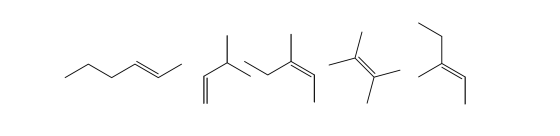
Draw a molecule that could eliminate to give each of the above molecules.
Draw a molecule that could eliminate to give each of the above molecules.
Homework Answers

Add Answer to:
Draw a molecule that could eliminate to give each of the above
molecules.
11. Select one molecule from "Molecules 5' and one molecule from "Molecules 6". Draw the molecules...
 11. Select one molecule from "Molecules 5' and one molecule from "Molecules 6". Draw the molecules and draw all possible combinations of hydrogen bonds between the two molecules you have chosen [Select your molecules such that one or more hydrogen bond(s) may form.) You will receive points for each correct hydrogen bond, up to the total number of possible hydrogen bonds. You will lose points for incorrect drawings [HINT: You may draw your molecule pairs multiple times, rotating them as...
Name the functional groups found in the above molecule. After each listing below, draw the first...
 Name the functional groups found in the above molecule.
After each listing below, draw the first few atoms of the
appropriate group attached to the molecules single chirality
center.
Top priority____
Second priority____
Third priority____
Lowest priority___
Absolute configuration___
NH2 о НО, ОН IZ
Name the functional groups found in the above molecule.
After each listing below, draw the first few atoms of the
appropriate group attached to the molecules single chirality
center.
Top priority____
Second priority____
Third priority____
Lowest priority___
Absolute configuration___
NH2 о НО, ОН IZ
1.(8) Draw the Lewis structures for the following molecules and for each molecule: 0) indicate the...
 1.(8) Draw the Lewis structures for the following molecules and for each molecule: 0) indicate the orbital rybridization on the central atom () predict the molecular shape and whether the molecule is polar or nonpolar (a) SiF4 (b) SF4 2.(8) The following energy diagrams show a slight variation for the relative energy of , and 13, molecular orbitals. (a) Use the appropriate diagram to build the electron configurations for Og and CO molecules: (label cach diagram correctly.) (b) For each...
Draw three-dimensional depictions of the following molecules. For each molecule provide theoretical bond angles, shape, and...
Draw three-dimensional depictions of the following molecules. For each molecule provide theoretical bond angles, shape, and electron group geometry (ie octahedral, tetrahedral, bent, etc.). For each molecule, provide all possible structural and geometric isomers. If the molecule/ion possesses resonance structures, draw all relevant structures? What is the point group of each structure? If the compound is chiral, draw its enantiomer. NiCl2(NH3)2 (tetrahedral) PCl2F3 NO3-
Draw Lewis structures for the following molecules. What is the dominant intermolecular force for each molecule...
 Draw Lewis structures for the following molecules. What is the dominant intermolecular force for each molecule with itself? a. CH CH NH b. CH.CH c. CH(OẠCH,CH,
Organic Chemistry 1. Draw each one of the following molecules and label it as: alkyl halide,...
 Organic Chemistry
1. Draw each one of the following molecules and label it as:
alkyl halide, allyl halide or vinyl halide
a) 2-chloro-3-ethylpentane
b) 6-ethyl-3-lodocyclohexene
2. Give all resonance structures of the allylic radical
intermediate that arise from reaction above. All allylic C-H on the
molecule are equivalent so only show the two resonance structures
arising from one C-H bond reacting.
3. Are the resonance structures above equivalent or
non-equivalent?
4. Give all the products expected from the reaction
above....
Organic Chemistry
1. Draw each one of the following molecules and label it as:
alkyl halide, allyl halide or vinyl halide
a) 2-chloro-3-ethylpentane
b) 6-ethyl-3-lodocyclohexene
2. Give all resonance structures of the allylic radical
intermediate that arise from reaction above. All allylic C-H on the
molecule are equivalent so only show the two resonance structures
arising from one C-H bond reacting.
3. Are the resonance structures above equivalent or
non-equivalent?
4. Give all the products expected from the reaction
above....
Two different molecules have the formula C2H2Cl2. Draw a Lewis structure for each molecule. (All the...
Two different molecules have the formula C2H2Cl2. Draw a Lewis structure for each molecule. (All the H and Cl atoms are bonded to carbon. The two carbon atoms are bonded to each other.)
For each the following molecules draw the best possible structure based on formal charges for each...
For each the following molecules draw the best possible structure based on formal charges for each molecule(including resonance structures). Does the structure violate the octet rule? If so, explain. (will give a thumb up thx) N2O (PO4)3- BrF3 ClOCCH2NH2 CH3CHCHCO2H
Write the molecule, functional group or class of molecules described by each clue. If the clue...
Write the molecule, functional group or class of molecules described by each clue. If the clue describes more than one (type of) molecule, give an example of a molecule or class of molecules described by the clue: (A) Molecule used to “read” mRNA in protein synthesis. This molecule also serves as the leaving group in peptide bond formation
2. 2) Draw three-dimensional depictions of the following molecules. For each molecule provide theoretical bond angles,...
2. 2) Draw three-dimensional depictions of the following molecules. For each molecule provide theoretical bond angles, shape, and electron group geometry (ie octahedral, tetrahedral, bent, etc.). For each molecule, provide all possible structural and geometric isomers. If the molecule/ion possesses resonance structures, draw all relevant structures? What is the point group of each structure? If the compound is chiral, draw its enantiomer. a. C(CN)BrFCl b. WBr3Cl3 c. PtCl2(NH3)2 (square planar) d. NiCl2(NH3)2 (tetrahedral) e. PCl2F3 f. NO3-
 11. Select one molecule from "Molecules 5' and one molecule from "Molecules 6". Draw the molecules and draw all possible combinations of hydrogen bonds between the two molecules you have chosen [Select your molecules such that one or more hydrogen bond(s) may form.) You will receive points for each correct hydrogen bond, up to the total number of possible hydrogen bonds. You will lose points for incorrect drawings [HINT: You may draw your molecule pairs multiple times, rotating them as...
 Name the functional groups found in the above molecule.
After each listing below, draw the first few atoms of the
appropriate group attached to the molecules single chirality
center.
Top priority____
Second priority____
Third priority____
Lowest priority___
Absolute configuration___
NH2 о НО, ОН IZ
Name the functional groups found in the above molecule.
After each listing below, draw the first few atoms of the
appropriate group attached to the molecules single chirality
center.
Top priority____
Second priority____
Third priority____
Lowest priority___
Absolute configuration___
NH2 о НО, ОН IZ
 1.(8) Draw the Lewis structures for the following molecules and for each molecule: 0) indicate the orbital rybridization on the central atom () predict the molecular shape and whether the molecule is polar or nonpolar (a) SiF4 (b) SF4 2.(8) The following energy diagrams show a slight variation for the relative energy of , and 13, molecular orbitals. (a) Use the appropriate diagram to build the electron configurations for Og and CO molecules: (label cach diagram correctly.) (b) For each...
 Draw Lewis structures for the following molecules. What is the dominant intermolecular force for each molecule with itself? a. CH CH NH b. CH.CH c. CH(OẠCH,CH,
 Organic Chemistry
1. Draw each one of the following molecules and label it as:
alkyl halide, allyl halide or vinyl halide
a) 2-chloro-3-ethylpentane
b) 6-ethyl-3-lodocyclohexene
2. Give all resonance structures of the allylic radical
intermediate that arise from reaction above. All allylic C-H on the
molecule are equivalent so only show the two resonance structures
arising from one C-H bond reacting.
3. Are the resonance structures above equivalent or
non-equivalent?
4. Give all the products expected from the reaction
above....
Organic Chemistry
1. Draw each one of the following molecules and label it as:
alkyl halide, allyl halide or vinyl halide
a) 2-chloro-3-ethylpentane
b) 6-ethyl-3-lodocyclohexene
2. Give all resonance structures of the allylic radical
intermediate that arise from reaction above. All allylic C-H on the
molecule are equivalent so only show the two resonance structures
arising from one C-H bond reacting.
3. Are the resonance structures above equivalent or
non-equivalent?
4. Give all the products expected from the reaction
above....
Most questions answered within 3 hours.
-
Where is the error in this code sequence?
String s1 = "Hello";
String s2 = "ello";...
asked 10 months ago -
Financial data for Joel de Paris, Inc., for last year
follow:
Joel de Paris, Inc.
Balance...
asked 10 months ago -
Consider this reaction:
Al2(SO4)3 (aq)+ BaCl3
(aq) Al2Cl6 (aq)- +
3BaSO4(s) . What is the...
asked 10 months ago -
Suppose that Savneet is considering increasing her
recent random sample from 20 car rentals to 40...
asked 10 months ago -
Trucks arrive at an unloading terminal at an average rate of 120
per hour.
Trucks arrive...
asked 10 months ago -
Why are methanol and ethanol completely soluble in water while
octanol is not very little soluble....
asked 10 months ago -
A facilities manager at a university reads in a research report
that the mean amount of...
asked 10 months ago -
When the CuSO4 is rehydrated by adding water to the anhydrous
compound, is this an endothermic...
asked 10 months ago -
A ray of sunlight is passing from diamond into crown glass; the
angle of incidence is...
asked 10 months ago -
A block of mass 0.249 kg is placed on top of a light, vertical
spring of...
asked 10 months ago -
how do the kidneys compensate in the presences of acidosis
a) trigger hyperventilate
b) reserve acid...
asked 10 months ago -
Question 501 pts
The rental rate of capital to the firm increases. Which of the
following...
asked 10 months ago