All the following salts are acidic except Fe(NO3)3 BaCr2O7 NH4Cl CuI2 A buffer can be made...
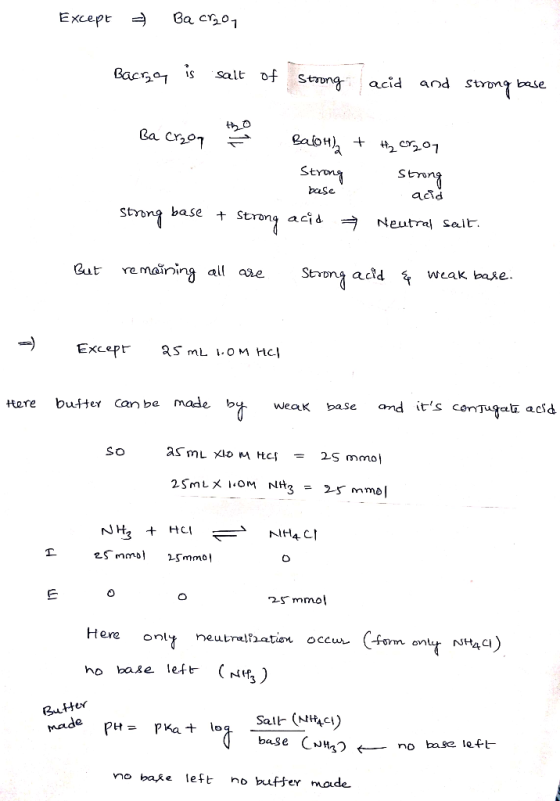
All the following salts are acidic except
| Fe(NO3)3 | |
| BaCr2O7 | |
| NH4Cl | |
|
CuI2 |
A buffer can be made by adding any of the following to 25 mL of 1.0 M NH3except
| 5 mL 1.0 M HCl | |
| 10 mL 2.0 M HCl | |
| 25 mL 1.0 M HCl | |
| 20 mL 2.0 M NH4Cl |
Homework Answers
Add Answer to:
All the following salts are acidic except
Fe(NO3)3
BaCr2O7
NH4Cl
CuI2
A buffer can be made...
How do I calculate the Initial Fe(NO3)3 for each tria. Please help and show all work...
How do I calculate the Initial Fe(NO3)3 for each tria. Please help and show all work Please!!!! 1 2 3 4 5 mL Fe(NO3)3 1.0 2.0 3.0 4.0 5.0 0.0003 M mL KSCN 1.0 M 5 5 5 5 5 mL HNO3 0.1 M 4 3 2 1 0 Total mL 10 10 10 10 10 Initial [Fe(NO3)3] 3.0x10^-5 Absorbance .284 1.085 1.325 1.820 2.121 Transmittance 52.01 8.22 4.73 1.51 0.76
Item 6 Determine whether each of the following salts will form a solution that is acidic,...
 Item 6 Determine whether each of the following salts will form a solution that is acidic, basic, or pHneutral. Drag the appropriate items to their respective bins. Reset Help Fe(NO3)3 RDI CH,NH4Cl CH,NH, CN LiF Acidic Basic pH-neutral
a) Calculate the pH of a buffer that is 0.20 M NH3 and 0.20 M NH4Cl...
a) Calculate the pH of a buffer that is 0.20 M NH3 and 0.20 M NH4Cl Correct? b) Calculate the pH after addition of 10 mL 0.10 M HCl to 65 mL of the buffer? c) Calculate the pH after addition of 5 mL of 1.0 M LiOH to 200 mL of the buffer?
Question 3 (1 point) A buffer solution is made by adding 15.0 mL of a 0.50...
Question 3 (1 point) A buffer solution is made by adding 15.0 mL of a 0.50 M Na2CO3 solution to 15.0 mL of a 0.50 M NaHCO3 solution in a test tube. 2.4 mL of a 1.0 M HCl solution is added to this buffer solution. What is the final pH of the solution in the test tube? H2CO3 has Ka1 = 4.3×10⁻⁷ and Ka2 = 5.6×10⁻¹¹. Question 4 (1 point) A buffer solution is made by adding 10.0 mL...
If the full equations/math could be provided it would help greatly. Thank you. All the following...
If the full equations/math could be provided it would help greatly. Thank you. All the following salts are alkaline except LiClO NH4NO3 SrCrO4 K2HPO4 The pH after adding 21.0 mL of 1.0 M NaOH to 25.0 mL of 1.0 M HCl is 0.087 0.16 0.80 1.1 What is the pH when 20.0 mL of 1.00 M NaOH has been added to 25.0 mL of 1.00 M CH3COOH (Ka=1.8x10⁻⁵)? 4.14 0.70 5.35 0.95 You can make a buffer with all the...
A buffer solution is made by adding 20.0 mL of a 0.50 M Na2CO3 solution to 10.0...
A buffer solution is made by adding 20.0 mL of a 0.50 M Na2CO3 solution to 10.0 mL of a 0.50 M NaHCO3 solution in a test tube. The pH of this buffer was found to be 10.20. After 2.0 mL of 1.0 M HCl solution is added to this buffer solution, the pH is measured to be 9.95. What is the buffering capacity with respect to a strong acid, βa, of this buffer solution, in units of mol/L per pH unit?...
a. A 10 ml calibration solution is made by mixing 5 mL of 0.200 M Fe(NO3)3,...
 a. A 10 ml calibration solution is made by mixing 5 mL of 0.200 M Fe(NO3)3, 1.50 mL of 2.00X10⁻³ M KNCS, 1 mL of 0.100 M nitric acid and 2.50 mL H20. What is the final concentration of only the NCS-ion? b. If 1.00 ml of this solution is then diluted to a final volume of 25.00 ml with DI water. What is the new concentration of NCS?
Which of the chemical equations below are acid-base (proton transfer) reactions? Select all that apply. Fe(NO3)3...
Which of the chemical equations below are acid-base (proton transfer) reactions? Select all that apply. Fe(NO3)3 (aq) + 3 KOH (aq) → Fe(OH)3 (s) + 3 KNO3 (aq) NH3 (aq) + HCl (aq) → NH4Cl (aq) HCl (aq) + KOH (aq) → KCl (aq) + H2O (l) Mg(OH)2 (s) + H2SO4 (aq) → MgSO4 (s) + 2 H2O (l) Mg (s) + Cu(NO3)2 (aq) --> Mg(NO3)3 (aq) + Cu (s) Zn (s) + Cu(NO3)2 (aq) → Zn(NO3)2 (aq) + Cu...
1. Calculate the equilibrium concentrations of all species present and the pH of a solution obtained...
1. Calculate the equilibrium concentrations of all species present and the pH of a solution obtained by adding 0.100 moles of solid NaOH to 1.00 L of 15.0 M NH3. Kb = 1.8 × 10⁻⁵ 2. One mole of a weak acid HA was dissolved in 2.0 L of water. After the system had come to equilibrium, the concentration of HA was found to be 0.45 M. Calculate the Ka for this weak acid. 3. Calculate the pH of a...
Calculate the pH of a buffer solution made with 0.75 M HC2H3O2 and 0.25 M NaC2H3O2...
Calculate the pH of a buffer solution made with 0.75 M HC2H3O2 and 0.25 M NaC2H3O2 at 25 degrees Celsius. (Ka = 1.8 x 10⁻⁵) Which direction will the reaction move in when 1.0 mL of HCl is added to the above buffer solution?
 Item 6 Determine whether each of the following salts will form a solution that is acidic, basic, or pHneutral. Drag the appropriate items to their respective bins. Reset Help Fe(NO3)3 RDI CH,NH4Cl CH,NH, CN LiF Acidic Basic pH-neutral
 a. A 10 ml calibration solution is made by mixing 5 mL of 0.200 M Fe(NO3)3, 1.50 mL of 2.00X10⁻³ M KNCS, 1 mL of 0.100 M nitric acid and 2.50 mL H20. What is the final concentration of only the NCS-ion? b. If 1.00 ml of this solution is then diluted to a final volume of 25.00 ml with DI water. What is the new concentration of NCS?
Most questions answered within 3 hours.
-
Where is the error in this code sequence?
String s1 = "Hello";
String s2 = "ello";...
asked 11 months ago -
Financial data for Joel de Paris, Inc., for last year
follow:
Joel de Paris, Inc.
Balance...
asked 11 months ago -
Consider this reaction:
Al2(SO4)3 (aq)+ BaCl3
(aq) Al2Cl6 (aq)- +
3BaSO4(s) . What is the...
asked 11 months ago -
Suppose that Savneet is considering increasing her
recent random sample from 20 car rentals to 40...
asked 11 months ago -
Trucks arrive at an unloading terminal at an average rate of 120
per hour.
Trucks arrive...
asked 11 months ago -
Why are methanol and ethanol completely soluble in water while
octanol is not very little soluble....
asked 11 months ago -
A facilities manager at a university reads in a research report
that the mean amount of...
asked 11 months ago -
When the CuSO4 is rehydrated by adding water to the anhydrous
compound, is this an endothermic...
asked 11 months ago -
A ray of sunlight is passing from diamond into crown glass; the
angle of incidence is...
asked 11 months ago -
A block of mass 0.249 kg is placed on top of a light, vertical
spring of...
asked 11 months ago -
how do the kidneys compensate in the presences of acidosis
a) trigger hyperventilate
b) reserve acid...
asked 11 months ago -
Question 501 pts
The rental rate of capital to the firm increases. Which of the
following...
asked 11 months ago