Bosch modified the Haber process to make fertilizers and he produced the hydrogen by the water-gas...
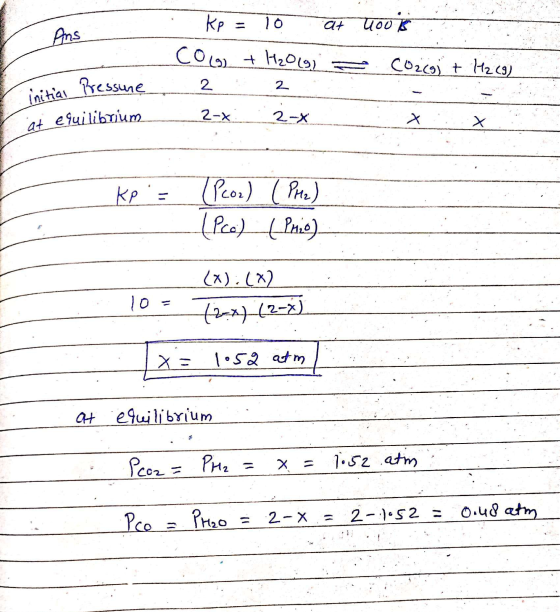
Bosch modified the Haber process to make fertilizers and he produced the hydrogen by the water-gas shift reaction: CO(g) + H2O(g) <===> CO2(g) + H2(g) At 400. C we start with the reaction vessel with 2.00 atm each of carbon monoxide and water vapor. Note that you can use atm rather than Molarity in the equilibrium calculation. Calculate the equilibrium values of all gases in atm being given that Kp = 10.0 at 400C
Homework Answers
Add Answer to:
Bosch modified the Haber process to make fertilizers and he
produced the hydrogen by the water-gas...
The Haber-Bosch process is a very important industrial process. In the Haber-Bosch process, hydrogen gas reacts...
The Haber-Bosch process is a very important industrial process. In the Haber-Bosch process, hydrogen gas reacts with nitrogen gas to produce ammonia according to the equation 3H2(g)+N2(g)→2NH3(g)3H2(g)+N2(g)→2NH3(g) The ammonia produced in the Haber-Bosch process has a wide range of uses, from fertilizer to pharmaceuticals. However, the production of ammonia is difficult, resulting in lower yields than those predicted from the chemical equation. 1.36 g H2 is allowed to react with 9.75 g N2, producing 1.75 g NH3 What is the...
The Haber-Bosch process is a very important industrial process. In the Haber-Bosch process, hydrogen gas reacts...
The Haber-Bosch process is a very important industrial process. In the Haber-Bosch process, hydrogen gas reacts with nitrogen gas to produce ammonia according to the equation 3H2(g)+N2(g)→2NH3(g) The ammonia produced in the Haber-Bosch process has a wide range of uses, from fertilizer to pharmaceuticals. However, the production of ammonia is difficult, resulting in lower yields than those predicted from the chemical equation. 1.43 g H2 is allowed to react with 9.70 g N2, producing 2.31 g NH3. Part A: What...
The Haber-Bosch process is a very important industrial process. In the Haber-Bosch process, hydrogen gas reacts...
The Haber-Bosch process is a very important industrial process. In the Haber-Bosch process, hydrogen gas reacts with nitrogen gas to produce ammonia according to the equation 3H2(g)+N2(g)→2NH3(g) The ammonia produced in the Haber-Bosch process has a wide range of uses, from fertilizer to pharmaceuticals. However, the production of ammonia is difficult, resulting in lower yields than those predicted from the chemical equation. 1.26 g H2 is allowed to react with 9.75 g N2, producing 1.63 g NH3. Part A) What...
The Haber-Bosch process is a very important industrial process. In the Haber-Bosch process, hydrogen gas reacts...
The Haber-Bosch process is a very important industrial process. In the Haber-Bosch process, hydrogen gas reacts with nitrogen gas to produce ammonia according to the equation 3H2(g)+N2(g)→2NH3(g) The ammonia produced in the Haber-Bosch process has a wide range of uses, from fertilizer to pharmaceuticals. However, the production of ammonia is difficult, resulting in lower yields than those predicted from the chemical equation. 1.10 g H2 is allowed to react with 9.72 g N2, producing 1.68 g NH3. Part A What...
The Haber-Bosch process is a very important industrial process. In the Haber-Bosch process, hydrogen gas reacts...
The Haber-Bosch process is a very important industrial process. In the Haber-Bosch process, hydrogen gas reacts with nitrogen gas to produce ammonia according to the equation 3H2(g)+N2(g)→2NH3(g) The ammonia produced in the Haber-Bosch process has a wide range of uses, from fertilizer to pharmaceuticals. However, the production of ammonia is difficult, resulting in lower yields than those predicted from the chemical equation. 1.94 g H2 is allowed to react with 10.1 g N2, producing 1.59 g NH3. Part A What...
10) The Haber-Bosch Process for nitrogen fixation is needed to make fertilizers such as ammonia (NH3):...
10) The Haber-Bosch Process for nitrogen fixation is needed to make fertilizers such as ammonia (NH3): N2 (g) + 3 H2 (g) → 2 NH3 (g) The above reaction produces about 1.75 × 10¹⁴ g of ammonia each year, and is responsible for ~1–2% of the world’s energy consumption! This reaction is not very efficient however. Typically it only results in about 87% yield. How many grams of ammonia are NOT formed every year due to the inefficiency of this...
In the Haber–Bosch process, ammonia is synthesized from hydrogen and nitrogen gas. The equilibrium concentrations of...
In the Haber–Bosch process, ammonia is synthesized from hydrogen and nitrogen gas. The equilibrium concentrations of NH3, H2, and N2 are 0.0040 M, 0.20 M, and 0.080 M, respectively. Determine the directional shift of the reaction for each of the following situations: i. All three concentrations are 0.20 M ii. All three concentrations are 2.0 M
1. The cartoon below represents the reaction of nitrogen gas (N2) with hydrogen gas (H2) to synthesize ammonia (NHs). Industrially, this che pro mical process is called the Haber-Bosch cess...
 1. The cartoon below represents the reaction of nitrogen gas (N2) with hydrogen gas (H2) to synthesize ammonia (NHs). Industrially, this che pro mical process is called the Haber-Bosch cess, and is still a very important reaction in the manufacture of fertilizers. The ability to fix every day). It has been estimated that use of nitrogen-based fertilizers has doubled the world's a. The cartoon below shows 6 molecules of hydrogen gas and 2 molecules of nitrogen nitrogen and manufacture fertilizers...
The Haber-Bosch process is used to make ammonia from nitrogen and hydrogen: N2(g) + 3 H2(g)...
The Haber-Bosch process is used to make ammonia from nitrogen and hydrogen: N2(g) + 3 H2(g) 2 NH3(g). A 10.0 L reactor at 450 °C is filled with 3 moles of nitrogen and 12 moles of hydrogen, K is 0.16 under these conditions.
The Haber-Bosch process is a very important industrial process. In the Haber Process, hydrogen gas reacts...
The Haber-Bosch process is a very important industrial process. In the Haber Process, hydrogen gas reacts with nitrogen gas to produce ammonia according to the equation 3H2(g) + N2(g) ---> 2NH3(g) The ammonia produced in the Haber process has a wide range of uses from fertilizer to pharmaceuticals. However, the production of ammonia is difficult, resulting in lower yields than those predicted from the chemical equation. 1.57 g H2 is allowed to react with 9.87 g N2, producing 1.69 g Nh3....
 1. The cartoon below represents the reaction of nitrogen gas (N2) with hydrogen gas (H2) to synthesize ammonia (NHs). Industrially, this che pro mical process is called the Haber-Bosch cess, and is still a very important reaction in the manufacture of fertilizers. The ability to fix every day). It has been estimated that use of nitrogen-based fertilizers has doubled the world's a. The cartoon below shows 6 molecules of hydrogen gas and 2 molecules of nitrogen nitrogen and manufacture fertilizers...
Most questions answered within 3 hours.
-
Where is the error in this code sequence?
String s1 = "Hello";
String s2 = "ello";...
asked 10 months ago -
Financial data for Joel de Paris, Inc., for last year
follow:
Joel de Paris, Inc.
Balance...
asked 10 months ago -
Consider this reaction:
Al2(SO4)3 (aq)+ BaCl3
(aq) Al2Cl6 (aq)- +
3BaSO4(s) . What is the...
asked 10 months ago -
Suppose that Savneet is considering increasing her
recent random sample from 20 car rentals to 40...
asked 10 months ago -
Trucks arrive at an unloading terminal at an average rate of 120
per hour.
Trucks arrive...
asked 10 months ago -
Why are methanol and ethanol completely soluble in water while
octanol is not very little soluble....
asked 10 months ago -
A facilities manager at a university reads in a research report
that the mean amount of...
asked 10 months ago -
When the CuSO4 is rehydrated by adding water to the anhydrous
compound, is this an endothermic...
asked 10 months ago -
A ray of sunlight is passing from diamond into crown glass; the
angle of incidence is...
asked 10 months ago -
A block of mass 0.249 kg is placed on top of a light, vertical
spring of...
asked 10 months ago -
how do the kidneys compensate in the presences of acidosis
a) trigger hyperventilate
b) reserve acid...
asked 10 months ago -
Question 501 pts
The rental rate of capital to the firm increases. Which of the
following...
asked 10 months ago