Applications of Differentiation
Consider the function f(x)= cos(x) - (1/2)x. This function has two critical numbers A<B in [0,2pi]. Give the following:
A=
B=
f''(A)=
f''(B)=
Homework Answers
f(x)=cosx +(√2 /2)x
f '(x)=-sinx+(√2 /2)
for critical numbers f '(x)=0
-sinx+(√2 /2)=0
sinx=(√2 /2)
x=pi/4 ,3pi/4
A=pi/4
B=3pi/4
f "(x)=-cosx
f "(pi/4)=-cos(pi/4)= -(√2 /2) <0
f "(3pi/4)=-cos(3pi/4)= (√2 /2) >0
f(x) has a localmaximum at A and a local minimum at B
Applications of Differentiation
Consider the function f(x)= 2sin(x) + [(sqrt3)/2] x2 This function has two inflection numbers A<B in [0,2pi]:A= and B= For each of the following intervals, tell whether f(x) is concave up (type in CU) or concave down (type in CD).[0,A)=(A,B)=(B,2pi]=
(1 point) Consider the function f(x) = x2/5(x – 9). This function has two critical numbers...
 (1 point) Consider the function f(x) = x2/5(x – 9). This function has two critical numbers A< B Then A = and B For each of the following intervals, tell whether f(x) is increasing or decreasing. (-0, A]: ? [A, B]: ? [B, 0) ? The critical number A is ? and the critical number B is ? There are two numbers C < D where either F"(x) = 0 or f'(x) is undefined. Then C= and D= Finally for...
(1 point) Consider the function f(x) = -22% + 36x? - 162x + 10. This function...
 (1 point) Consider the function f(x) = -22% + 36x? - 162x + 10. This function has two critical numbers A <B: А 3 and B 9 f"(A) 36 f"(B) = -36 Thus f(x) has a local -206 and a local 10 at A (type in MAX or MIN) at B (type in MAX or MIN).
2. for the function f(x)= x+2 cos x on the interval [0,2pi] a. find the first...
 2. for the function f(x)= x+2 cos x on the interval
[0,2pi] a. find the first derivative
b.) find the second derivative
c.) find the functions critical values(if any). include their y-
coordinates in your answers in order to form critical points.
d. )find the intervals on which f is increasing or
decreasing.
e. )find the local extrema of f.
f. )find the functions hyper critical values(if any). include their
y coordinates
g.) find the intervals of concavity, i.e. the...
2. for the function f(x)= x+2 cos x on the interval
[0,2pi] a. find the first derivative
b.) find the second derivative
c.) find the functions critical values(if any). include their y-
coordinates in your answers in order to form critical points.
d. )find the intervals on which f is increasing or
decreasing.
e. )find the local extrema of f.
f. )find the functions hyper critical values(if any). include their
y coordinates
g.) find the intervals of concavity, i.e. the...
Each blank is a part of one question so fill in all blanks please. (1 point)...
 Each blank is a part of one
question so fill in all blanks please.
(1 point) Book Problem 27 Consider the function f(x) = 12x5 + 15x4 - 240x3 + 6. This function has 3 critical numbers A <B<C: B = and C= A= At these critical numbers, tell whether f(x) has a local min (type in LMIN), a local max (LMAX), or neither (NEIT at B and at C At A f(x) has inflection points at (reading from left...
Each blank is a part of one
question so fill in all blanks please.
(1 point) Book Problem 27 Consider the function f(x) = 12x5 + 15x4 - 240x3 + 6. This function has 3 critical numbers A <B<C: B = and C= A= At these critical numbers, tell whether f(x) has a local min (type in LMIN), a local max (LMAX), or neither (NEIT at B and at C At A f(x) has inflection points at (reading from left...
A rocket travels vertically at a speed of 1300 km/hr. The rocket is tracked through a...
 A rocket travels vertically at a speed of 1300 km/hr. The rocket is tracked through a telescope by an observer located 14 km from the launching pad. Find the rate at which the angle between the telescope and the ground is increasing 3 min after the lift-off. (Give your answer to two decimal places.) rad/hr Find the linearization at x = a. f(x) = 5, a=5 (Express numbers in exact form. Use symbolic notation and fractions where needed.) L(x) =...
Why is 0 one of the critical points? Part 1: Identify Critical Numbers Consider the function f(x) = x - 3x5 Σ The domain...
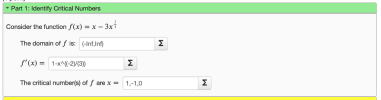 Why is 0 one of the critical points?
Part 1: Identify Critical Numbers Consider the function f(x) = x - 3x5 Σ The domain of f is: (-Inf,Inf) f'(x) =1-x^(-2)/(3) The critical number(s) of f are x = Σ 1,-1,0 -3 IT N/M
Part 1: Identify Critical Numbers Consider the function f(x) = x - 3x5 Σ The domain of f is: (-Inf,Inf) f'(x) =1-x^(-2)/(3) The critical number(s) of f are x = Σ 1,-1,0
-3 IT N/M
Why is 0 one of the critical points?
Part 1: Identify Critical Numbers Consider the function f(x) = x - 3x5 Σ The domain of f is: (-Inf,Inf) f'(x) =1-x^(-2)/(3) The critical number(s) of f are x = Σ 1,-1,0 -3 IT N/M
Part 1: Identify Critical Numbers Consider the function f(x) = x - 3x5 Σ The domain of f is: (-Inf,Inf) f'(x) =1-x^(-2)/(3) The critical number(s) of f are x = Σ 1,-1,0
-3 IT N/M
Finding Absolute Maximums and Absolute Minimums. We are guided here by two theorems about extreme...
 Finding Absolute Maximums and Absolute Minimums. We are guided here by two theorems about extreme values of functions Theorem 1: Iff(x) is continuous on a closed interval [a, b], then f(x) has both an absolute minimum value, m, and an absolute maximum value, M. This means there are some numbers c and d with m = f(c) and M = f(d) and m s f(x) s M for each x in [a, b]. The theorem does not tell us where...
Consider the following function. f(x) = cos(x) - sin(x), (0, 2) (a) Find the critical numbers...
 Consider the following function. f(x) = cos(x) - sin(x), (0, 2) (a) Find the critical numbers of f, if any. (Enter your answers as a comma-separated list.) (b) Find the open intervals on which the function is increasing or decreasing (Enter your answers using interval notation. If an answer does not exist, enter DNE.) increasing х decreasing X (c) Apply the First Derivative Test to identify all relative extrema. (If an answer does not exist, enter DNE.) relative minimum (X,Y)...
Question For this problem, consider the function y=f(x)= |x| + x 3 on the domain of...
 Question For this problem, consider the function
y=f(x)=
|x|
+
x
3
on the domain of all real numbers.
(a) The value of
limx→
∞f(x)
is
. (If you need to use -∞ or ∞, enter -infinity or
infinity.)
(b) The value of
limx→
−∞f(x)
is
. (If you need to use -∞ or ∞, enter -infinity or
infinity.)
(c) There are two x-intercepts; list these in increasing
order: s=
, t=
.
(d) The intercepts in part (c) divide...
Question For this problem, consider the function
y=f(x)=
|x|
+
x
3
on the domain of all real numbers.
(a) The value of
limx→
∞f(x)
is
. (If you need to use -∞ or ∞, enter -infinity or
infinity.)
(b) The value of
limx→
−∞f(x)
is
. (If you need to use -∞ or ∞, enter -infinity or
infinity.)
(c) There are two x-intercepts; list these in increasing
order: s=
, t=
.
(d) The intercepts in part (c) divide...
 (1 point) Consider the function f(x) = x2/5(x – 9). This function has two critical numbers A< B Then A = and B For each of the following intervals, tell whether f(x) is increasing or decreasing. (-0, A]: ? [A, B]: ? [B, 0) ? The critical number A is ? and the critical number B is ? There are two numbers C < D where either F"(x) = 0 or f'(x) is undefined. Then C= and D= Finally for...
 (1 point) Consider the function f(x) = -22% + 36x? - 162x + 10. This function has two critical numbers A <B: А 3 and B 9 f"(A) 36 f"(B) = -36 Thus f(x) has a local -206 and a local 10 at A (type in MAX or MIN) at B (type in MAX or MIN).
 2. for the function f(x)= x+2 cos x on the interval
[0,2pi] a. find the first derivative
b.) find the second derivative
c.) find the functions critical values(if any). include their y-
coordinates in your answers in order to form critical points.
d. )find the intervals on which f is increasing or
decreasing.
e. )find the local extrema of f.
f. )find the functions hyper critical values(if any). include their
y coordinates
g.) find the intervals of concavity, i.e. the...
2. for the function f(x)= x+2 cos x on the interval
[0,2pi] a. find the first derivative
b.) find the second derivative
c.) find the functions critical values(if any). include their y-
coordinates in your answers in order to form critical points.
d. )find the intervals on which f is increasing or
decreasing.
e. )find the local extrema of f.
f. )find the functions hyper critical values(if any). include their
y coordinates
g.) find the intervals of concavity, i.e. the...
 Each blank is a part of one
question so fill in all blanks please.
(1 point) Book Problem 27 Consider the function f(x) = 12x5 + 15x4 - 240x3 + 6. This function has 3 critical numbers A <B<C: B = and C= A= At these critical numbers, tell whether f(x) has a local min (type in LMIN), a local max (LMAX), or neither (NEIT at B and at C At A f(x) has inflection points at (reading from left...
Each blank is a part of one
question so fill in all blanks please.
(1 point) Book Problem 27 Consider the function f(x) = 12x5 + 15x4 - 240x3 + 6. This function has 3 critical numbers A <B<C: B = and C= A= At these critical numbers, tell whether f(x) has a local min (type in LMIN), a local max (LMAX), or neither (NEIT at B and at C At A f(x) has inflection points at (reading from left...
 A rocket travels vertically at a speed of 1300 km/hr. The rocket is tracked through a telescope by an observer located 14 km from the launching pad. Find the rate at which the angle between the telescope and the ground is increasing 3 min after the lift-off. (Give your answer to two decimal places.) rad/hr Find the linearization at x = a. f(x) = 5, a=5 (Express numbers in exact form. Use symbolic notation and fractions where needed.) L(x) =...
 Why is 0 one of the critical points?
Part 1: Identify Critical Numbers Consider the function f(x) = x - 3x5 Σ The domain of f is: (-Inf,Inf) f'(x) =1-x^(-2)/(3) The critical number(s) of f are x = Σ 1,-1,0 -3 IT N/M
Part 1: Identify Critical Numbers Consider the function f(x) = x - 3x5 Σ The domain of f is: (-Inf,Inf) f'(x) =1-x^(-2)/(3) The critical number(s) of f are x = Σ 1,-1,0
-3 IT N/M
Why is 0 one of the critical points?
Part 1: Identify Critical Numbers Consider the function f(x) = x - 3x5 Σ The domain of f is: (-Inf,Inf) f'(x) =1-x^(-2)/(3) The critical number(s) of f are x = Σ 1,-1,0 -3 IT N/M
Part 1: Identify Critical Numbers Consider the function f(x) = x - 3x5 Σ The domain of f is: (-Inf,Inf) f'(x) =1-x^(-2)/(3) The critical number(s) of f are x = Σ 1,-1,0
-3 IT N/M
 Finding Absolute Maximums and Absolute Minimums. We are guided here by two theorems about extreme values of functions Theorem 1: Iff(x) is continuous on a closed interval [a, b], then f(x) has both an absolute minimum value, m, and an absolute maximum value, M. This means there are some numbers c and d with m = f(c) and M = f(d) and m s f(x) s M for each x in [a, b]. The theorem does not tell us where...
 Consider the following function. f(x) = cos(x) - sin(x), (0, 2) (a) Find the critical numbers of f, if any. (Enter your answers as a comma-separated list.) (b) Find the open intervals on which the function is increasing or decreasing (Enter your answers using interval notation. If an answer does not exist, enter DNE.) increasing х decreasing X (c) Apply the First Derivative Test to identify all relative extrema. (If an answer does not exist, enter DNE.) relative minimum (X,Y)...
 Question For this problem, consider the function
y=f(x)=
|x|
+
x
3
on the domain of all real numbers.
(a) The value of
limx→
∞f(x)
is
. (If you need to use -∞ or ∞, enter -infinity or
infinity.)
(b) The value of
limx→
−∞f(x)
is
. (If you need to use -∞ or ∞, enter -infinity or
infinity.)
(c) There are two x-intercepts; list these in increasing
order: s=
, t=
.
(d) The intercepts in part (c) divide...
Question For this problem, consider the function
y=f(x)=
|x|
+
x
3
on the domain of all real numbers.
(a) The value of
limx→
∞f(x)
is
. (If you need to use -∞ or ∞, enter -infinity or
infinity.)
(b) The value of
limx→
−∞f(x)
is
. (If you need to use -∞ or ∞, enter -infinity or
infinity.)
(c) There are two x-intercepts; list these in increasing
order: s=
, t=
.
(d) The intercepts in part (c) divide...
Most questions answered within 3 hours.
-
Where is the error in this code sequence?
String s1 = "Hello";
String s2 = "ello";...
asked 10 months ago -
Financial data for Joel de Paris, Inc., for last year
follow:
Joel de Paris, Inc.
Balance...
asked 10 months ago -
Consider this reaction:
Al2(SO4)3 (aq)+ BaCl3
(aq) Al2Cl6 (aq)- +
3BaSO4(s) . What is the...
asked 10 months ago -
Suppose that Savneet is considering increasing her
recent random sample from 20 car rentals to 40...
asked 10 months ago -
Trucks arrive at an unloading terminal at an average rate of 120
per hour.
Trucks arrive...
asked 10 months ago -
Why are methanol and ethanol completely soluble in water while
octanol is not very little soluble....
asked 10 months ago -
A facilities manager at a university reads in a research report
that the mean amount of...
asked 10 months ago -
When the CuSO4 is rehydrated by adding water to the anhydrous
compound, is this an endothermic...
asked 10 months ago -
A ray of sunlight is passing from diamond into crown glass; the
angle of incidence is...
asked 10 months ago -
A block of mass 0.249 kg is placed on top of a light, vertical
spring of...
asked 10 months ago -
how do the kidneys compensate in the presences of acidosis
a) trigger hyperventilate
b) reserve acid...
asked 10 months ago -
Question 501 pts
The rental rate of capital to the firm increases. Which of the
following...
asked 10 months ago