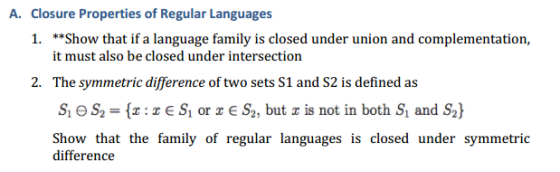
Questions from my recent quiz that I had problems with. Can anyone assist?
Homework Answers
Let the two languages be L1 and L2. As they are regular they have DFA's so let us call them D1 and D2 respectively.
1) Union:
Let us construct a new DFA. We create a new start symbol and join it with ϵ to the start states of D1 and D2. The final state of new DFA will be the union of final states of D1 and D2. The state transition function will be the same. The set of states will union of set of states of D1 and D2 and new start symbol. The set of alphabets is same as D1,D2.
So the new DFA looks like:
 2) Completement:
Let D1 be DFA of L1.
D1 = (A, Q, S, F, t)
A -> set of all alphabets
Q -> set of all the states
S -> start states
F - > set of all final states
t -> state transition function
The DFA for complement of L1 will be:
DC = (A, Q, S, F1, t)
Where A,Q,S,t are same as above
We make F1 as Q-F (F from D1)
3) Intersection:
Let D1 be DFA of L1.
D1 = (A, Q1, S1, F1, t1)
A -> set of all alphabets
Q1 -> set of all the states
S1 -> start states
F1 - > set of all final states
t1-> state transition function
Let D2 be DFA of L2.
D2 = (A, Q2, S2, F2, t2)
A -> set of all alphabets
Q2 -> set of all the states
S2 -> start states
F2 - > set of all final states
t2-> state transition function
Let us construct the DFA of intersection D3
Let D1 be DFA of L1.
D3 = (A, Q, S, F, t)
A -> same as above
Q -> we create new states by pairing states from states from Q1 and Q2. So Q contains (qi,qj) where qi and qj belong to Q1 and Q2. Such that we make all possible pairs.
S -> (S1,S2)
F - > (Fi,Fj) all possible pairs. Such that Fi belongs to F1 and Fj belongs to F2
t -> state transition function such (qi,qj) goes to (t1(qi,a),t2(qj,a)) for an alphabet a.
Add Answer to:
Questions from my recent quiz that I had problems with. Can
anyone assist?
Closure Properties of...
(express the language in terms of basic set operations) a) Prove that if L and Ly...
 (express the language in terms of basic set operations) a) Prove that if L and Ly are regular then //\/2 (set difference) is also regular. b) The symmetric difference of two sets S, and S2 is defined as: sas, = {x:xes, or xes, but x is not in both S, and S2}. Show that the family of regular languages is closed under symmetric difference.
1. Complete the following exercises a) For Σ = {a, b} find regular expressions for the...
 1. Complete the following exercises a) For Σ = {a, b} find regular expressions for the compliment of the following languages L = L(aa*bb) b) Let Li = L(ab*aa), L2 = L(a"bba"). Find a regular expression for (L1 n Ljl2. c) The symmetric difference of two sets Sı and S2 is defined as sı Θ s,-(x : x E Si or x E S2 but x is not in both S1 and S2). Show that the family of regular languages...
 (express the language in terms of basic set operations) a) Prove that if L and Ly are regular then //\/2 (set difference) is also regular. b) The symmetric difference of two sets S, and S2 is defined as: sas, = {x:xes, or xes, but x is not in both S, and S2}. Show that the family of regular languages is closed under symmetric difference.
 1. Complete the following exercises a) For Σ = {a, b} find regular expressions for the compliment of the following languages L = L(aa*bb) b) Let Li = L(ab*aa), L2 = L(a"bba"). Find a regular expression for (L1 n Ljl2. c) The symmetric difference of two sets Sı and S2 is defined as sı Θ s,-(x : x E Si or x E S2 but x is not in both S1 and S2). Show that the family of regular languages...
Most questions answered within 3 hours.
-
Where is the error in this code sequence?
String s1 = "Hello";
String s2 = "ello";...
asked 10 months ago -
Financial data for Joel de Paris, Inc., for last year
follow:
Joel de Paris, Inc.
Balance...
asked 10 months ago -
Consider this reaction:
Al2(SO4)3 (aq)+ BaCl3
(aq) Al2Cl6 (aq)- +
3BaSO4(s) . What is the...
asked 10 months ago -
Suppose that Savneet is considering increasing her
recent random sample from 20 car rentals to 40...
asked 10 months ago -
Trucks arrive at an unloading terminal at an average rate of 120
per hour.
Trucks arrive...
asked 10 months ago -
Why are methanol and ethanol completely soluble in water while
octanol is not very little soluble....
asked 10 months ago -
A facilities manager at a university reads in a research report
that the mean amount of...
asked 10 months ago -
When the CuSO4 is rehydrated by adding water to the anhydrous
compound, is this an endothermic...
asked 10 months ago -
A ray of sunlight is passing from diamond into crown glass; the
angle of incidence is...
asked 10 months ago -
A block of mass 0.249 kg is placed on top of a light, vertical
spring of...
asked 10 months ago -
how do the kidneys compensate in the presences of acidosis
a) trigger hyperventilate
b) reserve acid...
asked 10 months ago -
Question 501 pts
The rental rate of capital to the firm increases. Which of the
following...
asked 10 months ago