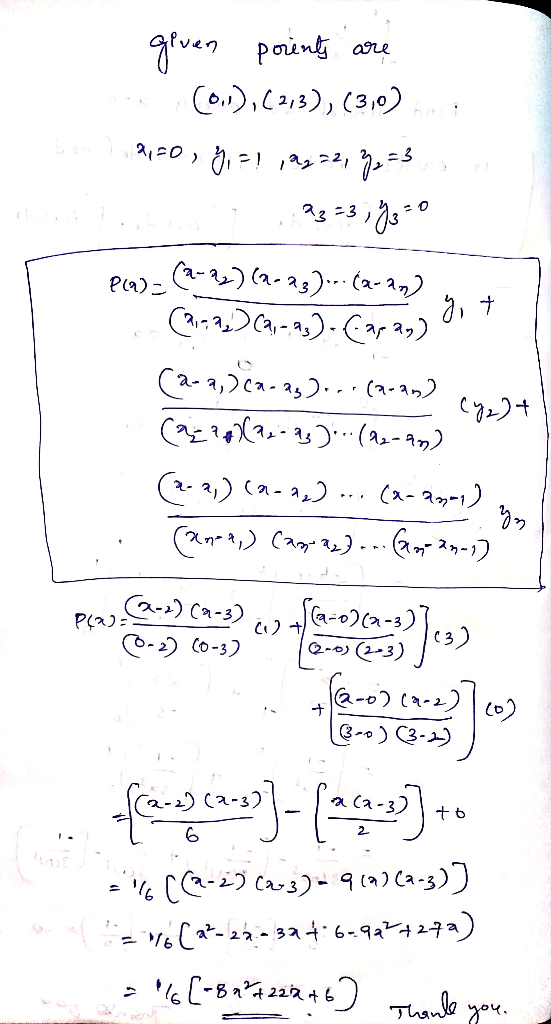
Can you find a cubic polynomial that interpolates the points (0, 1), (2, 3), (3, 0)?...
Can you find a cubic polynomial that interpolates the points (0, 1), (2, 3), (3, 0)? How many of them can you find? State one.
Homework Answers
Add Answer to:
Can you find a cubic polynomial that interpolates the points (0,
1), (2, 3), (3, 0)?...
Consider the three points (-1,0), (0,1), (2,0) 1. Construct a second degree polynomial P(a) that interpolates the g...
 Consider the three points (-1,0), (0,1), (2,0) 1. Construct a second degree polynomial P(a) that interpolates the given points. Use Matlab to solve the resulting linear system. 2. Find a piecewise linear function L(x) that interpolates the given points.
Consider the three points (-1,0), (0,1), (2,0) 1. Construct a second degree polynomial P(a) that interpolates the given points. Use Matlab to solve the resulting linear system. 2. Find a piecewise linear function L(x) that interpolates the given points.
Consider the three points (-1,0), (0,1), (2,0) 1. Construct a second degree polynomial P(a) that interpolates the given points. Use Matlab to solve the resulting linear system. 2. Find a piecewise linear function L(x) that interpolates the given points.
Given the data points (-3,5),(-2,5),(-1,3), (0, 1) (a) Find the interpolating polynomial passing through these points....
 Given the data points (-3,5),(-2,5),(-1,3), (0, 1) (a) Find the interpolating polynomial passing through these points. (b) Using your polynomial from (a), evaluate P(1). (c) This polynomial interpolates the function f(x) = 24. Find an upper bound for the approximation in part (b).
2. The polynomial p of degree n that interpolates a given function f at n+1 prescribed nodes is u...
 Please answer problem 4, thank you.
2. The polynomial p of degree n that interpolates a given function f at n+1 prescribed nodes is uniquely defined. Hence, there is a mapping f -> p. Denote this mapping by L and show that rl Show that L is linear; that is, 3. Prove that the algorithm for computing the coefficients ci in the Newton form of the interpolating polynomial involves n long operations (multiplications and divisions 4. Refer to Problem 2,...
Please answer problem 4, thank you.
2. The polynomial p of degree n that interpolates a given function f at n+1 prescribed nodes is uniquely defined. Hence, there is a mapping f -> p. Denote this mapping by L and show that rl Show that L is linear; that is, 3. Prove that the algorithm for computing the coefficients ci in the Newton form of the interpolating polynomial involves n long operations (multiplications and divisions 4. Refer to Problem 2,...
(x0,y0), (x1,y1) Using natural cubic spline, how can I get ax^3+bx^2+cx+d formula? (can a, b, c, d=0) Describe explicit...
 (x0,y0), (x1,y1) Using natural cubic spline, how can I get
ax^3+bx^2+cx+d formula? (can a, b, c, d=0)
Describe explicitly the natural cubic spline that interpolates a table with only two entries: 0 Give a formula for it. Here, to and t are the knots.
Describe explicitly the natural cubic spline that interpolates a table with only two entries: 0 Give a formula for it. Here, to and t are the knots.
(x0,y0), (x1,y1) Using natural cubic spline, how can I get
ax^3+bx^2+cx+d formula? (can a, b, c, d=0)
Describe explicitly the natural cubic spline that interpolates a table with only two entries: 0 Give a formula for it. Here, to and t are the knots.
Describe explicitly the natural cubic spline that interpolates a table with only two entries: 0 Give a formula for it. Here, to and t are the knots.
please write down detailed solution (do not copy 3. [Polynomial interpolation versus least squares fitting, 10pts]...
 please write down detailed solution (do not copy
3. [Polynomial interpolation versus least squares fitting, 10pts] Recall how Q7 in HW3 required you to find the cubic best fit to six given data points. This led to a least squares optimization problem. We are given the same points as in HW3: i 01 | 2 | 3 | 4 | 5 X 0.0 0.5 1.0 1.5 2.0 2.5 Y 0.0 0.20 0.27 0.30 0.32 0.33 (a) Write down the least...
please write down detailed solution (do not copy
3. [Polynomial interpolation versus least squares fitting, 10pts] Recall how Q7 in HW3 required you to find the cubic best fit to six given data points. This led to a least squares optimization problem. We are given the same points as in HW3: i 01 | 2 | 3 | 4 | 5 X 0.0 0.5 1.0 1.5 2.0 2.5 Y 0.0 0.20 0.27 0.30 0.32 0.33 (a) Write down the least...
with distinct nodes, prove there is at most one polynomial of degree ≤ 2n + 1 that interpolates the data. Remember the F...
 with distinct nodes, prove there is at most one polynomial of
degree ≤ 2n + 1 that interpolates the data. Remember the
Fundamental Theorem of Algebra says a nonzero polynomial has number
of roots ≤ its degree. Also, Generalized Rolle’s Theorem says if r0
≤ r1 ≤ . . . ≤ rm are roots of g ∈ C m[r0, rm], then there exists ξ
∈ (r0, rm) such that g (m) (ξ) = 0.
1. (25 pts) Given the table...
with distinct nodes, prove there is at most one polynomial of
degree ≤ 2n + 1 that interpolates the data. Remember the
Fundamental Theorem of Algebra says a nonzero polynomial has number
of roots ≤ its degree. Also, Generalized Rolle’s Theorem says if r0
≤ r1 ≤ . . . ≤ rm are roots of g ∈ C m[r0, rm], then there exists ξ
∈ (r0, rm) such that g (m) (ξ) = 0.
1. (25 pts) Given the table...
6. lol suppose a cubic polynomial y = a +br +cr2-dr3 goes through the points (zi, yi) for i 1, 2,...
 6. lol suppose a cubic polynomial y = a +br +cr2-dr3 goes through the points (zi, yi) for i 1, 2,3,4, where r, f a, for i,j 1,2,3,4 and i f j (a) 2 Find the system of equations that determines the coefficients a, b, c and d (b) (61 Find the determinant of the coefficiant matrix using row operations, and show that the coefficient matrix is invertible. Note that you will receive no mark if you compute the determinant...
T47:02 731 VPN 97% 5 TOⓇ + : 4. Find the Hermite interpolating polynomial which interpolates...
 T47:02 731 VPN 97% 5 TOⓇ + : 4. Find the Hermite interpolating polynomial which interpolates the values f(1) = 4, f'(1) = -3, f(4) = 13, f'(4) = 9 and verify your answer. 5 13
Problem 2 (2 points): Sketch a cubic function (third degree polynomial function) y x = 1...
 Problem 2 (2 points): Sketch a cubic function (third degree polynomial function) y x = 1 and x 4 and a loc p(x) with two distinct zeros at al maximum at x 4. Then determine a formula for your function. [Hint you will have one double root.] Sketch: Formula: p(x)-
4. For the following table, answer the questions. (1) Find the cubic Newton’s interpolating polynomial using...
 4. For the following table, answer the questions.
(1) Find the cubic Newton’s interpolating polynomial using the
first four data points and estimate the function value at x=2.5
with the interpolating polynomial.
(2) Find the quartic Newton’s interpolating polynomial using the
five data points and estimate the function value at x=2.5 with the
interpolating polynomial.
(3) Find the bases functions of Lagrange interpolation, Li(x)
(i=1,2,…,5), and estimate the function value at x=2.5 with the
Lagrange interpolating polynomial.
3 5 1...
4. For the following table, answer the questions.
(1) Find the cubic Newton’s interpolating polynomial using the
first four data points and estimate the function value at x=2.5
with the interpolating polynomial.
(2) Find the quartic Newton’s interpolating polynomial using the
five data points and estimate the function value at x=2.5 with the
interpolating polynomial.
(3) Find the bases functions of Lagrange interpolation, Li(x)
(i=1,2,…,5), and estimate the function value at x=2.5 with the
Lagrange interpolating polynomial.
3 5 1...
 Consider the three points (-1,0), (0,1), (2,0) 1. Construct a second degree polynomial P(a) that interpolates the given points. Use Matlab to solve the resulting linear system. 2. Find a piecewise linear function L(x) that interpolates the given points.
Consider the three points (-1,0), (0,1), (2,0) 1. Construct a second degree polynomial P(a) that interpolates the given points. Use Matlab to solve the resulting linear system. 2. Find a piecewise linear function L(x) that interpolates the given points.
Consider the three points (-1,0), (0,1), (2,0) 1. Construct a second degree polynomial P(a) that interpolates the given points. Use Matlab to solve the resulting linear system. 2. Find a piecewise linear function L(x) that interpolates the given points.
 Given the data points (-3,5),(-2,5),(-1,3), (0, 1) (a) Find the interpolating polynomial passing through these points. (b) Using your polynomial from (a), evaluate P(1). (c) This polynomial interpolates the function f(x) = 24. Find an upper bound for the approximation in part (b).
 Please answer problem 4, thank you.
2. The polynomial p of degree n that interpolates a given function f at n+1 prescribed nodes is uniquely defined. Hence, there is a mapping f -> p. Denote this mapping by L and show that rl Show that L is linear; that is, 3. Prove that the algorithm for computing the coefficients ci in the Newton form of the interpolating polynomial involves n long operations (multiplications and divisions 4. Refer to Problem 2,...
Please answer problem 4, thank you.
2. The polynomial p of degree n that interpolates a given function f at n+1 prescribed nodes is uniquely defined. Hence, there is a mapping f -> p. Denote this mapping by L and show that rl Show that L is linear; that is, 3. Prove that the algorithm for computing the coefficients ci in the Newton form of the interpolating polynomial involves n long operations (multiplications and divisions 4. Refer to Problem 2,...
 (x0,y0), (x1,y1) Using natural cubic spline, how can I get
ax^3+bx^2+cx+d formula? (can a, b, c, d=0)
Describe explicitly the natural cubic spline that interpolates a table with only two entries: 0 Give a formula for it. Here, to and t are the knots.
Describe explicitly the natural cubic spline that interpolates a table with only two entries: 0 Give a formula for it. Here, to and t are the knots.
(x0,y0), (x1,y1) Using natural cubic spline, how can I get
ax^3+bx^2+cx+d formula? (can a, b, c, d=0)
Describe explicitly the natural cubic spline that interpolates a table with only two entries: 0 Give a formula for it. Here, to and t are the knots.
Describe explicitly the natural cubic spline that interpolates a table with only two entries: 0 Give a formula for it. Here, to and t are the knots.
 please write down detailed solution (do not copy
3. [Polynomial interpolation versus least squares fitting, 10pts] Recall how Q7 in HW3 required you to find the cubic best fit to six given data points. This led to a least squares optimization problem. We are given the same points as in HW3: i 01 | 2 | 3 | 4 | 5 X 0.0 0.5 1.0 1.5 2.0 2.5 Y 0.0 0.20 0.27 0.30 0.32 0.33 (a) Write down the least...
please write down detailed solution (do not copy
3. [Polynomial interpolation versus least squares fitting, 10pts] Recall how Q7 in HW3 required you to find the cubic best fit to six given data points. This led to a least squares optimization problem. We are given the same points as in HW3: i 01 | 2 | 3 | 4 | 5 X 0.0 0.5 1.0 1.5 2.0 2.5 Y 0.0 0.20 0.27 0.30 0.32 0.33 (a) Write down the least...
 with distinct nodes, prove there is at most one polynomial of
degree ≤ 2n + 1 that interpolates the data. Remember the
Fundamental Theorem of Algebra says a nonzero polynomial has number
of roots ≤ its degree. Also, Generalized Rolle’s Theorem says if r0
≤ r1 ≤ . . . ≤ rm are roots of g ∈ C m[r0, rm], then there exists ξ
∈ (r0, rm) such that g (m) (ξ) = 0.
1. (25 pts) Given the table...
with distinct nodes, prove there is at most one polynomial of
degree ≤ 2n + 1 that interpolates the data. Remember the
Fundamental Theorem of Algebra says a nonzero polynomial has number
of roots ≤ its degree. Also, Generalized Rolle’s Theorem says if r0
≤ r1 ≤ . . . ≤ rm are roots of g ∈ C m[r0, rm], then there exists ξ
∈ (r0, rm) such that g (m) (ξ) = 0.
1. (25 pts) Given the table...
 6. lol suppose a cubic polynomial y = a +br +cr2-dr3 goes through the points (zi, yi) for i 1, 2,3,4, where r, f a, for i,j 1,2,3,4 and i f j (a) 2 Find the system of equations that determines the coefficients a, b, c and d (b) (61 Find the determinant of the coefficiant matrix using row operations, and show that the coefficient matrix is invertible. Note that you will receive no mark if you compute the determinant...
 T47:02 731 VPN 97% 5 TOⓇ + : 4. Find the Hermite interpolating polynomial which interpolates the values f(1) = 4, f'(1) = -3, f(4) = 13, f'(4) = 9 and verify your answer. 5 13
 Problem 2 (2 points): Sketch a cubic function (third degree polynomial function) y x = 1 and x 4 and a loc p(x) with two distinct zeros at al maximum at x 4. Then determine a formula for your function. [Hint you will have one double root.] Sketch: Formula: p(x)-
 4. For the following table, answer the questions.
(1) Find the cubic Newton’s interpolating polynomial using the
first four data points and estimate the function value at x=2.5
with the interpolating polynomial.
(2) Find the quartic Newton’s interpolating polynomial using the
five data points and estimate the function value at x=2.5 with the
interpolating polynomial.
(3) Find the bases functions of Lagrange interpolation, Li(x)
(i=1,2,…,5), and estimate the function value at x=2.5 with the
Lagrange interpolating polynomial.
3 5 1...
4. For the following table, answer the questions.
(1) Find the cubic Newton’s interpolating polynomial using the
first four data points and estimate the function value at x=2.5
with the interpolating polynomial.
(2) Find the quartic Newton’s interpolating polynomial using the
five data points and estimate the function value at x=2.5 with the
interpolating polynomial.
(3) Find the bases functions of Lagrange interpolation, Li(x)
(i=1,2,…,5), and estimate the function value at x=2.5 with the
Lagrange interpolating polynomial.
3 5 1...
Most questions answered within 3 hours.
-
Where is the error in this code sequence?
String s1 = "Hello";
String s2 = "ello";...
asked 10 months ago -
Financial data for Joel de Paris, Inc., for last year
follow:
Joel de Paris, Inc.
Balance...
asked 10 months ago -
Consider this reaction:
Al2(SO4)3 (aq)+ BaCl3
(aq) Al2Cl6 (aq)- +
3BaSO4(s) . What is the...
asked 10 months ago -
Suppose that Savneet is considering increasing her
recent random sample from 20 car rentals to 40...
asked 10 months ago -
Trucks arrive at an unloading terminal at an average rate of 120
per hour.
Trucks arrive...
asked 10 months ago -
Why are methanol and ethanol completely soluble in water while
octanol is not very little soluble....
asked 10 months ago -
A facilities manager at a university reads in a research report
that the mean amount of...
asked 10 months ago -
When the CuSO4 is rehydrated by adding water to the anhydrous
compound, is this an endothermic...
asked 10 months ago -
A ray of sunlight is passing from diamond into crown glass; the
angle of incidence is...
asked 10 months ago -
A block of mass 0.249 kg is placed on top of a light, vertical
spring of...
asked 10 months ago -
how do the kidneys compensate in the presences of acidosis
a) trigger hyperventilate
b) reserve acid...
asked 10 months ago -
Question 501 pts
The rental rate of capital to the firm increases. Which of the
following...
asked 10 months ago