
Homework Answers

Add Answer to:
Problem 6: A wastewater from a local brewing company contains 1500 m Determine the BODu of...
Problem 4: An environmental consultancy firm collected a wastewater sample from a Brewing Industry which contains...
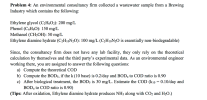 Problem 4: An environmental consultancy firm collected a wastewater sample from a Brewing Industry which contains the following: Ethylene glycol (C2H602): 200 mg/L Phenol (C6H6O): 150 mg/L Methanol (CH3OH): 50 mg/L Ethylene diamine hydrate (C2HioN20): 100 mg/L (C2Hi0N20 is essentially non-biodegradable) Since, the consultancy firm does not have any lab facility, they only rely on the theoretical calculation by themselves and the third party's experimental data. As an environmental engineer working there, you are assigned to answer the following questions:...
Determine the minimum dissolved oxygen (DO) concentration in a river downstream from a wastewater treatment plant (W...
 Determine the minimum dissolved oxygen (DO) concentration in a river downstream from a wastewater treatment plant (WWTP) discharging at a flow rate of 5.00 million gallons per day (MGD). The WWTP achieves secondary treatment standards (BOD5 = 30 mg/L). The wastewater temperature is 25.0 °C and contains 4.0 mg/L of DO. The characteristics of the river upstream from the point of discharge are Q=20.0 cubic feet per second (cfs), T = 20.0°C, BODu = 3.0 mg/L. and DO = 7.0...
is proposed to discharge a wastewater to a small river (wastewater and river characteristics given below)....
 is proposed to discharge a wastewater to a small river (wastewater and river characteristics given below). The temperature of the river and wastewater i and velocity downstream of the discharge is 1.5 m/s. Saturation DO concentr:a 25°C is 8.2 mg/L 2. It s 25°C, Wastewater 1.5 w 31.5 6.1 River Parameter Flow (m/s) BODu( mg/L) DO (mg/L) negligible 8.0 kra20c 0.41 day kd@20c = 0.26 day. Determine: a. Ultimate BOD just downstream of the point of discharge (8 pts) b....
An industrial wastewater stream of 15,000 gpd contains 100 mg/l of Cyanide (CN). Determine the theoritical...
An industrial wastewater stream of 15,000 gpd contains 100 mg/l of Cyanide (CN). Determine the theoritical amounts of calcium hypochlorite, Ca(OCl)2 (70%), required to (1) Cyanate (CNO) and (2) Nitrogen gas (N2).
6) (10 points) The BODs of a wastewater sample is expected to range from 25 to...
 6) (10 points) The BODs of a wastewater sample is expected to range from 25 to 200 mg/L. Three different dilutions are prepared to cover the range. The same procedure was used for each analysis and 300 ml BOD bottles are used for the BODs test. Please determine average BODs value with standard deviation Sample Volume Initial DO, mg/L Final DO, mg/L 5 mL 9.2 6.7 10 mL20 mL 9.0 1.5 8.9 4.5
6-3 (1 point) The you have been asked to determine whether the discharge of a town's...
 6-3 (1 point) The you have been asked to determine whether the discharge of a town's wastewater into a creek will reduce the DO below the standard of 5 mg/L at any point downstream. | Wastewater Creek Flow rate (m/s) 0.44 2.83 Ultimate BOD (mg/L) 14.0 7.0 DO (mg/L) L 1.0 6.0 ka (d-?) 0.20 ka (d) 0.37 Flow velocity (m/s) 0.65 Temperature (°C) 20 The temperature varies in Problem 6-3. Develop a spreadsheet to calculate the DO profiles (plot...
Two trickling filters operating in parallel are being designed to treat the domestic wastewater from a town of 5500 people where the average per-capita wastewater generation is 450 liters per person p...
Two trickling filters operating in parallel are being designed to treat the domestic wastewater from a town of 5500 people where the average per-capita wastewater generation is 450 liters per person per day. A plastic trickling filter media and filter height of 3.5 m have been selected. The influent BOD5 is 120 mg/L and the facility must meet an NPDES permit limiting effluent BOD5 to 35 mg/L. The filter media constant (n) is 0.67 and the BOD decay constant for...
Situation (note: Problem 2 is not linked with Problem 1): Assuming the design flow rate of...
 Situation (note: Problem 2 is not linked with Problem 1): Assuming the design flow rate of raw wastewater to be treated is 20 MGD in the design year, the dissolved BODs is 380 mg/L, and SS is 360 mg/L. The wastewater generated by the sludge treatment process is about 4 MGD with the dissolved BODs being 1800 mg/L, and SS being 1200 mg/L, and will be returned to the wet well in the pumping station at the beginning of the...
A regional STP handles wastewater from 22,000 people where the per capita flow is assumed to...
A regional STP handles wastewater from 22,000 people where the per capita flow is assumed to be 380 L/person/day. This STP comprises (in series) a primary settler, a trickling filter, two facultative ponds, and a mature constructed wetland. The table below gives typical values (all in mg/L) for the overflow stream after the primary settler (APS) and for the final treated effluent (FTE). Parameter APS FTE Suspended solids 120 2 Biochemical oxygen demand 130 3 Total nitrogen (as N) 30...
(30 points) A completely mixed activated sludge system comprised of an aerated reactor and a secondary clarifier with sludge return is going to treat 15,000 m/d of industrial wastewater. Th...
 (30 points) A completely mixed activated sludge system comprised of an aerated reactor and a secondary clarifier with sludge return is going to treat 15,000 m/d of industrial wastewater. The primary effluent going to the reactor has a BODs of 1,100 mg/L that must be reduced to 150 mg/L prior to discharge to a municipal sewer. The pilot study was conducted and generated the following results: 3. Mean cell residence time- 5 day, MLSS concentration in the reactor 7.200 mg/L...
 Problem 4: An environmental consultancy firm collected a wastewater sample from a Brewing Industry which contains the following: Ethylene glycol (C2H602): 200 mg/L Phenol (C6H6O): 150 mg/L Methanol (CH3OH): 50 mg/L Ethylene diamine hydrate (C2HioN20): 100 mg/L (C2Hi0N20 is essentially non-biodegradable) Since, the consultancy firm does not have any lab facility, they only rely on the theoretical calculation by themselves and the third party's experimental data. As an environmental engineer working there, you are assigned to answer the following questions:...
 Determine the minimum dissolved oxygen (DO) concentration in a river downstream from a wastewater treatment plant (WWTP) discharging at a flow rate of 5.00 million gallons per day (MGD). The WWTP achieves secondary treatment standards (BOD5 = 30 mg/L). The wastewater temperature is 25.0 °C and contains 4.0 mg/L of DO. The characteristics of the river upstream from the point of discharge are Q=20.0 cubic feet per second (cfs), T = 20.0°C, BODu = 3.0 mg/L. and DO = 7.0...
 is proposed to discharge a wastewater to a small river (wastewater and river characteristics given below). The temperature of the river and wastewater i and velocity downstream of the discharge is 1.5 m/s. Saturation DO concentr:a 25°C is 8.2 mg/L 2. It s 25°C, Wastewater 1.5 w 31.5 6.1 River Parameter Flow (m/s) BODu( mg/L) DO (mg/L) negligible 8.0 kra20c 0.41 day kd@20c = 0.26 day. Determine: a. Ultimate BOD just downstream of the point of discharge (8 pts) b....
 6) (10 points) The BODs of a wastewater sample is expected to range from 25 to 200 mg/L. Three different dilutions are prepared to cover the range. The same procedure was used for each analysis and 300 ml BOD bottles are used for the BODs test. Please determine average BODs value with standard deviation Sample Volume Initial DO, mg/L Final DO, mg/L 5 mL 9.2 6.7 10 mL20 mL 9.0 1.5 8.9 4.5
 6-3 (1 point) The you have been asked to determine whether the discharge of a town's wastewater into a creek will reduce the DO below the standard of 5 mg/L at any point downstream. | Wastewater Creek Flow rate (m/s) 0.44 2.83 Ultimate BOD (mg/L) 14.0 7.0 DO (mg/L) L 1.0 6.0 ka (d-?) 0.20 ka (d) 0.37 Flow velocity (m/s) 0.65 Temperature (°C) 20 The temperature varies in Problem 6-3. Develop a spreadsheet to calculate the DO profiles (plot...
 Situation (note: Problem 2 is not linked with Problem 1): Assuming the design flow rate of raw wastewater to be treated is 20 MGD in the design year, the dissolved BODs is 380 mg/L, and SS is 360 mg/L. The wastewater generated by the sludge treatment process is about 4 MGD with the dissolved BODs being 1800 mg/L, and SS being 1200 mg/L, and will be returned to the wet well in the pumping station at the beginning of the...
 (30 points) A completely mixed activated sludge system comprised of an aerated reactor and a secondary clarifier with sludge return is going to treat 15,000 m/d of industrial wastewater. The primary effluent going to the reactor has a BODs of 1,100 mg/L that must be reduced to 150 mg/L prior to discharge to a municipal sewer. The pilot study was conducted and generated the following results: 3. Mean cell residence time- 5 day, MLSS concentration in the reactor 7.200 mg/L...
Most questions answered within 3 hours.
-
Where is the error in this code sequence?
String s1 = "Hello";
String s2 = "ello";...
asked 10 months ago -
Financial data for Joel de Paris, Inc., for last year
follow:
Joel de Paris, Inc.
Balance...
asked 10 months ago -
Consider this reaction:
Al2(SO4)3 (aq)+ BaCl3
(aq) Al2Cl6 (aq)- +
3BaSO4(s) . What is the...
asked 10 months ago -
Suppose that Savneet is considering increasing her
recent random sample from 20 car rentals to 40...
asked 10 months ago -
Trucks arrive at an unloading terminal at an average rate of 120
per hour.
Trucks arrive...
asked 10 months ago -
Why are methanol and ethanol completely soluble in water while
octanol is not very little soluble....
asked 10 months ago -
A facilities manager at a university reads in a research report
that the mean amount of...
asked 10 months ago -
When the CuSO4 is rehydrated by adding water to the anhydrous
compound, is this an endothermic...
asked 10 months ago -
A ray of sunlight is passing from diamond into crown glass; the
angle of incidence is...
asked 10 months ago -
A block of mass 0.249 kg is placed on top of a light, vertical
spring of...
asked 10 months ago -
how do the kidneys compensate in the presences of acidosis
a) trigger hyperventilate
b) reserve acid...
asked 10 months ago -
Question 501 pts
The rental rate of capital to the firm increases. Which of the
following...
asked 10 months ago