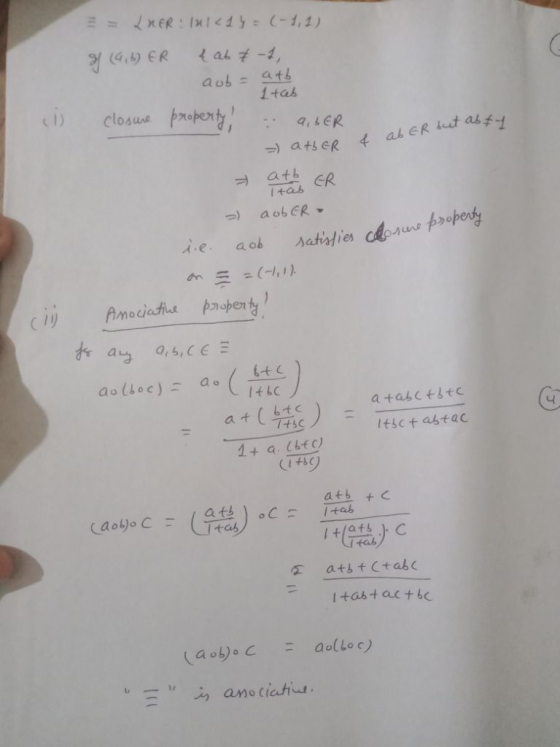
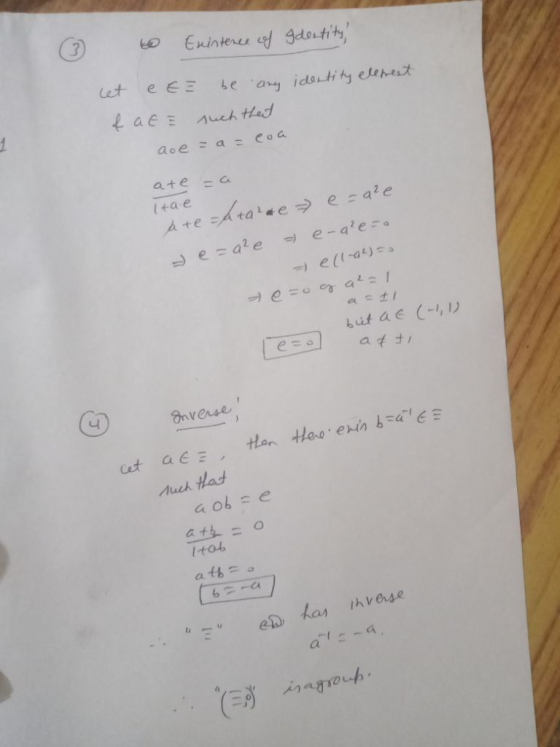
![Let S = {x ER:[x]<1}=(-1,1). We will refer to E as hyperbolic relativity space. Now a+b define a binary operation by: if a,be](http://img.homeworklib.com/questions/efaded80-ba7d-11eb-a6be-550a18450d4b.png?x-oss-process=image/resize,w_560)
Homework Answers
ANSWER:
Add Answer to:
Let S = {x ER:[x]<1}=(-1,1). We will refer to E as hyperbolic relativity space. Now a+b...
Correction: first problem is #2, not #1. Please show all steps in the proofs. Definitions for...
 Correction: first problem is #2, not #1. Please show all steps
in the proofs.
Definitions for problems #2 through #5: Let C be the set of all Cauchy sequences of rational numbers, with the operations of addition and multiplication defined on C by (an) + (bn) = (an + bn) and (an)(bn) = (anbn). Let N be the subset of C consisting of all null sequences in c. Properties of a ring: A1. (a + b) +c= a + b...
Correction: first problem is #2, not #1. Please show all steps
in the proofs.
Definitions for problems #2 through #5: Let C be the set of all Cauchy sequences of rational numbers, with the operations of addition and multiplication defined on C by (an) + (bn) = (an + bn) and (an)(bn) = (anbn). Let N be the subset of C consisting of all null sequences in c. Properties of a ring: A1. (a + b) +c= a + b...
1. Let G = {a, b, c, d, e} be a set with an associative binary...
1. Let G = {a, b, c, d, e} be a set with an associative binary operation multiplication such that ab = ba = d, ed = de = c. Prove that G under this multiplication cannot consist of a group. Hint: Assume that G under this operation does consist of a group. Try to complete the multiplication table and deduce a contradiction. 2. Let G be a group containing 4 elements a, b, c, and d. Under the group...
(3) Let (2,A, /i) be a measure space. Let f : N > R* be a nonnegative measurable function. Define the sequence fn(x)...
 (3) Let (2,A, /i) be a measure space. Let f : N > R* be a nonnegative measurable function. Define the sequence fn(x) = min{f(x), n}, n E N. Prove that for any A E A f du lim fn du A 4 (You must show that the integrals exist.)
(3) Let (2,A, /i) be a measure space. Let f : N > R* be a nonnegative measurable function. Define the sequence fn(x) = min{f(x), n}, n E N. Prove...
(3) Let (2,A, /i) be a measure space. Let f : N > R* be a nonnegative measurable function. Define the sequence fn(x) = min{f(x), n}, n E N. Prove that for any A E A f du lim fn du A 4 (You must show that the integrals exist.)
(3) Let (2,A, /i) be a measure space. Let f : N > R* be a nonnegative measurable function. Define the sequence fn(x) = min{f(x), n}, n E N. Prove...
1. Let a,b ER with a < b. In this problem we are going to prove...
 1. Let a,b ER with a < b. In this problem we are going to prove that the open interval (a, b) containes infinitely many rational numbers by following these steps (a) First let NEN be an arbitrary rational number. Use the density of the rational numbers to show that (a, b) contains N rational numbers. There is a hint about this in the lecture on the density of rationals.) (b) Now uppose that there are finitely many rational numbers...
2. (a) Prove that 1 (f, g)=| x2 f(x)g(x)dx is an inner product on the vector space C(I-1,1) of co...
 NEED (B) AND (C)
2. (a) Prove that 1 (f, g)=| x2 f(x)g(x)dx is an inner product on the vector space C(I-1,1) of continuous real-valued funo- tions on the domain [-1, 1] (b) Use the Gram-Schmidt process to find an orthonormal basis for P2(R) with re- spect to this inner product (c) Find a polynomial q(x) such that for every p E P2R
2. (a) Prove that 1 (f, g)=| x2 f(x)g(x)dx is an inner product on the vector space...
NEED (B) AND (C)
2. (a) Prove that 1 (f, g)=| x2 f(x)g(x)dx is an inner product on the vector space C(I-1,1) of continuous real-valued funo- tions on the domain [-1, 1] (b) Use the Gram-Schmidt process to find an orthonormal basis for P2(R) with re- spect to this inner product (c) Find a polynomial q(x) such that for every p E P2R
2. (a) Prove that 1 (f, g)=| x2 f(x)g(x)dx is an inner product on the vector space...
Question 1 (4 Marks) A weird vector space. Consider the set R+ = {2 ER: I...
 Question 1 (4 Marks) A weird vector space. Consider the set R+ = {2 ER: I >0} = V. We define addition by zey=ry, the product of x and y. We use the field F=R, and define multiplication by cor = xº. Prove that (V, e, Ro) is a vector space. ONLY HAND IN : i) The zero vector ii) what is 6-7 iii) proof of e) of the axioms.
i want answers of all Questions Example. As another special case of examples we may regard...
 i want answers of all Questions
Example. As another special case of examples we may regard the set R of all of n umber vector 1.4.6. Example. Yet another al l the vector space M of mx matrices of members of where m - NI. We will use M. horthand for M F ) and M. for M.(R) 1.4.9. Exercise. Let be the total real numbers. Define an operation of addition by y the maximum of u and y for...
i want answers of all Questions
Example. As another special case of examples we may regard the set R of all of n umber vector 1.4.6. Example. Yet another al l the vector space M of mx matrices of members of where m - NI. We will use M. horthand for M F ) and M. for M.(R) 1.4.9. Exercise. Let be the total real numbers. Define an operation of addition by y the maximum of u and y for...
Let G be a group of order 6 and let X be the set (a, b,c) E G3: abc That is, X is the set of trip...
 Let G be a group of order 6 and let X be the set (a, b,c) E G3: abc That is, X is the set of triples of elements of G with the product of its coordinates equals the identity element of G (a) How many elements does X have? Hint: Every triple (a, b, c) in X is completely determined by the choice of a and b. Because once you choose a and b then c must be (ab)-1...
Define where S is the collection of all real valued sequences i.e. S = {x : N → R} and we denote ...
 Define where S is the collection of all real valued sequences i.e. S = {x : N → R} and we denote xi for the ith element a the sequence x E S. Take for any x EL (i) Show that lic 12 (where recall 1-(x є s i Izel < oo)) (ii) Is l? Prove this or find a counterexample to show that these two sets do not coinside (iii) ls e c loc where recall looー(x є sl...
Please answer all parts. Thank you! 20. Let R be a commutative ring with identity. We define a multiplicative subset of R to be a subset S such that 1 S and ab S if a, b E S. Define a relation ~ on R...
 Please answer all parts. Thank you!
20. Let R be a commutative ring with identity. We define a multiplicative subset of R to be a subset S such that 1 S and ab S if a, b E S. Define a relation ~ on R × S by (a, s) ~ (a, s') if there exists an s"e S such that s* (s,a-sa,) a. 0. Show that ~ is an equivalence relation on b. Let a/s denote the equivalence class...
Please answer all parts. Thank you!
20. Let R be a commutative ring with identity. We define a multiplicative subset of R to be a subset S such that 1 S and ab S if a, b E S. Define a relation ~ on R × S by (a, s) ~ (a, s') if there exists an s"e S such that s* (s,a-sa,) a. 0. Show that ~ is an equivalence relation on b. Let a/s denote the equivalence class...
 Correction: first problem is #2, not #1. Please show all steps
in the proofs.
Definitions for problems #2 through #5: Let C be the set of all Cauchy sequences of rational numbers, with the operations of addition and multiplication defined on C by (an) + (bn) = (an + bn) and (an)(bn) = (anbn). Let N be the subset of C consisting of all null sequences in c. Properties of a ring: A1. (a + b) +c= a + b...
Correction: first problem is #2, not #1. Please show all steps
in the proofs.
Definitions for problems #2 through #5: Let C be the set of all Cauchy sequences of rational numbers, with the operations of addition and multiplication defined on C by (an) + (bn) = (an + bn) and (an)(bn) = (anbn). Let N be the subset of C consisting of all null sequences in c. Properties of a ring: A1. (a + b) +c= a + b...
 (3) Let (2,A, /i) be a measure space. Let f : N > R* be a nonnegative measurable function. Define the sequence fn(x) = min{f(x), n}, n E N. Prove that for any A E A f du lim fn du A 4 (You must show that the integrals exist.)
(3) Let (2,A, /i) be a measure space. Let f : N > R* be a nonnegative measurable function. Define the sequence fn(x) = min{f(x), n}, n E N. Prove...
(3) Let (2,A, /i) be a measure space. Let f : N > R* be a nonnegative measurable function. Define the sequence fn(x) = min{f(x), n}, n E N. Prove that for any A E A f du lim fn du A 4 (You must show that the integrals exist.)
(3) Let (2,A, /i) be a measure space. Let f : N > R* be a nonnegative measurable function. Define the sequence fn(x) = min{f(x), n}, n E N. Prove...
 1. Let a,b ER with a < b. In this problem we are going to prove that the open interval (a, b) containes infinitely many rational numbers by following these steps (a) First let NEN be an arbitrary rational number. Use the density of the rational numbers to show that (a, b) contains N rational numbers. There is a hint about this in the lecture on the density of rationals.) (b) Now uppose that there are finitely many rational numbers...
 NEED (B) AND (C)
2. (a) Prove that 1 (f, g)=| x2 f(x)g(x)dx is an inner product on the vector space C(I-1,1) of continuous real-valued funo- tions on the domain [-1, 1] (b) Use the Gram-Schmidt process to find an orthonormal basis for P2(R) with re- spect to this inner product (c) Find a polynomial q(x) such that for every p E P2R
2. (a) Prove that 1 (f, g)=| x2 f(x)g(x)dx is an inner product on the vector space...
NEED (B) AND (C)
2. (a) Prove that 1 (f, g)=| x2 f(x)g(x)dx is an inner product on the vector space C(I-1,1) of continuous real-valued funo- tions on the domain [-1, 1] (b) Use the Gram-Schmidt process to find an orthonormal basis for P2(R) with re- spect to this inner product (c) Find a polynomial q(x) such that for every p E P2R
2. (a) Prove that 1 (f, g)=| x2 f(x)g(x)dx is an inner product on the vector space...
 Question 1 (4 Marks) A weird vector space. Consider the set R+ = {2 ER: I >0} = V. We define addition by zey=ry, the product of x and y. We use the field F=R, and define multiplication by cor = xº. Prove that (V, e, Ro) is a vector space. ONLY HAND IN : i) The zero vector ii) what is 6-7 iii) proof of e) of the axioms.
 i want answers of all Questions
Example. As another special case of examples we may regard the set R of all of n umber vector 1.4.6. Example. Yet another al l the vector space M of mx matrices of members of where m - NI. We will use M. horthand for M F ) and M. for M.(R) 1.4.9. Exercise. Let be the total real numbers. Define an operation of addition by y the maximum of u and y for...
i want answers of all Questions
Example. As another special case of examples we may regard the set R of all of n umber vector 1.4.6. Example. Yet another al l the vector space M of mx matrices of members of where m - NI. We will use M. horthand for M F ) and M. for M.(R) 1.4.9. Exercise. Let be the total real numbers. Define an operation of addition by y the maximum of u and y for...
 Let G be a group of order 6 and let X be the set (a, b,c) E G3: abc That is, X is the set of triples of elements of G with the product of its coordinates equals the identity element of G (a) How many elements does X have? Hint: Every triple (a, b, c) in X is completely determined by the choice of a and b. Because once you choose a and b then c must be (ab)-1...
 Define where S is the collection of all real valued sequences i.e. S = {x : N → R} and we denote xi for the ith element a the sequence x E S. Take for any x EL (i) Show that lic 12 (where recall 1-(x є s i Izel < oo)) (ii) Is l? Prove this or find a counterexample to show that these two sets do not coinside (iii) ls e c loc where recall looー(x є sl...
 Please answer all parts. Thank you!
20. Let R be a commutative ring with identity. We define a multiplicative subset of R to be a subset S such that 1 S and ab S if a, b E S. Define a relation ~ on R × S by (a, s) ~ (a, s') if there exists an s"e S such that s* (s,a-sa,) a. 0. Show that ~ is an equivalence relation on b. Let a/s denote the equivalence class...
Please answer all parts. Thank you!
20. Let R be a commutative ring with identity. We define a multiplicative subset of R to be a subset S such that 1 S and ab S if a, b E S. Define a relation ~ on R × S by (a, s) ~ (a, s') if there exists an s"e S such that s* (s,a-sa,) a. 0. Show that ~ is an equivalence relation on b. Let a/s denote the equivalence class...
Most questions answered within 3 hours.
-
Where is the error in this code sequence?
String s1 = "Hello";
String s2 = "ello";...
asked 1 year ago -
Financial data for Joel de Paris, Inc., for last year
follow:
Joel de Paris, Inc.
Balance...
asked 1 year ago -
Consider this reaction:
Al2(SO4)3 (aq)+ BaCl3
(aq) Al2Cl6 (aq)- +
3BaSO4(s) . What is the...
asked 1 year ago -
Suppose that Savneet is considering increasing her
recent random sample from 20 car rentals to 40...
asked 1 year ago -
Trucks arrive at an unloading terminal at an average rate of 120
per hour.
Trucks arrive...
asked 1 year ago -
Why are methanol and ethanol completely soluble in water while
octanol is not very little soluble....
asked 1 year ago -
A facilities manager at a university reads in a research report
that the mean amount of...
asked 1 year ago -
When the CuSO4 is rehydrated by adding water to the anhydrous
compound, is this an endothermic...
asked 1 year ago -
A ray of sunlight is passing from diamond into crown glass; the
angle of incidence is...
asked 1 year ago -
A block of mass 0.249 kg is placed on top of a light, vertical
spring of...
asked 1 year ago -
how do the kidneys compensate in the presences of acidosis
a) trigger hyperventilate
b) reserve acid...
asked 1 year ago -
Question 501 pts
The rental rate of capital to the firm increases. Which of the
following...
asked 1 year ago