
Homework Answers
Add Answer to:
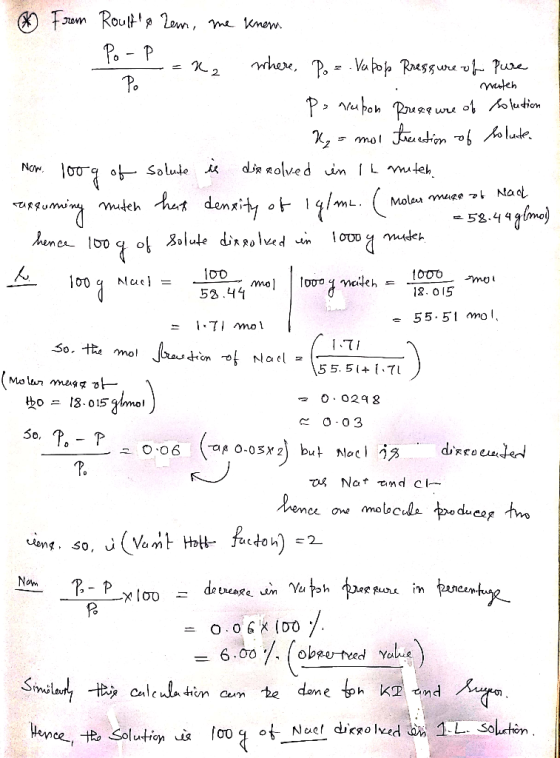
This question is not incomplete. all the information is
there.
13.5-2. One hundred grams of a...
1. Solubility in WATER Check solubility of four solutes in water (H2O). For each solute record...
1. Solubility in WATER Check solubility of four solutes in water (H2O). For each solute record how many teaspoons dissolved in 1/2 cup of water. NaCl: Start out with 4 small glasses (cups) and add 1/2 cup of water to each. Put 1/2 level teaspoon (tsp) of salt (NaCl) into the first cup and stir. If it dissolves within 1 minute; add another 1/2 tsp of salt and stir. Count the number of 1/2 tsps you are adding. Repeat until...
Question 1 (1 point) Using the solubility curve, at which temperature do KCl and KCIO, have...
 Question 1 (1 point) Using the solubility curve, at which temperature do KCl and KCIO, have the same solubility? Solubility Curve Grams of solute/100g H30 to .- 30. 0 10 70 80 90 100 20 30 40 50 60 Temperature (°C) O 93°C 56°C O 85°C 0750 Previous Page Next Page Page 2 of 24 Question 2 (1 point) Saline (salt) solution is 0.9% by mass which is similar to tears, blood, and other body fluids. Which of the following...
please help me answer question 1 to 3, thank you Chapter 9, Solutions, Review & Extra Credit. 2 Points for each XC c...
 please help me answer question 1 to 3,
thank you
Chapter 9, Solutions, Review & Extra Credit. 2 Points for each XC correct answer; 6 points total, max. Partial Credit given. Suggestions...work in teams [it will improve the learning experience] 1. Solutions-A solution forms when a solute (the smaller quantity) dissolves in a solvent (the larger quantity). In a solution, the particles of solute are evenly distributed in the solvent. A solute may be a gas, liquid or solid. A...
please help me answer question 1 to 3,
thank you
Chapter 9, Solutions, Review & Extra Credit. 2 Points for each XC correct answer; 6 points total, max. Partial Credit given. Suggestions...work in teams [it will improve the learning experience] 1. Solutions-A solution forms when a solute (the smaller quantity) dissolves in a solvent (the larger quantity). In a solution, the particles of solute are evenly distributed in the solvent. A solute may be a gas, liquid or solid. A...
Exercise 2 Separation of a Mixture Based on Acid-Base Properties One purpose of this exercise is...
Exercise 2 Separation of a Mixture Based on Acid-Base Properties One purpose of this exercise is to learn how to use a separatory funnel to extract a single component away from other compounds in solution. To do so, we will apply the principles of solubility and acid-base behavior you’re seeing in class. One of the compounds is neutral in the acid-base sense. It has no ability to either donate or accept a proton from an aqueous solution, and will remain...
e. 18 Test Your Knowledge MULTIPLE CHOICE: Choose the one best answer. 1. Each element has...
 e. 18 Test Your Knowledge MULTIPLE CHOICE: Choose the one best answer. 1. Each element has its own characteristic atom in which a. the atomic mass is constant. b. the atomic number is constant. c. the mass number is constant. d. Two of the above are correct. e. All of the above are correct. 2. Which of the following is not a trace element in the human body? a. iodine b. zinc c. iron d. calcium e. fluorine 3. A...
The following primary standards can be used for the standardization of bases except. a. Benzoic acid...
The following primary standards can be used for the standardization of bases except. a. Benzoic acid b. Oxalic acid c. CaCO3 d. KHP A solution that may contain NaOH, Na 2CO3, and NaHCO3, alone or in compatible combination was titrated with 0.1200 M HCl. The volume of the acid required to reach the phenolphthalein endpoint was 25.67 mL while 38.13 mL to reach the methyl red endpoint. What are the components of the mixture? a. Na2CO3 only b. NaOH only...
i uploaded everything that was given. Where would I find the experiemental values? Complete the calcula...
 i
uploaded everything that was given. Where would I find the
experiemental values?
Complete the calculation summary below. READ THE EXPERIMENTAL DISCUSSION FIRST! REPORT ALL ANSWERS TO THE CORRECT SIGNIFICANT FIGURES. SHOW CALCULATION SET-UP on the next page. PART B: Molarity Determination via Solution Stoichiometry 7.625 g Mass of Empty 50 mL Beaker 7.976 g Mass of Beaker and NaCl (final heating) Mass of NaCl Produced (Experimental Yield of NaCl) moles Moles of Na,CO, Consumed 0.00500 Liter Volume of Na,CO,...
i
uploaded everything that was given. Where would I find the
experiemental values?
Complete the calculation summary below. READ THE EXPERIMENTAL DISCUSSION FIRST! REPORT ALL ANSWERS TO THE CORRECT SIGNIFICANT FIGURES. SHOW CALCULATION SET-UP on the next page. PART B: Molarity Determination via Solution Stoichiometry 7.625 g Mass of Empty 50 mL Beaker 7.976 g Mass of Beaker and NaCl (final heating) Mass of NaCl Produced (Experimental Yield of NaCl) moles Moles of Na,CO, Consumed 0.00500 Liter Volume of Na,CO,...
QUESTION 6 The body uses urea, H2NCONH2, to conduct waste nitrogen from protein decomposition out of...
QUESTION 6 The body uses urea, H2NCONH2, to conduct waste nitrogen from protein decomposition out of the body.Calculate the molar mass of urea and determine the number of moles of nitrogen there are in 12.6 g of urea. The molar masses of the elements are as follows: N = 14.01, C = 12.01, O = 16.00, and H = 1.008 (all g/mol) a. 0.42 mol N b. 0.21 mol N c. 0.54 mol N d. 0.47 mol N e. None...
1. Which of the following are the sites within the human body where carbon dioxide and...
1. Which of the following are the sites within the human body where carbon dioxide and oxygen are exchanged? A. Alveoli B. Arteries C. Synapses D. Venules 2. Which of the following describes the most important reason for repeating an experimental investigation? A. To verify the validity of the original findings B. To expand upon the original investigation C. To manipulate the independent variable D. To attempt to disprove the hypothesis 3. Lithium has an atomic number of 3 and...
Need answers. thank you VOCABULARY BUILDER Misspelled Words Find the words below that are misspelled; circle...
 Need answers. thank you
VOCABULARY BUILDER Misspelled Words Find the words below that are misspelled; circle them, and then correctly spell them in the spaces provided. Then fill in the blanks below with the correct vocabulary terms from the following list. amino acids digestion clectrolytes nutrients antioxident nutrition basal metabolic rate extracellulare oxydation calories fat-soluble presearvatives catalist glycogen processed foods cellulose homeostasis saturated fats major mineral coenzyeme trace minerals diaretics metabolism water-soluable 1. Artificial flavors, colors, and commonly added to...
Need answers. thank you
VOCABULARY BUILDER Misspelled Words Find the words below that are misspelled; circle them, and then correctly spell them in the spaces provided. Then fill in the blanks below with the correct vocabulary terms from the following list. amino acids digestion clectrolytes nutrients antioxident nutrition basal metabolic rate extracellulare oxydation calories fat-soluble presearvatives catalist glycogen processed foods cellulose homeostasis saturated fats major mineral coenzyeme trace minerals diaretics metabolism water-soluable 1. Artificial flavors, colors, and commonly added to...
 Question 1 (1 point) Using the solubility curve, at which temperature do KCl and KCIO, have the same solubility? Solubility Curve Grams of solute/100g H30 to .- 30. 0 10 70 80 90 100 20 30 40 50 60 Temperature (°C) O 93°C 56°C O 85°C 0750 Previous Page Next Page Page 2 of 24 Question 2 (1 point) Saline (salt) solution is 0.9% by mass which is similar to tears, blood, and other body fluids. Which of the following...
 please help me answer question 1 to 3,
thank you
Chapter 9, Solutions, Review & Extra Credit. 2 Points for each XC correct answer; 6 points total, max. Partial Credit given. Suggestions...work in teams [it will improve the learning experience] 1. Solutions-A solution forms when a solute (the smaller quantity) dissolves in a solvent (the larger quantity). In a solution, the particles of solute are evenly distributed in the solvent. A solute may be a gas, liquid or solid. A...
please help me answer question 1 to 3,
thank you
Chapter 9, Solutions, Review & Extra Credit. 2 Points for each XC correct answer; 6 points total, max. Partial Credit given. Suggestions...work in teams [it will improve the learning experience] 1. Solutions-A solution forms when a solute (the smaller quantity) dissolves in a solvent (the larger quantity). In a solution, the particles of solute are evenly distributed in the solvent. A solute may be a gas, liquid or solid. A...
 e. 18 Test Your Knowledge MULTIPLE CHOICE: Choose the one best answer. 1. Each element has its own characteristic atom in which a. the atomic mass is constant. b. the atomic number is constant. c. the mass number is constant. d. Two of the above are correct. e. All of the above are correct. 2. Which of the following is not a trace element in the human body? a. iodine b. zinc c. iron d. calcium e. fluorine 3. A...
 i
uploaded everything that was given. Where would I find the
experiemental values?
Complete the calculation summary below. READ THE EXPERIMENTAL DISCUSSION FIRST! REPORT ALL ANSWERS TO THE CORRECT SIGNIFICANT FIGURES. SHOW CALCULATION SET-UP on the next page. PART B: Molarity Determination via Solution Stoichiometry 7.625 g Mass of Empty 50 mL Beaker 7.976 g Mass of Beaker and NaCl (final heating) Mass of NaCl Produced (Experimental Yield of NaCl) moles Moles of Na,CO, Consumed 0.00500 Liter Volume of Na,CO,...
i
uploaded everything that was given. Where would I find the
experiemental values?
Complete the calculation summary below. READ THE EXPERIMENTAL DISCUSSION FIRST! REPORT ALL ANSWERS TO THE CORRECT SIGNIFICANT FIGURES. SHOW CALCULATION SET-UP on the next page. PART B: Molarity Determination via Solution Stoichiometry 7.625 g Mass of Empty 50 mL Beaker 7.976 g Mass of Beaker and NaCl (final heating) Mass of NaCl Produced (Experimental Yield of NaCl) moles Moles of Na,CO, Consumed 0.00500 Liter Volume of Na,CO,...
 Need answers. thank you
VOCABULARY BUILDER Misspelled Words Find the words below that are misspelled; circle them, and then correctly spell them in the spaces provided. Then fill in the blanks below with the correct vocabulary terms from the following list. amino acids digestion clectrolytes nutrients antioxident nutrition basal metabolic rate extracellulare oxydation calories fat-soluble presearvatives catalist glycogen processed foods cellulose homeostasis saturated fats major mineral coenzyeme trace minerals diaretics metabolism water-soluable 1. Artificial flavors, colors, and commonly added to...
Need answers. thank you
VOCABULARY BUILDER Misspelled Words Find the words below that are misspelled; circle them, and then correctly spell them in the spaces provided. Then fill in the blanks below with the correct vocabulary terms from the following list. amino acids digestion clectrolytes nutrients antioxident nutrition basal metabolic rate extracellulare oxydation calories fat-soluble presearvatives catalist glycogen processed foods cellulose homeostasis saturated fats major mineral coenzyeme trace minerals diaretics metabolism water-soluable 1. Artificial flavors, colors, and commonly added to...
Most questions answered within 3 hours.
-
Where is the error in this code sequence?
String s1 = "Hello";
String s2 = "ello";...
asked 10 months ago -
Financial data for Joel de Paris, Inc., for last year
follow:
Joel de Paris, Inc.
Balance...
asked 10 months ago -
Consider this reaction:
Al2(SO4)3 (aq)+ BaCl3
(aq) Al2Cl6 (aq)- +
3BaSO4(s) . What is the...
asked 10 months ago -
Suppose that Savneet is considering increasing her
recent random sample from 20 car rentals to 40...
asked 10 months ago -
Trucks arrive at an unloading terminal at an average rate of 120
per hour.
Trucks arrive...
asked 10 months ago -
Why are methanol and ethanol completely soluble in water while
octanol is not very little soluble....
asked 10 months ago -
A facilities manager at a university reads in a research report
that the mean amount of...
asked 10 months ago -
When the CuSO4 is rehydrated by adding water to the anhydrous
compound, is this an endothermic...
asked 10 months ago -
A ray of sunlight is passing from diamond into crown glass; the
angle of incidence is...
asked 10 months ago -
A block of mass 0.249 kg is placed on top of a light, vertical
spring of...
asked 10 months ago -
how do the kidneys compensate in the presences of acidosis
a) trigger hyperventilate
b) reserve acid...
asked 10 months ago -
Question 501 pts
The rental rate of capital to the firm increases. Which of the
following...
asked 10 months ago