A possible mechanism for the reaction of chlorine gas and chloroform to produce carbon tetrachloride and...
A possible mechanism for the reaction of chlorine gas and chloroform to produce carbon tetrachloride and hydrogen chloride is given below.
Cl2(g) ⇄ 2 Cl(g)
Cl(g) + CHCl3(g) → HCl(g) +
CCl3(g)
Cl(g) + CCl3(g) →
CCl4(g)
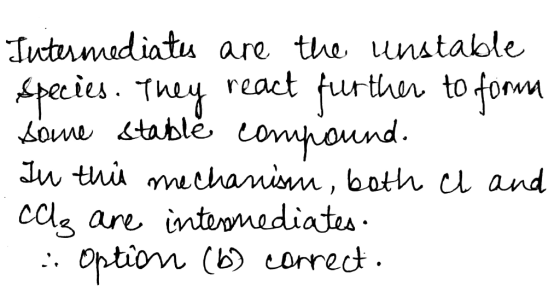
What is/are the intermediate(s) in this mechanism?
| Cl only |
| both Cl and CCl3 |
| CCl3 only |
| HCl only |
Homework Answers
Add Answer to:
A possible mechanism for the reaction of chlorine gas and
chloroform to produce carbon tetrachloride and...
The following mechanism has been proposed for the gas-phase reaction of chloroform (CHCl3) and chlorine. Cl2...
The following mechanism has been proposed for the gas-phase reaction of chloroform (CHCl3) and chlorine. Cl2 ⇌ 2Cl (fast, reversible) Cl + CHCl3 → HCl + CCl3 (slow) Cl + CCl3 → CCl4 (fast) What rate law does this mechanism predict? (Choose from the list below and enter your answers in alphabetical order, e.g. ABC ). A)k G) [CHCl3]1/2 M) [CCl3]2 B) [Cl2] H) [CCl3]1/2 N) [HCl]2 C) [Cl] I) [HCl]1/2 O) [Cl2]2 D) [CHCl3] J) [Cl2]1/2 P) [Cl]2 E)...
The following mechanism has been proposed for the gas-phase reaction of chloroform (CHCl3) and chlorine. Cl2...
The following mechanism has been proposed for the gas-phase reaction of chloroform (CHCl3) and chlorine. Cl2 ⇌ 2Cl (fast, reversible) Cl + CHCl3 → HCl + CCl3 (slow) Cl + CCl3 → CCl4 (fast) What rate law does this mechanism predict? (Choose from the list below and enter your answers in alphabetical order, e.g. ABC ). A)k G) [Cl2]1/2 M) [CHCl3]2 B) [CCl3] H) [Cl]1/2 N) [CCl3]2 C) [HCl] I) [CHCl3]1/2 O) [HCl]2 D) [Cl2] J) [CCl3]1/2 P) [Cl2]2 E)...
1. The rate of formation of carbon tetrachloride from chloroform, CHCl3(g) + Cl2(g) => CCl4(g) +...
1. The rate of formation of carbon tetrachloride from chloroform, CHCl3(g) + Cl2(g) => CCl4(g) + HCl(g) is first order in CHCl3 and half order in Cl2. Which step of the proposed mechanism must be slow in order to agree with this rate law? 1. Cl2(g) => 2 Cl(g) 2. Cl(g) + CHCl3(g) => HCl(g) + CCl3(g) 3. CCl3(g) + Cl(g) => CCl4(g) 1. 1 2. 2 3. 3 2. The proposed mechanism for a reaction is Cl2 =>...
Show all your work please Chloroform, CHCl3, reacts with chlorine, Cl2, to form carbon tetrachloride, CCl4,...
 Show all your work please
Chloroform, CHCl3, reacts with chlorine, Cl2, to form carbon tetrachloride, CCl4, and hydrogen chloride, HCl. In an experiment 25 grams of chloroform and 25 grams of chlorine were mixed. In the laboratory, 10 grams of CCl4 are actually produced. Which is the limiting reactant? What is the theoretical yield of CCl4 in grams? 2. Limiting Reagent: Theoretical Yield: % Percent Yield: xcess (2.5 pts.) (2.5 pts.) (2.5 pts.) (2.5 pts.) reactant remaining
Show all your work please
Chloroform, CHCl3, reacts with chlorine, Cl2, to form carbon tetrachloride, CCl4, and hydrogen chloride, HCl. In an experiment 25 grams of chloroform and 25 grams of chlorine were mixed. In the laboratory, 10 grams of CCl4 are actually produced. Which is the limiting reactant? What is the theoretical yield of CCl4 in grams? 2. Limiting Reagent: Theoretical Yield: % Percent Yield: xcess (2.5 pts.) (2.5 pts.) (2.5 pts.) (2.5 pts.) reactant remaining
For the reaction mechanism shown, identify the intermediates(s) Cl2(gas)<------>2Cl(gas) CHCl3(gas)+ Cl(gas)<------>HCL(gas)+CCl3(gas) CCl3(gas)+Cl(gas)<------>CCl4(gas)
For the reaction mechanism shown, identify the intermediates(s) Cl2(gas)<------>2Cl(gas) CHCl3(gas)+ Cl(gas)<------>HCL(gas)+CCl3(gas) CCl3(gas)+Cl(gas)<------>CCl4(gas)
Carbon tetrachloride reacts at high temperature with oxygen to produce two toxic gases: phosgene and chlorine:...
Carbon tetrachloride reacts at high temperature with oxygen to produce two toxic gases: phosgene and chlorine: CCl4 (g) + (1/2) O2 (g) ↔ COCl2 (g) + Cl2 (g), Kp = 4.4 x 10⁹ at 1000 K. 1.25 atm for both carbon tetrachloride and oxygen were initially injected in the reactor. (1) Determine Kc of the equilibrium (2) What will be the partial pressure for each gas at equilibrium
Consider the following three step mechanism for a reaction Cl2 > 2Cl Fast Cl+CHCl3 > HCl+CCl3...
Consider the following three step mechanism for a reaction Cl2 > 2Cl Fast Cl+CHCl3 > HCl+CCl3 Slow Cl+CCl3 > CCl4 Fast What is the predicted rate law? How do you do it? The answer is rate=K[Cl2]^.5 [CHCl3]
1. Draw a mechanism for the chlorination of chloroform to produce carbon tetrachloride.
 1. Draw a mechanism for the chlorination of chloroform to produce carbon tetrachloride.
When cyclohexene reacts with chlorine in carbon tetrachloride the trans-dihalide is formed. Draw the product and...
 When cyclohexene reacts with chlorine in carbon tetrachloride
the trans-dihalide is formed. Draw the product and write the
complete stepwise mechanism for this reaction. Be sure to show all
intermediate structures and all electron flow using arrows.
Cl2 CCl4
When cyclohexene reacts with chlorine in carbon tetrachloride
the trans-dihalide is formed. Draw the product and write the
complete stepwise mechanism for this reaction. Be sure to show all
intermediate structures and all electron flow using arrows.
Cl2 CCl4
Carbon tetrachloride reacts at high temperatures with oxygen to produce two toxic gases,...
Carbon tetrachloride reacts at high temperatures with oxygen to produce two toxic gases, phosgene and chlorine.CCl4(g) + 1/2O2(g) COCl2(g) + Cl2(g), Kc = 4.4 × 10⁹ at 1,000 KCalculate Kc for the reaction 2CCl4(g) + O2(g) 2COCl2(g) + 2Cl2(g).
 Show all your work please
Chloroform, CHCl3, reacts with chlorine, Cl2, to form carbon tetrachloride, CCl4, and hydrogen chloride, HCl. In an experiment 25 grams of chloroform and 25 grams of chlorine were mixed. In the laboratory, 10 grams of CCl4 are actually produced. Which is the limiting reactant? What is the theoretical yield of CCl4 in grams? 2. Limiting Reagent: Theoretical Yield: % Percent Yield: xcess (2.5 pts.) (2.5 pts.) (2.5 pts.) (2.5 pts.) reactant remaining
Show all your work please
Chloroform, CHCl3, reacts with chlorine, Cl2, to form carbon tetrachloride, CCl4, and hydrogen chloride, HCl. In an experiment 25 grams of chloroform and 25 grams of chlorine were mixed. In the laboratory, 10 grams of CCl4 are actually produced. Which is the limiting reactant? What is the theoretical yield of CCl4 in grams? 2. Limiting Reagent: Theoretical Yield: % Percent Yield: xcess (2.5 pts.) (2.5 pts.) (2.5 pts.) (2.5 pts.) reactant remaining
 1. Draw a mechanism for the chlorination of chloroform to produce carbon tetrachloride.
 When cyclohexene reacts with chlorine in carbon tetrachloride
the trans-dihalide is formed. Draw the product and write the
complete stepwise mechanism for this reaction. Be sure to show all
intermediate structures and all electron flow using arrows.
Cl2 CCl4
When cyclohexene reacts with chlorine in carbon tetrachloride
the trans-dihalide is formed. Draw the product and write the
complete stepwise mechanism for this reaction. Be sure to show all
intermediate structures and all electron flow using arrows.
Cl2 CCl4
Most questions answered within 3 hours.
-
Where is the error in this code sequence?
String s1 = "Hello";
String s2 = "ello";...
asked 11 months ago -
Financial data for Joel de Paris, Inc., for last year
follow:
Joel de Paris, Inc.
Balance...
asked 11 months ago -
Consider this reaction:
Al2(SO4)3 (aq)+ BaCl3
(aq) Al2Cl6 (aq)- +
3BaSO4(s) . What is the...
asked 11 months ago -
Suppose that Savneet is considering increasing her
recent random sample from 20 car rentals to 40...
asked 11 months ago -
Trucks arrive at an unloading terminal at an average rate of 120
per hour.
Trucks arrive...
asked 11 months ago -
Why are methanol and ethanol completely soluble in water while
octanol is not very little soluble....
asked 11 months ago -
A facilities manager at a university reads in a research report
that the mean amount of...
asked 11 months ago -
When the CuSO4 is rehydrated by adding water to the anhydrous
compound, is this an endothermic...
asked 11 months ago -
A ray of sunlight is passing from diamond into crown glass; the
angle of incidence is...
asked 11 months ago -
A block of mass 0.249 kg is placed on top of a light, vertical
spring of...
asked 11 months ago -
how do the kidneys compensate in the presences of acidosis
a) trigger hyperventilate
b) reserve acid...
asked 11 months ago -
Question 501 pts
The rental rate of capital to the firm increases. Which of the
following...
asked 11 months ago