
Homework Answers
Request Answer!
We need at least 10 more requests to produce the answer.
0 / 10 have requested this problem solution
The more requests, the faster the answer.
Add Answer to:
What is a big-O estimate of the function f(n)= n logan +n!? On!) (2") (log2n) Oln...
What is the average running time for quicksort? O(1) O(log10N) O(log2N) O(log2N) O(N) O(N log N)...
What is the average running time for quicksort? O(1) O(log10N) O(log2N) O(log2N) O(N) O(N log N) O(N2) O(N3) O(Nk) O(2N) O(N!)
What is the worst case running time of a linear search? O(1) O(log10N) O(log2N) O(log2N) O(N)...
What is the worst case running time of a linear search? O(1) O(log10N) O(log2N) O(log2N) O(N) O(N log N) O(N2) O(N3) O(Nk) O(2N) O(N!)
What is the worst case running time of a binary search? O(1) O(log10N) O(log2N) O(log2N) O(N)...
What is the worst case running time of a binary search? O(1) O(log10N) O(log2N) O(log2N) O(N) O(N log N) O(N2) O(N3) O(Nk) O(2N) O(N!)
1. What is the best asymptotic ("big-O”) characterization of the following function: f(n) = (14logn)2 +...
 1. What is the best asymptotic ("big-O”) characterization of the following function: f(n) = (14logn)2 + log (3) a) 0(3) Show steps. b) O(n) c) 0(n) d) 0(21) e) O(logn)
For each of the following g(n), which are legitimate Big-O, Big-Theta, or Big-Omega for f(n) =...
For each of the following g(n), which are legitimate Big-O, Big-Theta, or Big-Omega for f(n) = n^2 + 2n. List all that apply. a) n^2 b) n^3 c) n d) 2^n e) lg n
Suppose that the function f satisfies the recurrence rela- tion f (n)2f(Vn)+1 whenever n is a...
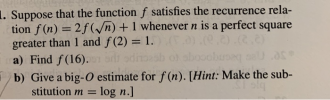 Suppose that the function f satisfies the recurrence rela- tion f (n)2f(Vn)+1 whenever n is a perfect square greater than 1 and f (2) 1. a) Find f(16). . b) Give a big-O estimate for f(n). [Hint: Make the sub- stitution m log n
Assume that an O(log2N) algorithm runs for 10 milliseconds when the input size (N) is 32....
Assume that an O(log2N) algorithm runs for 10 milliseconds when the input size (N) is 32. What is input size makes the algorithm run for 14 milliseconds?
Formal Definitions of Big-Oh, Big-Theta and Big-Omega: 1. Use the formal definition of Big-Oh to prove that if f(n) is...
 Formal Definitions of Big-Oh, Big-Theta and Big-Omega:
1. Use the formal definition of Big-Oh to prove that if f(n) is a decreasing function, then f(n) = 0(1). A decreasing function is one in which f(x1) f(r2) if and only if xi 5 r2. You may assume that f(n) is positive evervwhere Hint: drawing a picture might make the proof for this problem more obvious 2. Use the formal definition of Big-Oh to prove that if f(n) = 0(g(n)) and g(n)...
Formal Definitions of Big-Oh, Big-Theta and Big-Omega:
1. Use the formal definition of Big-Oh to prove that if f(n) is a decreasing function, then f(n) = 0(1). A decreasing function is one in which f(x1) f(r2) if and only if xi 5 r2. You may assume that f(n) is positive evervwhere Hint: drawing a picture might make the proof for this problem more obvious 2. Use the formal definition of Big-Oh to prove that if f(n) = 0(g(n)) and g(n)...
Looking at the big O of functions, If f1(N)=O(NlogN) and f2(N)=O(log N), then what is "big...
Looking at the big O of functions, If f1(N)=O(NlogN) and f2(N)=O(log N), then what is "big O" of f1 +f2?
What is the order of the following growth function expressed using Big-Oh notation: T(N)=7*N3 + N/2...
What is the order of the following growth function expressed using Big-Oh notation: T(N)=7*N3 + N/2 + 2 * log N + 38 ? O(2N) O(N3) O(N/2) O(N3 + log N)
 1. What is the best asymptotic ("big-O”) characterization of the following function: f(n) = (14logn)2 + log (3) a) 0(3) Show steps. b) O(n) c) 0(n) d) 0(21) e) O(logn)
 Suppose that the function f satisfies the recurrence rela- tion f (n)2f(Vn)+1 whenever n is a perfect square greater than 1 and f (2) 1. a) Find f(16). . b) Give a big-O estimate for f(n). [Hint: Make the sub- stitution m log n
 Formal Definitions of Big-Oh, Big-Theta and Big-Omega:
1. Use the formal definition of Big-Oh to prove that if f(n) is a decreasing function, then f(n) = 0(1). A decreasing function is one in which f(x1) f(r2) if and only if xi 5 r2. You may assume that f(n) is positive evervwhere Hint: drawing a picture might make the proof for this problem more obvious 2. Use the formal definition of Big-Oh to prove that if f(n) = 0(g(n)) and g(n)...
Formal Definitions of Big-Oh, Big-Theta and Big-Omega:
1. Use the formal definition of Big-Oh to prove that if f(n) is a decreasing function, then f(n) = 0(1). A decreasing function is one in which f(x1) f(r2) if and only if xi 5 r2. You may assume that f(n) is positive evervwhere Hint: drawing a picture might make the proof for this problem more obvious 2. Use the formal definition of Big-Oh to prove that if f(n) = 0(g(n)) and g(n)...
Most questions answered within 3 hours.
-
Where is the error in this code sequence?
String s1 = "Hello";
String s2 = "ello";...
asked 11 months ago -
Financial data for Joel de Paris, Inc., for last year
follow:
Joel de Paris, Inc.
Balance...
asked 11 months ago -
Consider this reaction:
Al2(SO4)3 (aq)+ BaCl3
(aq) Al2Cl6 (aq)- +
3BaSO4(s) . What is the...
asked 11 months ago -
Suppose that Savneet is considering increasing her
recent random sample from 20 car rentals to 40...
asked 11 months ago -
Trucks arrive at an unloading terminal at an average rate of 120
per hour.
Trucks arrive...
asked 11 months ago -
Why are methanol and ethanol completely soluble in water while
octanol is not very little soluble....
asked 11 months ago -
A facilities manager at a university reads in a research report
that the mean amount of...
asked 11 months ago -
When the CuSO4 is rehydrated by adding water to the anhydrous
compound, is this an endothermic...
asked 11 months ago -
A ray of sunlight is passing from diamond into crown glass; the
angle of incidence is...
asked 11 months ago -
A block of mass 0.249 kg is placed on top of a light, vertical
spring of...
asked 11 months ago -
how do the kidneys compensate in the presences of acidosis
a) trigger hyperventilate
b) reserve acid...
asked 11 months ago -
Question 501 pts
The rental rate of capital to the firm increases. Which of the
following...
asked 11 months ago