
Homework Answers
Fluorescence happens when an atom or molecules relaxes via vibrational relaxation to its ground state after being excited electrically. The availability of conjugation allows the delocalisation of double bonds over the complete molecular system making them to effectively absorb the indident radiation energy. The characteristic frequencies of excitation and emission are dependent on the respective molecule or atom.
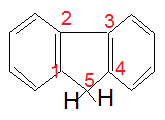
Molecule 1 (structure in the left hand side)
You can observe the availability of alternative presence of double bond and single bond in both the molecules given. This is called conjugation and it happens by the presence of continuous SP2 hybridised carbons. The careful look into the molecule 1 shows, this conjugation is not continous and there is a breakage at the carbon (numbered 5) bearing two H. The double bonds in either of the phenyl ring (at carbon 1 or carbon 4) can not undergo delocalisation through this carbon 5. This carbon 5 is SP3 hybridized and block the chain of delocalization through other SP2 carbons.
Therefore, molecule 1 is less likely to flouresce.
Molecule 2 (structure in the right hand side)
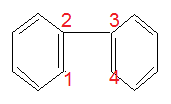
The molecule 2 in the right hand side of the given question is more likely to fluoresce than the molecule in the left hand side.
Unlike the molecule 1 discussed in the earlier case, this biphenyl moelcule 2 has no any intermediate SP3 hybridised carbon. All the Carbons are SP2 hybridized. There can be effective delocalisation of electrons between, 1,2,3 and 4.
Add Answer to:
Which of the following two molecules is more likely to fluoresce? Explain what properties of that...
1 a. Explain why compound with conjugated systems can fluoresce. b. Why is tryptophan more fluorescent...
1 a. Explain why compound with conjugated systems can fluoresce. b. Why is tryptophan more fluorescent than tyrosine and phenylalanine?
Structure of quinine. Refer to these diagrams wben answering the following questions. a. Which sp...
 please do all the 4 parts neat and clean thanks
structure of quinine. Refer to these diagrams wben answering the following questions. a. Which spectrum (red or blue) is the absorption spectrum? Which spectrum is the fluorescence spectrum? Rationalize your choices. b. What is the best wavelength at which to excite quinine in order to observe its entire fluorescence spectrum? Why? c. What is the best wavelength at which to monitor the fluorescence of quinine-containing solutions? Why? part of the...
please do all the 4 parts neat and clean thanks
structure of quinine. Refer to these diagrams wben answering the following questions. a. Which spectrum (red or blue) is the absorption spectrum? Which spectrum is the fluorescence spectrum? Rationalize your choices. b. What is the best wavelength at which to excite quinine in order to observe its entire fluorescence spectrum? Why? c. What is the best wavelength at which to monitor the fluorescence of quinine-containing solutions? Why? part of the...
(a) The two molecules below are structurally similar, however, one of these molecules is much more...
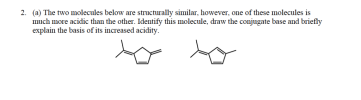 (a) The two molecules below are structurally similar, however, one of these molecules is much more acidic than the other. Identify this molecule, draw the conjugate base and briefly explain the basis of its increased acidity 2.
(a) The two molecules below are structurally similar, however, one of these molecules is much more acidic than the other. Identify this molecule, draw the conjugate base and briefly explain the basis of its increased acidity 2.
(a) The two molecules below are structurally similar, however, one of these molecules is much more acidic than the other. Identify this molecule, draw the conjugate base and briefly explain the basis of its increased acidity 2.
molecules, are molecules that contain two or more carbon atoms bonded together. 2. Which type of...
 molecules, are molecules that contain two or more carbon atoms bonded together. 2. Which type of control, positive or negative, contains the organic molecule for which the test is designed?
1. Select the two compounds that are more likely to be a gas at room temperature...
1. Select the two compounds that are more likely to be a gas at room temperature (as opposed to a liquid). CH4 CH3OH C2H6 H2O 2. The separation of charges within a polar molecule is called a(n) ________. polar bond strong attraction dipole ionic bond dipole-dipole 3. Which of the following intermolecular forces best describes why nonpolar molecules like gasoline (C8H18) have only limited solubility in water? dipole-dipole ion-dipole Both dipole-dipole and induced dipole-induced dipole induced dipole-induced dipole dipole-induced dipole
Which will produce more ATP: i). Three molecules of glucose that are metabolized by glycolysis to...
Which will produce more ATP: i). Three molecules of glucose that are metabolized by glycolysis to yield pyruvate orii). Three molecules of glucose that enter the Pentose Phosphate pathway and are converted to two molecules of fructose-6-phosphate and one molecule of glyceraldehyde-3-phosphate, which can then enter glycolysis. Explain your metabolic calculations/logic. NOTE: Do not consider ATP equivalents from NADH or NADPH in your answer.
5. To which of the following molecules does the spectrum below belong? Explain your choice carefu...
 5. To which of the following molecules does the spectrum below belong? Explain your choice carefully! (4 pts) I strongly suggest you draw each molecule. Cis-3-hexene, (z-1-ethoxy-1-butene 2-ethyl-1-butene, Cl Cl doublet iplet or JH 109 Cl Ci Explain why the resonance at ö 3.7 is so complex (this is a tough one) Draw out the molecule you selected and consider the relationships among hydrogens (4 pts)
5. To which of the following molecules does the spectrum below belong? Explain your...
5. To which of the following molecules does the spectrum below belong? Explain your choice carefully! (4 pts) I strongly suggest you draw each molecule. Cis-3-hexene, (z-1-ethoxy-1-butene 2-ethyl-1-butene, Cl Cl doublet iplet or JH 109 Cl Ci Explain why the resonance at ö 3.7 is so complex (this is a tough one) Draw out the molecule you selected and consider the relationships among hydrogens (4 pts)
5. To which of the following molecules does the spectrum below belong? Explain your...
1. Select the two compounds that are more likely to be a gas at room temperature...
1. Select the two compounds that are more likely to be a gas at room temperature (as opposed to a liquid). CH4 CH3OH C2H6 H2O 2. The separation of charges within a polar molecule is called a(n) ________. polar bond strong attraction dipole ionic bond dipole-dipole 3. Which of the following intermolecular forces best describes why nonpolar molecules like gasoline (C8H18) have only limited solubility in water? dipole-dipole ion-dipole Both dipole-dipole and induced dipole-induced dipole induced dipole-induced dipole dipole-induced dipole...
7. What two molecules could be used to make the following molecules using crossed aldol reaction....
 7. What two molecules could be used to make the following molecules using crossed aldol reaction. ook OH 8a. There are 4 alpha-carbons in this molecule. Which alpha carbon(s) is/are the most reactive? What is the product if NaOH and heat are used? a 8b. What is the scientist name whom the above reaction is named after? 9. Why does the base (used to proton transfer) need match the initial reactant in the Claisen Condensation? 10. Malonic ester synthesis questions...
7. What two molecules could be used to make the following molecules using crossed aldol reaction....
 7. What two molecules could be used to make the following molecules using crossed aldol reaction. OH 8a. There are 4 alpha-carbons in this molecule. Which alpha carbon(s) is/are the most reactive? What is the product if NaOH and heat are used? 8b. What is the scientist name whom the above reaction is named after? 9. Why does the base (used to proton transfer) need match the initial reactant in the Claisen Condensation? 10. Malonic ester synthesis questions - Show...
 please do all the 4 parts neat and clean thanks
structure of quinine. Refer to these diagrams wben answering the following questions. a. Which spectrum (red or blue) is the absorption spectrum? Which spectrum is the fluorescence spectrum? Rationalize your choices. b. What is the best wavelength at which to excite quinine in order to observe its entire fluorescence spectrum? Why? c. What is the best wavelength at which to monitor the fluorescence of quinine-containing solutions? Why? part of the...
please do all the 4 parts neat and clean thanks
structure of quinine. Refer to these diagrams wben answering the following questions. a. Which spectrum (red or blue) is the absorption spectrum? Which spectrum is the fluorescence spectrum? Rationalize your choices. b. What is the best wavelength at which to excite quinine in order to observe its entire fluorescence spectrum? Why? c. What is the best wavelength at which to monitor the fluorescence of quinine-containing solutions? Why? part of the...
 (a) The two molecules below are structurally similar, however, one of these molecules is much more acidic than the other. Identify this molecule, draw the conjugate base and briefly explain the basis of its increased acidity 2.
(a) The two molecules below are structurally similar, however, one of these molecules is much more acidic than the other. Identify this molecule, draw the conjugate base and briefly explain the basis of its increased acidity 2.
(a) The two molecules below are structurally similar, however, one of these molecules is much more acidic than the other. Identify this molecule, draw the conjugate base and briefly explain the basis of its increased acidity 2.
 molecules, are molecules that contain two or more carbon atoms bonded together. 2. Which type of control, positive or negative, contains the organic molecule for which the test is designed?
 5. To which of the following molecules does the spectrum below belong? Explain your choice carefully! (4 pts) I strongly suggest you draw each molecule. Cis-3-hexene, (z-1-ethoxy-1-butene 2-ethyl-1-butene, Cl Cl doublet iplet or JH 109 Cl Ci Explain why the resonance at ö 3.7 is so complex (this is a tough one) Draw out the molecule you selected and consider the relationships among hydrogens (4 pts)
5. To which of the following molecules does the spectrum below belong? Explain your...
5. To which of the following molecules does the spectrum below belong? Explain your choice carefully! (4 pts) I strongly suggest you draw each molecule. Cis-3-hexene, (z-1-ethoxy-1-butene 2-ethyl-1-butene, Cl Cl doublet iplet or JH 109 Cl Ci Explain why the resonance at ö 3.7 is so complex (this is a tough one) Draw out the molecule you selected and consider the relationships among hydrogens (4 pts)
5. To which of the following molecules does the spectrum below belong? Explain your...
 7. What two molecules could be used to make the following molecules using crossed aldol reaction. ook OH 8a. There are 4 alpha-carbons in this molecule. Which alpha carbon(s) is/are the most reactive? What is the product if NaOH and heat are used? a 8b. What is the scientist name whom the above reaction is named after? 9. Why does the base (used to proton transfer) need match the initial reactant in the Claisen Condensation? 10. Malonic ester synthesis questions...
 7. What two molecules could be used to make the following molecules using crossed aldol reaction. OH 8a. There are 4 alpha-carbons in this molecule. Which alpha carbon(s) is/are the most reactive? What is the product if NaOH and heat are used? 8b. What is the scientist name whom the above reaction is named after? 9. Why does the base (used to proton transfer) need match the initial reactant in the Claisen Condensation? 10. Malonic ester synthesis questions - Show...
Most questions answered within 3 hours.
-
Where is the error in this code sequence?
String s1 = "Hello";
String s2 = "ello";...
asked 11 months ago -
Financial data for Joel de Paris, Inc., for last year
follow:
Joel de Paris, Inc.
Balance...
asked 11 months ago -
Consider this reaction:
Al2(SO4)3 (aq)+ BaCl3
(aq) Al2Cl6 (aq)- +
3BaSO4(s) . What is the...
asked 11 months ago -
Suppose that Savneet is considering increasing her
recent random sample from 20 car rentals to 40...
asked 11 months ago -
Trucks arrive at an unloading terminal at an average rate of 120
per hour.
Trucks arrive...
asked 11 months ago -
Why are methanol and ethanol completely soluble in water while
octanol is not very little soluble....
asked 11 months ago -
A facilities manager at a university reads in a research report
that the mean amount of...
asked 11 months ago -
When the CuSO4 is rehydrated by adding water to the anhydrous
compound, is this an endothermic...
asked 11 months ago -
A ray of sunlight is passing from diamond into crown glass; the
angle of incidence is...
asked 11 months ago -
A block of mass 0.249 kg is placed on top of a light, vertical
spring of...
asked 11 months ago -
how do the kidneys compensate in the presences of acidosis
a) trigger hyperventilate
b) reserve acid...
asked 11 months ago -
Question 501 pts
The rental rate of capital to the firm increases. Which of the
following...
asked 11 months ago