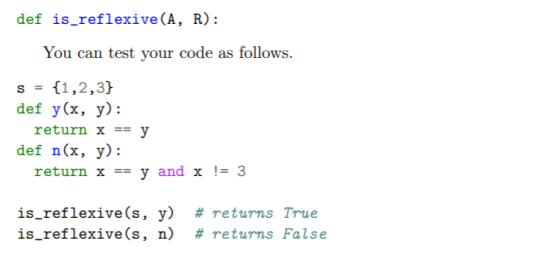
Write a function in python that takes a set A and a relation R(x, y) on A (as a python function such that R(x, y) returns true if and only if the relation xRy holds), and returns True if and only if the relation R is reflexive. Here is the function signature you need to use.
Homework Answers
ANSWER:-
CODE:-
def y(x, y):
return x == y
def n(x, y):
return x == y and x != 3
def is_reflexive(A, R):
setA = []
for i in A:
setA.append(i)
s = []
for i in setA:
for j in setA:
if R(i,j):
s.append((i,j))
for item in s:
if item[0] ==
item[1]:
setA.remove(item[0])
if len(setA) == 0:
return True
return False
s = {1,2,3}
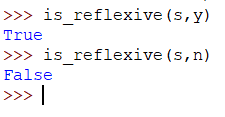
is_reflexive(s,y)
is_reflexive(s,n)
NOTE:- If you need any modifications in the code,please comment below.Please give positive rating.THUMBS UP.
THANK YOU!!!
OUTPUT:-
CODE SCREENSHOT:-
![def y(x, y): return x == y def n(x, y): return x == y and x != 3 def is reflexive (A, R): seta = [] for i in A: setA.append(i](http://img.homeworklib.com/questions/3e3d2e40-bbf8-11eb-a9e1-4dff91d59171.png?x-oss-process=image/resize,w_560)
Add Answer to:
Write a function in python that takes a set A and a relation
R(x, y) on...
8. On the set A = {1,2,3,4,...,20}, an equivalence relation R is defined as follows: For...
 8. On the set A = {1,2,3,4,...,20}, an equivalence relation R is defined as follows: For all x, y € A, xRy 4(x - y). For each of the following, circle TRUE or FALSE. [4 points) a. TRUE or FALSE: There are only 4 distinct equivalence classes for this relation. b. TRUE or FALSE: If you remove all the even numbers from A, the relation would still be an equivalence relation. C. TRUE or FALSE: In this equivalence relation, 2R5...
Let R be the relation on N defined by xRy iff 2 divides x+y. R is...
Let R be the relation on N defined by xRy iff 2 divides x+y. R is an equivalence relation. You do not have to prove that R is an equivalence relation. True or False: 3 ∈ 4/R.
Jupyter code (PYTHON) True error Write a function called trueError that takes the following inputs: •...
 Jupyter code (PYTHON)
True error Write a function called trueError that takes the following inputs: • X, the new value • Xtrue, the previous value And returns the following output: • error, the calculated relative error The formula for the relative error is shown below: errue = 11100% In (): def trueError(x,xtrue): # YOUR CODE HERE raise Not ImplementedError() In (): # You can call and test your function here # YOUR CODE HERE raise Not ImplementedError()
Jupyter code (PYTHON)
True error Write a function called trueError that takes the following inputs: • X, the new value • Xtrue, the previous value And returns the following output: • error, the calculated relative error The formula for the relative error is shown below: errue = 11100% In (): def trueError(x,xtrue): # YOUR CODE HERE raise Not ImplementedError() In (): # You can call and test your function here # YOUR CODE HERE raise Not ImplementedError()
QUESTION 30 Let R be the relation on the set A={1,2,3,4,5} given by R={(x,y): y=x+2}. What...
 QUESTION 30 Let R be the relation on the set A={1,2,3,4,5} given by R={(x,y): y=x+2}. What is the size of RoR? QUESTION 31 How many relations on the set {4,5} are reflexive? QUESTION 32 How many relations on the set {4,5} are not reflexive?
How do I write a one-line (excluding function definition) python function make_filter(limit), which takes in an...
How do I write a one-line (excluding function definition) python function make_filter(limit), which takes in an integer limit, and returns a function that takes in a list of strings, and returns a copy of the list with all strings shorter than limit characters removed. make_filter must be exactly one line of Python code, not including the function signature line ( def make_filter(limit): ) example: >>> filter5 = make_filter(5) >>> filter5(['', 'a', 'aa', 'aaa', 'aaaa', 'aaaaa', 'aaaaaa']) ['aaaaa', 'aaaaaa'] >>> filter2...
def max_of_two( x, y): ifx>y: return x returny a. Write a Python function called max_of_three( x,...
 def max_of_two( x, y): ifx>y: return x returny a. Write a Python function called max_of_three( x, y, z ) to return the largest numbers of three numbers passing to the function You can use the function max_of_two in your solution. /Your code
I. In each of the flbwing prdblems, the relation Bis defined in the set Z of all the integers. Say in eadh case if...
 I. In each of the flbwing prdblems, the relation Bis defined in the set Z of all the integers. Say in eadh case if Ris: ne Reflexive Symmetnic 3 Antisymmetnic Transt ve Partial arder relotian 6) Equivalence relotion Justfy yaur a.xRy fondonly if x-2y b.xRy if ond only if X=-y c. xRy ifond only f X <Y d.xRy ifond anly if x2y e. xRy Ff and only if x-y-sk Pa any kez S onswer:
I. In each of the flbwing...
I. In each of the flbwing prdblems, the relation Bis defined in the set Z of all the integers. Say in eadh case if Ris: ne Reflexive Symmetnic 3 Antisymmetnic Transt ve Partial arder relotian 6) Equivalence relotion Justfy yaur a.xRy fondonly if x-2y b.xRy if ond only if X=-y c. xRy ifond only f X <Y d.xRy ifond anly if x2y e. xRy Ff and only if x-y-sk Pa any kez S onswer:
I. In each of the flbwing...
Let the relation R be defined on the set {x ∈ R | 0 ≤ x ≤ 1} by xRy ⇔ ∃t(x + t = y and 0 ≤ t ≤ 1)...
Let the relation R be defined on the set {x ∈ R | 0 ≤ x ≤ 1} by xRy ⇔ ∃t(x + t = y and 0 ≤ t ≤ 1) Is R transitive?
4. Consider the relation on the positive integers xRy if and only if x x+y (a)...
 4. Consider the relation on the positive integers xRy if and only if x x+y (a) List three ordered pairs from this relationship (b) Is R reflexive? Prove your answer (c) Is R symmetric? Prove your answer (d) Is R anti-symmetric? Prove your answer (e) Is R transitive? Prove your answer.
IN PYTHON: Write a function that takes, as an argument, a positive integer n, and returns...
IN PYTHON: Write a function that takes, as an argument, a positive integer n, and returns a LIST consisting of all of the digits of n (as integers) in the same order. Name this function intToList(n). For example, intToList(123) should return the list [1,2,3].
 8. On the set A = {1,2,3,4,...,20}, an equivalence relation R is defined as follows: For all x, y € A, xRy 4(x - y). For each of the following, circle TRUE or FALSE. [4 points) a. TRUE or FALSE: There are only 4 distinct equivalence classes for this relation. b. TRUE or FALSE: If you remove all the even numbers from A, the relation would still be an equivalence relation. C. TRUE or FALSE: In this equivalence relation, 2R5...
 Jupyter code (PYTHON)
True error Write a function called trueError that takes the following inputs: • X, the new value • Xtrue, the previous value And returns the following output: • error, the calculated relative error The formula for the relative error is shown below: errue = 11100% In (): def trueError(x,xtrue): # YOUR CODE HERE raise Not ImplementedError() In (): # You can call and test your function here # YOUR CODE HERE raise Not ImplementedError()
Jupyter code (PYTHON)
True error Write a function called trueError that takes the following inputs: • X, the new value • Xtrue, the previous value And returns the following output: • error, the calculated relative error The formula for the relative error is shown below: errue = 11100% In (): def trueError(x,xtrue): # YOUR CODE HERE raise Not ImplementedError() In (): # You can call and test your function here # YOUR CODE HERE raise Not ImplementedError()
 QUESTION 30 Let R be the relation on the set A={1,2,3,4,5} given by R={(x,y): y=x+2}. What is the size of RoR? QUESTION 31 How many relations on the set {4,5} are reflexive? QUESTION 32 How many relations on the set {4,5} are not reflexive?
 def max_of_two( x, y): ifx>y: return x returny a. Write a Python function called max_of_three( x, y, z ) to return the largest numbers of three numbers passing to the function You can use the function max_of_two in your solution. /Your code
 I. In each of the flbwing prdblems, the relation Bis defined in the set Z of all the integers. Say in eadh case if Ris: ne Reflexive Symmetnic 3 Antisymmetnic Transt ve Partial arder relotian 6) Equivalence relotion Justfy yaur a.xRy fondonly if x-2y b.xRy if ond only if X=-y c. xRy ifond only f X <Y d.xRy ifond anly if x2y e. xRy Ff and only if x-y-sk Pa any kez S onswer:
I. In each of the flbwing...
I. In each of the flbwing prdblems, the relation Bis defined in the set Z of all the integers. Say in eadh case if Ris: ne Reflexive Symmetnic 3 Antisymmetnic Transt ve Partial arder relotian 6) Equivalence relotion Justfy yaur a.xRy fondonly if x-2y b.xRy if ond only if X=-y c. xRy ifond only f X <Y d.xRy ifond anly if x2y e. xRy Ff and only if x-y-sk Pa any kez S onswer:
I. In each of the flbwing...
 4. Consider the relation on the positive integers xRy if and only if x x+y (a) List three ordered pairs from this relationship (b) Is R reflexive? Prove your answer (c) Is R symmetric? Prove your answer (d) Is R anti-symmetric? Prove your answer (e) Is R transitive? Prove your answer.
Most questions answered within 3 hours.
-
Where is the error in this code sequence?
String s1 = "Hello";
String s2 = "ello";...
asked 11 months ago -
Financial data for Joel de Paris, Inc., for last year
follow:
Joel de Paris, Inc.
Balance...
asked 11 months ago -
Consider this reaction:
Al2(SO4)3 (aq)+ BaCl3
(aq) Al2Cl6 (aq)- +
3BaSO4(s) . What is the...
asked 11 months ago -
Suppose that Savneet is considering increasing her
recent random sample from 20 car rentals to 40...
asked 11 months ago -
Trucks arrive at an unloading terminal at an average rate of 120
per hour.
Trucks arrive...
asked 11 months ago -
Why are methanol and ethanol completely soluble in water while
octanol is not very little soluble....
asked 11 months ago -
A facilities manager at a university reads in a research report
that the mean amount of...
asked 11 months ago -
When the CuSO4 is rehydrated by adding water to the anhydrous
compound, is this an endothermic...
asked 11 months ago -
A ray of sunlight is passing from diamond into crown glass; the
angle of incidence is...
asked 11 months ago -
A block of mass 0.249 kg is placed on top of a light, vertical
spring of...
asked 11 months ago -
how do the kidneys compensate in the presences of acidosis
a) trigger hyperventilate
b) reserve acid...
asked 11 months ago -
Question 501 pts
The rental rate of capital to the firm increases. Which of the
following...
asked 11 months ago