 can you help me with this plesae?
Homework Answers


Add Answer to:
can you help me with this plesae?
O 3.5/7 points Previous Answers Tipler6 19 PO34 My...
0r4 points| Previaus Answers Tipleri 19 P035 Mty Notes Ask Your An ideal diatomic gas follows...
 0r4 points| Previaus Answers Tipleri 19 P035 Mty Notes Ask Your An ideal diatomic gas follows the cycle shown in the figure. The temperature of state 1 is 340 K. Let P1 -3.0 atm and P2 3.5 atm. 100 200 300 (a) Determine the temperatures of the other three states of the cycle. T2- 268.3 Ta= 689.9 (b) Determine the efficiency of the cycle. Use the ideal-gas law to find the temperatures of each state of the gas. You can...
16. 1.56/6.25 points | Previous Answers KatzPSE1 21 P080 My Notes Ask Your Teacher The PV...
 16. 1.56/6.25 points | Previous Answers KatzPSE1 21 P080 My Notes Ask Your Teacher The PV diagram in the figure below shows a set of thermodynamic processes that make up a cycle ABCDA for a monatomic gas, where AB is an isothermal expansion occurring at a temperature of 390 K. There are 1.95 mol of gas undergoing the cycle with PA 1.01 x 10⁶ Pa, PB 5.40x 10⁵ Pa, and Pc 2.02 x 10⁵ Pa. Ps (a) Find the volumes...
Can you please help me with these 5 problems!!! please and thank you Question 1 A...
Can you please help me with these 5 problems!!! please and thank you Question 1 A mass of 5 kilograms of carbon dioxide (CO2) in a piston-cylinder assembly undergoes two processes in series from an initial state where p1 = 2.4 MPa, T1 = 260°C: Process 1–2: Constant-temperature expansion until the volume is twice the initial volume. Process 2–3: Constant-volume heating until the pressure is again 2.4 MPa. Assuming ideal gas behavior, determine the overall work, in kJ. ____________________________________________________________ Nitrogen...
Can you please help me with a detailed solution to this problem? An ideal air-standard Brayton...
 Can you please help me with a detailed solution to this
problem?
An ideal air-standard Brayton cycle operates at steady state with compressor inlet conditions of 250 K and 25 kPa. The compressor pressure ratio is 10. The turbine inlet temperature is 1800 K. For the cycle: (a) the heat addition and work done in each process, in kJ/kg, (b) the thermal efficiency (c) the back work ratio
Can you please help me with a detailed solution to this
problem?
An ideal air-standard Brayton cycle operates at steady state with compressor inlet conditions of 250 K and 25 kPa. The compressor pressure ratio is 10. The turbine inlet temperature is 1800 K. For the cycle: (a) the heat addition and work done in each process, in kJ/kg, (b) the thermal efficiency (c) the back work ratio
One mole of an ideal mono-atomic gas is in a state A characterized by a temperature...
One mole of an ideal mono-atomic gas is in a state A characterized by a temperature TA. The gas is then subjected to a succession of three quasi-static reversible processes: An isothermal expansion A → B, which increases the volume by a factor y. The expansion factor is therefore y = VB / VA> 1. An adiabatic compression B → C which increases the pressure by a factor w. The compression factor is w = pC / pB> 1. A...
1. Name three characteristics of the atoms in a gas that are essential for the gas...
1. Name three characteristics of the atoms in a gas that are essential for the gas to be ideal. Explain why these three qualities of the atoms or molecules make the gas ideal. 2. Considering the Boltzmann distribution of atomic/molecular speeds for an ideal gas at temperature T (in K) , order the following speeds from smallest to largest: average speed, most probable speed, and root mean squared speed. Why are they different speeds? 3. What is the most important...
The working substance in an engine is 3.0 x 10²³ He atoms. Initially in state 1,...
The working substance in an engine is 3.0 x 10²³ He atoms. Initially in state 1, the gas volume is V1=1.5 x 10⁻³ m3 and the pressure is P1=1.00 x 10⁶ N/m2 . The gas undergoes a cycle that consists of four processes: (1→2) an isothermal expansion, (2→3) an isobaric compression until the volume is V3=2.00 x 10⁻³ m3 and the pressure is 2.00 x10⁵ N/m2 , (3→4) an isothermal compression until the volume is V4=V1, and (4→1) an isochoric...
CAN YALL PLEASE HELP ME I HAVE 4 HOURS TO DO THESE!! THANK YOU!! Question 1...
CAN YALL PLEASE HELP ME I HAVE 4 HOURS TO DO THESE!! THANK YOU!! Question 1 A mass of 4 kilograms of air in a piston-cylinder assembly undergoes two processes in series from an initial state where p1 = 0.3 MPa, T1 = 211°C: Process 1–2: Constant-temperature expansion until the volume is twice the initial volume. Process 2–3: Constant-volume heating until the pressure is again 0.3 MPa. Assuming ideal gas behavior, determine the temperature at state 3, in kelvin. _________________________________________________...
Can you please help me with a detailed solution to this problem? The principal states in...
 Can you please help me with a detailed solution to this
problem?
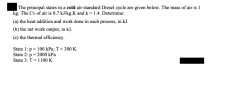
The principal states in a cold air-standard Diesel cycle are given below. The mass of air is 1 kg. The Cv of air is 0.7 kJ/kg.K and k=1.4. Determine: (a) the heat addition and work done in each process, in kJ. (b) the net work output, in kJ. (c) the thermal efficiency. State 1: p = 100 kPa; T = 300 K State 2: p= 2000 kPa State...
Can you please help me with a detailed solution to this
problem?
The principal states in a cold air-standard Diesel cycle are given below. The mass of air is 1 kg. The Cv of air is 0.7 kJ/kg.K and k=1.4. Determine: (a) the heat addition and work done in each process, in kJ. (b) the net work output, in kJ. (c) the thermal efficiency. State 1: p = 100 kPa; T = 300 K State 2: p= 2000 kPa State...
Need help with 2.3, my lecturers answers say that the efficiency is 55.9% and the T2s...
 Need help with 2.3, my lecturers answers say that the efficiency
is 55.9% and the T2s is 439.3K. If this is incorrect
please elaborate on why, if it is correct please show working.
Thank you!
0.01 kg of Air at 300 K and 100 kPa (state 1) is compressed in a piston cylinder (closed system). The compression process is a polytropic process. The pressure and temperature of the air at the end of the compression process are 380 kPa and...
Need help with 2.3, my lecturers answers say that the efficiency
is 55.9% and the T2s is 439.3K. If this is incorrect
please elaborate on why, if it is correct please show working.
Thank you!
0.01 kg of Air at 300 K and 100 kPa (state 1) is compressed in a piston cylinder (closed system). The compression process is a polytropic process. The pressure and temperature of the air at the end of the compression process are 380 kPa and...
 0r4 points| Previaus Answers Tipleri 19 P035 Mty Notes Ask Your An ideal diatomic gas follows the cycle shown in the figure. The temperature of state 1 is 340 K. Let P1 -3.0 atm and P2 3.5 atm. 100 200 300 (a) Determine the temperatures of the other three states of the cycle. T2- 268.3 Ta= 689.9 (b) Determine the efficiency of the cycle. Use the ideal-gas law to find the temperatures of each state of the gas. You can...
 16. 1.56/6.25 points | Previous Answers KatzPSE1 21 P080 My Notes Ask Your Teacher The PV diagram in the figure below shows a set of thermodynamic processes that make up a cycle ABCDA for a monatomic gas, where AB is an isothermal expansion occurring at a temperature of 390 K. There are 1.95 mol of gas undergoing the cycle with PA 1.01 x 10⁶ Pa, PB 5.40x 10⁵ Pa, and Pc 2.02 x 10⁵ Pa. Ps (a) Find the volumes...
 Can you please help me with a detailed solution to this
problem?
An ideal air-standard Brayton cycle operates at steady state with compressor inlet conditions of 250 K and 25 kPa. The compressor pressure ratio is 10. The turbine inlet temperature is 1800 K. For the cycle: (a) the heat addition and work done in each process, in kJ/kg, (b) the thermal efficiency (c) the back work ratio
Can you please help me with a detailed solution to this
problem?
An ideal air-standard Brayton cycle operates at steady state with compressor inlet conditions of 250 K and 25 kPa. The compressor pressure ratio is 10. The turbine inlet temperature is 1800 K. For the cycle: (a) the heat addition and work done in each process, in kJ/kg, (b) the thermal efficiency (c) the back work ratio
 Can you please help me with a detailed solution to this
problem?
The principal states in a cold air-standard Diesel cycle are given below. The mass of air is 1 kg. The Cv of air is 0.7 kJ/kg.K and k=1.4. Determine: (a) the heat addition and work done in each process, in kJ. (b) the net work output, in kJ. (c) the thermal efficiency. State 1: p = 100 kPa; T = 300 K State 2: p= 2000 kPa State...
Can you please help me with a detailed solution to this
problem?
The principal states in a cold air-standard Diesel cycle are given below. The mass of air is 1 kg. The Cv of air is 0.7 kJ/kg.K and k=1.4. Determine: (a) the heat addition and work done in each process, in kJ. (b) the net work output, in kJ. (c) the thermal efficiency. State 1: p = 100 kPa; T = 300 K State 2: p= 2000 kPa State...
 Need help with 2.3, my lecturers answers say that the efficiency
is 55.9% and the T2s is 439.3K. If this is incorrect
please elaborate on why, if it is correct please show working.
Thank you!
0.01 kg of Air at 300 K and 100 kPa (state 1) is compressed in a piston cylinder (closed system). The compression process is a polytropic process. The pressure and temperature of the air at the end of the compression process are 380 kPa and...
Need help with 2.3, my lecturers answers say that the efficiency
is 55.9% and the T2s is 439.3K. If this is incorrect
please elaborate on why, if it is correct please show working.
Thank you!
0.01 kg of Air at 300 K and 100 kPa (state 1) is compressed in a piston cylinder (closed system). The compression process is a polytropic process. The pressure and temperature of the air at the end of the compression process are 380 kPa and...
Most questions answered within 3 hours.
-
Where is the error in this code sequence?
String s1 = "Hello";
String s2 = "ello";...
asked 10 months ago -
Financial data for Joel de Paris, Inc., for last year
follow:
Joel de Paris, Inc.
Balance...
asked 10 months ago -
Consider this reaction:
Al2(SO4)3 (aq)+ BaCl3
(aq) Al2Cl6 (aq)- +
3BaSO4(s) . What is the...
asked 10 months ago -
Suppose that Savneet is considering increasing her
recent random sample from 20 car rentals to 40...
asked 10 months ago -
Trucks arrive at an unloading terminal at an average rate of 120
per hour.
Trucks arrive...
asked 10 months ago -
Why are methanol and ethanol completely soluble in water while
octanol is not very little soluble....
asked 10 months ago -
A facilities manager at a university reads in a research report
that the mean amount of...
asked 10 months ago -
When the CuSO4 is rehydrated by adding water to the anhydrous
compound, is this an endothermic...
asked 10 months ago -
A ray of sunlight is passing from diamond into crown glass; the
angle of incidence is...
asked 10 months ago -
A block of mass 0.249 kg is placed on top of a light, vertical
spring of...
asked 10 months ago -
how do the kidneys compensate in the presences of acidosis
a) trigger hyperventilate
b) reserve acid...
asked 10 months ago -
Question 501 pts
The rental rate of capital to the firm increases. Which of the
following...
asked 10 months ago