Can someone please tell me why this is suddenly is an addition (indicated by the blue arrow) when the formula has a subtraction here.
Thanks in advance!!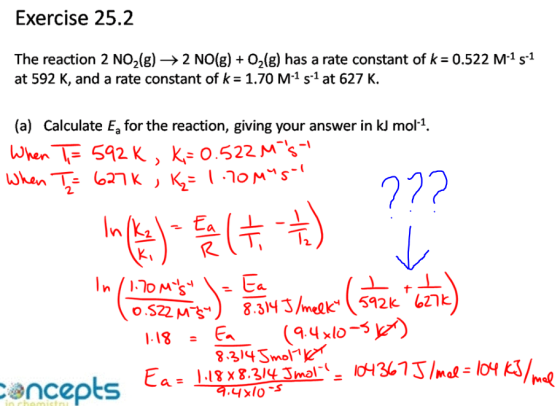
Homework Answers
Arhenius equation,
rate constant, k = Ae-Ea/RT
AT TWO DIFFERENT TEMPERATURES , DIFFERENT RATE CONSTANTS TO WRITE THE EQUATION TAKES AS,
In(K2/K1) = (Ea/R) [ (1/T1) -(1/T2] , THIS IS ONE ACTUAL CORRECT FORM AT TWO DIFFERENT TEMPERATURES.
EQUATION WRITTEN CORRECTLY. SUBSTITUTION ALSO CORRECT.
BUT WHAT IS WRONG?
SIGN WRONG.
-1/627K IS TO BE WRITTEN
THE SOLUTION SHOWING +1/627K, WHICH IS WRONG.
2.303 log(1.70/0.522) = (Ea/8.314)[(1/592)-(1/627]
on solving above , Ea = (0.3655x 8.314 x 105) /9.4292
= 32227 joules
= 32.227 kj
--------------------------------
please note Inx means ,it is 2.303logx
Add Answer to:
Can someone please tell me why this is suddenly is an addition
(indicated by the blue...
(a) 2 NO2(g) à 2 NO(g) + O2(g) The rate law for this reaction is 2nd...
(a) 2 NO2(g) à 2 NO(g) + O2(g) The rate law for this reaction is 2nd order. The rate constant is k = 0.775 M¯¹s¯¹. How much time would it require for [NO2] to go from 0.06M to 0.05M? (b) A 1st order reaction has a rate constant of k = 1.0 X 10¯³ s¯¹ at 25ᴼC. If the reaction rate doubles (2X faster) at 35ᴼC, what is the activation energy (Ea) for this reaction?
1a. The reaction of NO and O2 produces NO2. 2 NO(g) + O2(g) → 2 NO2(g)...
1a. The reaction of NO and O2 produces NO2. 2 NO(g) + O2(g) → 2 NO2(g) The reaction is second order with respect to NO(g) and first order with respect to O2(g). At a given temperature, the rate constant, k, equals 4.6 x 10² M–2 s–1. When the initial concentrations of NO and O2 are 0.02 M and 0.015 M, respectively, the rate of the reaction is ___ M/s. 1b. The rate constant of a first-order decomposition reaction is 0.014...
1. Calculate the activation energy, Ea, in kilojoules per mole for a reaction at 73.0 ∘C...
1. Calculate the activation energy, Ea, in kilojoules per mole for a reaction at 73.0 ∘C that has a rate constant of 0.278 s−1 and a frequency factor of 9.74×10¹¹ s−1. Ea= kJ/mol 2. Nitogen dioxide, NO2, is a red-brown gas that is considered an air pollutant. When heated, nitogen dioxide gas decomposes into nitrogen monoxide and oxygen gas, according to the following reaction. 2NO2(g)−⇀↽−2NO(g)+O2(g) A sample of nitrogen dioxide in a sealed vessel was heated to 575 K, and...
Could someone please answer both parts of this question for me! I have no idea how...
 Could someone please answer both parts of this question for me!
I have no idea how to do it. Thanks!
<Ch17rev Item 10 10 of 11 > Review Constants 1 Periodic Table Consider the following reaction: 2 NO(g) + O2(g) = 2 NO2 (9) Part A The data in the table show the equilibrium constant for this reaction measured at several different temperatures. Use the data to find A. Hº for the reaction. Temperature/ K 400 IVO AQ O ?...
Could someone please answer both parts of this question for me!
I have no idea how to do it. Thanks!
<Ch17rev Item 10 10 of 11 > Review Constants 1 Periodic Table Consider the following reaction: 2 NO(g) + O2(g) = 2 NO2 (9) Part A The data in the table show the equilibrium constant for this reaction measured at several different temperatures. Use the data to find A. Hº for the reaction. Temperature/ K 400 IVO AQ O ?...
The reaction of NO and O2 produces NO2. 2 NO(g) + O2(g) → 2 NO2(g) The...
The reaction of NO and O2 produces NO2. 2 NO(g) + O2(g) → 2 NO2(g) The reaction is second-order with respect to NO(g) and first-order with respect to O2(g). At a given temperature, the rate constant, k, equals 4.7E+2 M–2s–1. What is the rate of reaction when the initial concentrations of NO and O2 are 1.95E-2 M and 1.40E-2 M, respectively? 5.32E-6 M/s 2.50E-3 M/s 1.80E-3 M/s 0.128 M/s -2.50E-3 M/s
can someone please help me with these three please QUESTION 1 The rate law of a...
 can someone please help me with these three please
QUESTION 1 The rate law of a reaction is rate = k[X][Y][Z]. The units of the rate constant are O mol2 L-25-1 OL2 mol-25-1 mol L-lg-2 O L mol-lg-1 O mol L-15-1 QUESTION 2 For the equilibrium 2PH3(e) = P2(e)+3H2(g), the equilibrium partial pressures are PpH, -0.023 atm, PP, 0.32latm. and PH -0.732 atm at 738K. Calculate Kp. *Please report 3 significant figures. Numbers only, No unit. No scientific notation. QUESTION...
can someone please help me with these three please
QUESTION 1 The rate law of a reaction is rate = k[X][Y][Z]. The units of the rate constant are O mol2 L-25-1 OL2 mol-25-1 mol L-lg-2 O L mol-lg-1 O mol L-15-1 QUESTION 2 For the equilibrium 2PH3(e) = P2(e)+3H2(g), the equilibrium partial pressures are PpH, -0.023 atm, PP, 0.32latm. and PH -0.732 atm at 738K. Calculate Kp. *Please report 3 significant figures. Numbers only, No unit. No scientific notation. QUESTION...
The elementary reaction 2NO2 (g) -> 2NO (g) + O2 (g) is second order in NO2...
The elementary reaction 2NO2 (g) -> 2NO (g) + O2 (g) is second order in NO2 and the rate constant at 660 K is 5.23 M-1s-1. The reaction half-life at this temperature when [NO2]0 = 0.45 M is ____ s.
9,10,11 9. Consider the decomposition reaction of N2Os. 2 N203(g) → 4NO2(g) + O2(g) follows the...
 9,10,11
9. Consider the decomposition reaction of N2Os. 2 N203(g) → 4NO2(g) + O2(g) follows the first order kinetics with rate constant of 4.8 x 10's. (a) if the initial 165 x 10-2M what is the concentration at 825 s? (b) How long it will take for concentration is 1.65 x 10⁻²M what is the concentrat the concentration of N2Os to decrease to 1.00 x 10⁻²M? t 10. Nitrosyl chloride, NOCI, decomposes slowly to NO and Cl2, the reaction follows...
9,10,11
9. Consider the decomposition reaction of N2Os. 2 N203(g) → 4NO2(g) + O2(g) follows the first order kinetics with rate constant of 4.8 x 10's. (a) if the initial 165 x 10-2M what is the concentration at 825 s? (b) How long it will take for concentration is 1.65 x 10⁻²M what is the concentrat the concentration of N2Os to decrease to 1.00 x 10⁻²M? t 10. Nitrosyl chloride, NOCI, decomposes slowly to NO and Cl2, the reaction follows...
A reaction of importance in the formation of smog is that between ozone and nitrogen monoxide...
A reaction of importance in the formation of smog is that between ozone and nitrogen monoxide described by O3(g)+NO(g)⟶O2(g)+NO2(g)O3(g)+NO(g)⟶O2(g)+NO2(g) The rate law for this reaction is rate of reaction=?[O3][NO]rate of reaction=k[O3][NO] Given that ?=3.02×10⁶ M−1⋅s−1k=3.02×10⁶ M−1⋅s−1 at a certain temperature, calculate the initial reaction rate when [O3O3] and [NONO] remain essentially constant at the values [O3]0=2.65×10⁻⁶ M[O3]0=2.65×10⁻⁶ M and [NO]0=7.57×10⁻⁵ M[NO]0=7.57×10⁻⁵ M, owing to continuous production from separate sources. Calculate the number of moles of NO2(g)NO2(g) produced per hour per...
The rate constant for the reaction of nitrogen monoxide and ozone as shown in the corresponding...
 The rate constant for the reaction of nitrogen monoxide and
ozone as shown in the corresponding image, is 1.67 x
1010 M-1 s-1 at 325 K. The rate
constant for the same reaction at 375 K is 2.79 x 10¹⁰
M-1 s-1 determine the activation energy of
this reaction.
A) 10.4 kJ
B) 19.7 kJ
C) 21.3 kJ
D) 100.4 kJ
O3(g) + NO(g) → O2(g) + NO2(g)
The rate constant for the reaction of nitrogen monoxide and
ozone as shown in the corresponding image, is 1.67 x
1010 M-1 s-1 at 325 K. The rate
constant for the same reaction at 375 K is 2.79 x 10¹⁰
M-1 s-1 determine the activation energy of
this reaction.
A) 10.4 kJ
B) 19.7 kJ
C) 21.3 kJ
D) 100.4 kJ
O3(g) + NO(g) → O2(g) + NO2(g)
 Could someone please answer both parts of this question for me!
I have no idea how to do it. Thanks!
<Ch17rev Item 10 10 of 11 > Review Constants 1 Periodic Table Consider the following reaction: 2 NO(g) + O2(g) = 2 NO2 (9) Part A The data in the table show the equilibrium constant for this reaction measured at several different temperatures. Use the data to find A. Hº for the reaction. Temperature/ K 400 IVO AQ O ?...
Could someone please answer both parts of this question for me!
I have no idea how to do it. Thanks!
<Ch17rev Item 10 10 of 11 > Review Constants 1 Periodic Table Consider the following reaction: 2 NO(g) + O2(g) = 2 NO2 (9) Part A The data in the table show the equilibrium constant for this reaction measured at several different temperatures. Use the data to find A. Hº for the reaction. Temperature/ K 400 IVO AQ O ?...
 can someone please help me with these three please
QUESTION 1 The rate law of a reaction is rate = k[X][Y][Z]. The units of the rate constant are O mol2 L-25-1 OL2 mol-25-1 mol L-lg-2 O L mol-lg-1 O mol L-15-1 QUESTION 2 For the equilibrium 2PH3(e) = P2(e)+3H2(g), the equilibrium partial pressures are PpH, -0.023 atm, PP, 0.32latm. and PH -0.732 atm at 738K. Calculate Kp. *Please report 3 significant figures. Numbers only, No unit. No scientific notation. QUESTION...
can someone please help me with these three please
QUESTION 1 The rate law of a reaction is rate = k[X][Y][Z]. The units of the rate constant are O mol2 L-25-1 OL2 mol-25-1 mol L-lg-2 O L mol-lg-1 O mol L-15-1 QUESTION 2 For the equilibrium 2PH3(e) = P2(e)+3H2(g), the equilibrium partial pressures are PpH, -0.023 atm, PP, 0.32latm. and PH -0.732 atm at 738K. Calculate Kp. *Please report 3 significant figures. Numbers only, No unit. No scientific notation. QUESTION...
 9,10,11
9. Consider the decomposition reaction of N2Os. 2 N203(g) → 4NO2(g) + O2(g) follows the first order kinetics with rate constant of 4.8 x 10's. (a) if the initial 165 x 10-2M what is the concentration at 825 s? (b) How long it will take for concentration is 1.65 x 10⁻²M what is the concentrat the concentration of N2Os to decrease to 1.00 x 10⁻²M? t 10. Nitrosyl chloride, NOCI, decomposes slowly to NO and Cl2, the reaction follows...
9,10,11
9. Consider the decomposition reaction of N2Os. 2 N203(g) → 4NO2(g) + O2(g) follows the first order kinetics with rate constant of 4.8 x 10's. (a) if the initial 165 x 10-2M what is the concentration at 825 s? (b) How long it will take for concentration is 1.65 x 10⁻²M what is the concentrat the concentration of N2Os to decrease to 1.00 x 10⁻²M? t 10. Nitrosyl chloride, NOCI, decomposes slowly to NO and Cl2, the reaction follows...
 The rate constant for the reaction of nitrogen monoxide and
ozone as shown in the corresponding image, is 1.67 x
1010 M-1 s-1 at 325 K. The rate
constant for the same reaction at 375 K is 2.79 x 10¹⁰
M-1 s-1 determine the activation energy of
this reaction.
A) 10.4 kJ
B) 19.7 kJ
C) 21.3 kJ
D) 100.4 kJ
O3(g) + NO(g) → O2(g) + NO2(g)
The rate constant for the reaction of nitrogen monoxide and
ozone as shown in the corresponding image, is 1.67 x
1010 M-1 s-1 at 325 K. The rate
constant for the same reaction at 375 K is 2.79 x 10¹⁰
M-1 s-1 determine the activation energy of
this reaction.
A) 10.4 kJ
B) 19.7 kJ
C) 21.3 kJ
D) 100.4 kJ
O3(g) + NO(g) → O2(g) + NO2(g)
Most questions answered within 3 hours.
-
Where is the error in this code sequence?
String s1 = "Hello";
String s2 = "ello";...
asked 10 months ago -
Financial data for Joel de Paris, Inc., for last year
follow:
Joel de Paris, Inc.
Balance...
asked 10 months ago -
Consider this reaction:
Al2(SO4)3 (aq)+ BaCl3
(aq) Al2Cl6 (aq)- +
3BaSO4(s) . What is the...
asked 10 months ago -
Suppose that Savneet is considering increasing her
recent random sample from 20 car rentals to 40...
asked 10 months ago -
Trucks arrive at an unloading terminal at an average rate of 120
per hour.
Trucks arrive...
asked 10 months ago -
Why are methanol and ethanol completely soluble in water while
octanol is not very little soluble....
asked 10 months ago -
A facilities manager at a university reads in a research report
that the mean amount of...
asked 10 months ago -
When the CuSO4 is rehydrated by adding water to the anhydrous
compound, is this an endothermic...
asked 10 months ago -
A ray of sunlight is passing from diamond into crown glass; the
angle of incidence is...
asked 10 months ago -
A block of mass 0.249 kg is placed on top of a light, vertical
spring of...
asked 10 months ago -
how do the kidneys compensate in the presences of acidosis
a) trigger hyperventilate
b) reserve acid...
asked 10 months ago -
Question 501 pts
The rental rate of capital to the firm increases. Which of the
following...
asked 10 months ago