A cylinder contains 4.0 g of nitrogen gas. A piston compresses the gas to half its...
Homework Answers
density p1=m/V1 ... (1)
mass and moles are constant since no gas scaped
volume has changed so mass density also changes
V2=V1/2
p2= m/V2 = m/(V1/2) so p2= 2 * m/V1
from (1) p2= 2*p1
Increased by a factor of 2
Add Answer to:
A cylinder contains 4.0 g of nitrogen gas. A piston compresses the gas to half its...
The syringe shown at right contains nitrogen gas. The syringe has a movable piston of mass...
 The syringe shown at right contains nitrogen gas. The syringe
has a movable piston of mass M. At the bottom, the syringe is
closed by a valve, so that no gas may enter or leave the syringe.
(Neglect friction between the piston and the wall of the syringe.
Assume that nitrogen gas behaves like an ideal gas.) Initially the
syringe is in thermal equilibrium with an ice-water bath. The
pressure and volume of the gas inside the syringe are Pinitial...
The syringe shown at right contains nitrogen gas. The syringe
has a movable piston of mass M. At the bottom, the syringe is
closed by a valve, so that no gas may enter or leave the syringe.
(Neglect friction between the piston and the wall of the syringe.
Assume that nitrogen gas behaves like an ideal gas.) Initially the
syringe is in thermal equilibrium with an ice-water bath. The
pressure and volume of the gas inside the syringe are Pinitial...
c) A cylinder contains 25 g of oxygen gas. A piston is used to compress the...
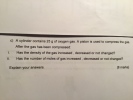 c) A cylinder contains 25 g of oxygen gas. A piston is used to compress the gas. After the gas has been compressed: i. Has the density of the gas increased, decreased or not changed? ii. Has the number of moles of gas increased, decreased or not changed? Explain your answers. [8 marks]
A piston-cylinder device contains 0.78 kg of nitrogen gas at 140 kPa and 37°C. The gas...
 A piston-cylinder device contains 0.78 kg of nitrogen gas at 140 kPa and 37°C. The gas is now compressed slowly in a polytropic process during which PV1.3 = constant. The process ends when the volume is reduced by one-half. Determine the entropy change of nitrogen during this process. The gas constant of nitrogen is R= 0.2968 kJ/kg-K. The constant volume specific heat of nitrogen at room temperature is Cr=0.743 kJ/kg-K. (Round the final answer to five decimal places.) The entropy...
9. (8 points) A 1.72 L cylinder with a moveable piston contains nitrogen gas at a...
 9. (8 points) A 1.72 L cylinder with a moveable piston contains nitrogen gas at a pressure of 0.985 atm and a temperature of 44°C. The gas is cooled while the pressure is maintained constant until the cylinder volume reaches 1.18 L. What is the final temperature (in °C) of the gas? 300
Joule Joule -_ Joule Joule cylinder with 20 g of nitrogen gas is mechanically coupled to...
 Joule Joule -_ Joule Joule cylinder with 20 g of nitrogen gas is mechanically coupled to the environment with a frictionless piston The initial pressure is 1 atm and the initial temperature is 20°C. The gas is then reversibly compressed to half of its initial volume in an isothermal process. Calculate the heat q, work w, change in internal energy ΔU and change in enthalpy ΔH for this process in Joule. You can assume ideal behavior for the nitrogen gas
which compresses the gas to a smaller volume as seen in the figure. What is the final pressure of the helium gas?
 5. A cylinder with a movable piston contains 0.41 mole of helium gas. The piston is open to the atmosphere on the top and has a mass of 30 kg and a radius of 0.1 m. The gas and cylinder are in equilibrium with the atmosphere, which has a temperature of 290 K and pressure of 1.00 x 10s Pa. The initial volume of the helium inside the cylinder is 0.0090 m when a 60-kg mass is placed on top...
A cylinder with a moveable piston contains 0.502 mol of gas and has a volume of...
A cylinder with a moveable piston contains 0.502 mol of gas and has a volume of 275 mL What will its volume be if an additional 0.198 mol of gas is added to the cylinder
Check my work 6 10 A piston-cylinder device contains 0.63 kg of nitrogen gas at 140...
 Check my work 6 10 A piston-cylinder device contains 0.63 kg of nitrogen gas at 140 kPa and 37°C. The gas is now compressed slowly in a polytropic process during which PV1.3 = constant. The process ends when the volume is reduced by one-half. Determine the entropy change of nitrogen during this process. The gas constant of nitrogen is R = 0.2968 kJ/kg.K. The constant volume specific heat of nitrogen at room temperature is cy" 0.743 kJ/kg.K. (Round the final...
A cylinder of volume 1.00m^3 contains 320 g of oxygen gas (O_2) at a temperature of...
 A cylinder of volume 1.00m^3 contains 320 g of oxygen gas (O_2) at a temperature of 27.0 degree C. The atomic mass of oxygen is 16 u. (1u = 1.66 times 10^-27 kg) What is the pressure exerted by the gas on the walls of the container? If the volume of the cylinder is reduced to half its original value by pushing down on a piston and the pressure exerted by the oxygen gas on the walls of the cylinder...
A piston-cylinder device contains 0.63 kg of nitrogen gas at 140 kPa and 37°C. The gas...
 A piston-cylinder device contains 0.63 kg of nitrogen gas at 140 kPa and 37°C. The gas is now compressed slowly in a polytropic process during which PV1.3. constant. The process ends when the volume is reduced by one-halt. Determine the entropy change of nitrogen during this process. The gas constant of nitrogen is R-0.2968 kJ/kg K. The constant volume specific heat of nitrogen at room temperature is C -0.743 kJ/kg K. (Round the final answer to five decimal places.) The...
 The syringe shown at right contains nitrogen gas. The syringe
has a movable piston of mass M. At the bottom, the syringe is
closed by a valve, so that no gas may enter or leave the syringe.
(Neglect friction between the piston and the wall of the syringe.
Assume that nitrogen gas behaves like an ideal gas.) Initially the
syringe is in thermal equilibrium with an ice-water bath. The
pressure and volume of the gas inside the syringe are Pinitial...
The syringe shown at right contains nitrogen gas. The syringe
has a movable piston of mass M. At the bottom, the syringe is
closed by a valve, so that no gas may enter or leave the syringe.
(Neglect friction between the piston and the wall of the syringe.
Assume that nitrogen gas behaves like an ideal gas.) Initially the
syringe is in thermal equilibrium with an ice-water bath. The
pressure and volume of the gas inside the syringe are Pinitial...
 c) A cylinder contains 25 g of oxygen gas. A piston is used to compress the gas. After the gas has been compressed: i. Has the density of the gas increased, decreased or not changed? ii. Has the number of moles of gas increased, decreased or not changed? Explain your answers. [8 marks]
 A piston-cylinder device contains 0.78 kg of nitrogen gas at 140 kPa and 37°C. The gas is now compressed slowly in a polytropic process during which PV1.3 = constant. The process ends when the volume is reduced by one-half. Determine the entropy change of nitrogen during this process. The gas constant of nitrogen is R= 0.2968 kJ/kg-K. The constant volume specific heat of nitrogen at room temperature is Cr=0.743 kJ/kg-K. (Round the final answer to five decimal places.) The entropy...
 9. (8 points) A 1.72 L cylinder with a moveable piston contains nitrogen gas at a pressure of 0.985 atm and a temperature of 44°C. The gas is cooled while the pressure is maintained constant until the cylinder volume reaches 1.18 L. What is the final temperature (in °C) of the gas? 300
 Joule Joule -_ Joule Joule cylinder with 20 g of nitrogen gas is mechanically coupled to the environment with a frictionless piston The initial pressure is 1 atm and the initial temperature is 20°C. The gas is then reversibly compressed to half of its initial volume in an isothermal process. Calculate the heat q, work w, change in internal energy ΔU and change in enthalpy ΔH for this process in Joule. You can assume ideal behavior for the nitrogen gas
 5. A cylinder with a movable piston contains 0.41 mole of helium gas. The piston is open to the atmosphere on the top and has a mass of 30 kg and a radius of 0.1 m. The gas and cylinder are in equilibrium with the atmosphere, which has a temperature of 290 K and pressure of 1.00 x 10s Pa. The initial volume of the helium inside the cylinder is 0.0090 m when a 60-kg mass is placed on top...
 Check my work 6 10 A piston-cylinder device contains 0.63 kg of nitrogen gas at 140 kPa and 37°C. The gas is now compressed slowly in a polytropic process during which PV1.3 = constant. The process ends when the volume is reduced by one-half. Determine the entropy change of nitrogen during this process. The gas constant of nitrogen is R = 0.2968 kJ/kg.K. The constant volume specific heat of nitrogen at room temperature is cy" 0.743 kJ/kg.K. (Round the final...
 A cylinder of volume 1.00m^3 contains 320 g of oxygen gas (O_2) at a temperature of 27.0 degree C. The atomic mass of oxygen is 16 u. (1u = 1.66 times 10^-27 kg) What is the pressure exerted by the gas on the walls of the container? If the volume of the cylinder is reduced to half its original value by pushing down on a piston and the pressure exerted by the oxygen gas on the walls of the cylinder...
 A piston-cylinder device contains 0.63 kg of nitrogen gas at 140 kPa and 37°C. The gas is now compressed slowly in a polytropic process during which PV1.3. constant. The process ends when the volume is reduced by one-halt. Determine the entropy change of nitrogen during this process. The gas constant of nitrogen is R-0.2968 kJ/kg K. The constant volume specific heat of nitrogen at room temperature is C -0.743 kJ/kg K. (Round the final answer to five decimal places.) The...
Most questions answered within 3 hours.
-
Where is the error in this code sequence?
String s1 = "Hello";
String s2 = "ello";...
asked 11 months ago -
Financial data for Joel de Paris, Inc., for last year
follow:
Joel de Paris, Inc.
Balance...
asked 11 months ago -
Consider this reaction:
Al2(SO4)3 (aq)+ BaCl3
(aq) Al2Cl6 (aq)- +
3BaSO4(s) . What is the...
asked 11 months ago -
Suppose that Savneet is considering increasing her
recent random sample from 20 car rentals to 40...
asked 11 months ago -
Trucks arrive at an unloading terminal at an average rate of 120
per hour.
Trucks arrive...
asked 11 months ago -
Why are methanol and ethanol completely soluble in water while
octanol is not very little soluble....
asked 11 months ago -
A facilities manager at a university reads in a research report
that the mean amount of...
asked 11 months ago -
When the CuSO4 is rehydrated by adding water to the anhydrous
compound, is this an endothermic...
asked 11 months ago -
A ray of sunlight is passing from diamond into crown glass; the
angle of incidence is...
asked 11 months ago -
A block of mass 0.249 kg is placed on top of a light, vertical
spring of...
asked 11 months ago -
how do the kidneys compensate in the presences of acidosis
a) trigger hyperventilate
b) reserve acid...
asked 11 months ago -
Question 501 pts
The rental rate of capital to the firm increases. Which of the
following...
asked 11 months ago