
Homework Answers
clc;
clear all;
close all;
fm=1500;
Fs = 2*fm;
T = 1/Fs;
L = 3000;
t = (0:L-1)*T;
x = cos(2*pi*500*t)+cos(2*pi*1500*t);
N = 2^nextpow2(L);
X = fft(x,N)/L;
f = Fs/2*linspace(0,1,N/2+1);
plot(f,2*abs(X(1:N/2+1)))
title('Amplitude Spectrum of x(t)')
xlabel('Frequency (Hz)')
ylabel('|X(f)|')

consider the signal using matlab Problem 2: Consider a signal: x[n] 3cos(n7/3) + 2sin(nt/4)+ cos(n7/5) Using...
 consider the signal using matlab
Problem 2: Consider a signal: x[n] 3cos(n7/3) + 2sin(nt/4)+ cos(n7/5) Using Matlab, (1) Plot this signal in time domain. Can you identify the various frequencies in this signal? Use n 0:1:1000 (2) Plot this signal in frequency domain using the "fft" command. Identify the individual frequencies in the plot. (3) Calculate the frequencies of these signals. In the frequency plot, 1000 2
consider the signal using matlab
Problem 2: Consider a signal: x[n] 3cos(n7/3) + 2sin(nt/4)+ cos(n7/5) Using Matlab, (1) Plot this signal in time domain. Can you identify the various frequencies in this signal? Use n 0:1:1000 (2) Plot this signal in frequency domain using the "fft" command. Identify the individual frequencies in the plot. (3) Calculate the frequencies of these signals. In the frequency plot, 1000 2
Consider a speech signal x() that has the following frequency spectrum: xga) 1 + cos( -/100 a) Se...
 Digital Signal Processing
DFT
Consider a speech signal x() that has the following frequency spectrum: xga) 1 + cos( -/100 a) Select appropriate values of N and T that will help us carry out DFT-based spectral analysis of this signal x401@) 800 such that the continuous-time frequencies are sampled no farther than 10 Hz apart. b) Ignore the issue of spectral leakage; under this assumption, provide a closed-form expression for the DFT of the signal using the values selected in...
Digital Signal Processing
DFT
Consider a speech signal x() that has the following frequency spectrum: xga) 1 + cos( -/100 a) Select appropriate values of N and T that will help us carry out DFT-based spectral analysis of this signal x401@) 800 such that the continuous-time frequencies are sampled no farther than 10 Hz apart. b) Ignore the issue of spectral leakage; under this assumption, provide a closed-form expression for the DFT of the signal using the values selected in...
Problem 2 (Spectrum of a rectangular signal): In this problem, the amplitude spectrum of the signal 1 or Ot 2 ms x(t)- 0 otherwise is to be analysed (b) Numerical calculation of the spectrum: (i) Us...
 Problem 2 (Spectrum of a rectangular signal): In this problem, the amplitude spectrum of the signal 1 or Ot 2 ms x(t)- 0 otherwise is to be analysed (b) Numerical calculation of the spectrum: (i) Use Matlab to generate and plot a vector containing the sample values of the rectangular signal defined in (2) sampled at f 8kHz. Choose the number N of sample values so that it is a power of 2 and that the signal duration is at...
P-3.8 Consider the signal ob d x (t) = 10 + 20 cos(21 (100)t + )...
 P-3.8 Consider the signal ob d x (t) = 10 + 20 cos(21 (100)t + ) + 10 cos(21 (250)t) L (a) Using Euler's relation, the signal x(t) defined above can be expressed as a sum of complex exponential signals using the finite Fourier synthesis summation (3.37) Determine values for fo, N, and all the complex amplitudes, az. It is not necessary to evaluate any integrals to obtain ak. (b) Is the signal x(t) periodic? If so, what is the...
(B) Implement Matlab code for each part as described below: i) Define the following signal in tim...
 Using MATLAB, Please read carefully, EXPLAIN CODE AND ANSWERS,
DISCUSS RESULTS, I NEED EVERY PART
(B) Implement Matlab code for each part as described below: i) Define the following signal in time and plot it where Ai 10, A2-3, fi-10 Hz, f2-40 Hz. part of the DFT, and discuss the results. zero. Do this carefully for both positive and negative frequencies. Call this signal G (f). ii) Compute the DFT S(f) of s (t) using the fft() function. Plot the...
Using MATLAB, Please read carefully, EXPLAIN CODE AND ANSWERS,
DISCUSS RESULTS, I NEED EVERY PART
(B) Implement Matlab code for each part as described below: i) Define the following signal in time and plot it where Ai 10, A2-3, fi-10 Hz, f2-40 Hz. part of the DFT, and discuss the results. zero. Do this carefully for both positive and negative frequencies. Call this signal G (f). ii) Compute the DFT S(f) of s (t) using the fft() function. Plot the...
Q2 Consider a communication signal x(t) described by the following mathematical expression: x(t)=2 cos(2000) + 4...
 Q2 Consider a communication signal x(t) described by the following mathematical expression: x(t)=2 cos(2000) + 4 sin? (2000) – 2+4rec(t)cos(6000mt) Analyse the communication signal x(t) then consider the following: (i) Determine the Fourier transform of the signal x(t). (ii) Plot the double-sided amplitude spectrum of the signal x(t).
MATLAB Code Question alpha = 2.3 beta = 4.3 zeta = 9.1 PROBLEM 4 (20 points). Consider three sinusoids with the following amplitudes and phases a.cs(2n(500t)) β.cos(2n(500t) +0.5r) x1n] x2[n] rn...
 MATLAB Code Question
alpha = 2.3
beta = 4.3
zeta = 9.1
PROBLEM 4 (20 points). Consider three sinusoids with the following amplitudes and phases a.cs(2n(500t)) β.cos(2n(500t) +0.5r) x1n] x2[n] rn = cos(2(500t)0.75) Create a MATLAB program to sample each sinusoid and generate a sum of three sinusoids, that is using a sampling rate of 8,000 Hz over a range of 0.1 seconds Use the MATLAB function stem) to plot r[n] for the first 20 samples Use the MATLAB function...
MATLAB Code Question
alpha = 2.3
beta = 4.3
zeta = 9.1
PROBLEM 4 (20 points). Consider three sinusoids with the following amplitudes and phases a.cs(2n(500t)) β.cos(2n(500t) +0.5r) x1n] x2[n] rn = cos(2(500t)0.75) Create a MATLAB program to sample each sinusoid and generate a sum of three sinusoids, that is using a sampling rate of 8,000 Hz over a range of 0.1 seconds Use the MATLAB function stem) to plot r[n] for the first 20 samples Use the MATLAB function...
Consider x(t) 1 + cos(50t) + cos( 150t) a. (5) Is x(t) periodic? If so, what...
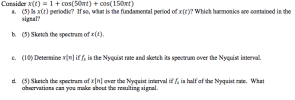 Consider x(t) 1 + cos(50t) + cos( 150t) a. (5) Is x(t) periodic? If so, what is the fundamental period of x(t)? Which harmonics are contained in the signal? b. (5) Sketch the spectrum of x(t) c. (10) Determine x [n] if fs is the Nyquist rate and sketch its spectrum over the Nyquist interval. (5) Sketch the spectrum of x[n] over the Nyquist interval if fs is half of the Nyquist rate. What observations can you make about the...
yin]-[x, -X]. Plot the magnitude of XIK] and YK] in Problem 1. Let x[n]=cos(2n/20*n)+randn( 1, 20) for n= 1:20 Matlab. x(k) is the fft of x zero padded to 40 data points. What is the relationship bet...
 yin]-[x, -X]. Plot the magnitude of XIK] and YK] in Problem 1. Let x[n]=cos(2n/20*n)+randn( 1, 20) for n= 1:20 Matlab. x(k) is the fft of x zero padded to 40 data points. What is the relationship between X[k] and YK? data points. What is the relationship between XIK] and YIK]?
yin]-[x, -X]. Plot the magnitude of XIK] and YK] in Problem 1. Let x[n]=cos(2n/20*n)+randn( 1, 20) for n= 1:20 Matlab. x(k) is the fft of x zero padded to 40...
yin]-[x, -X]. Plot the magnitude of XIK] and YK] in Problem 1. Let x[n]=cos(2n/20*n)+randn( 1, 20) for n= 1:20 Matlab. x(k) is the fft of x zero padded to 40 data points. What is the relationship between X[k] and YK? data points. What is the relationship between XIK] and YIK]?
yin]-[x, -X]. Plot the magnitude of XIK] and YK] in Problem 1. Let x[n]=cos(2n/20*n)+randn( 1, 20) for n= 1:20 Matlab. x(k) is the fft of x zero padded to 40...
Using Excel, plot the function f(t)=3*cos(500*π*t) + 5*cos(800*π*t) from 00025 to .1s at .0025s intervals. Connect...
Using Excel, plot the function f(t)=3*cos(500*π*t) + 5*cos(800*π*t) from 00025 to .1s at .0025s intervals. Connect the points with straight lines. Explain the shape of the resulting plot. Find the FFT using Microsoft Excel.
 consider the signal using matlab
Problem 2: Consider a signal: x[n] 3cos(n7/3) + 2sin(nt/4)+ cos(n7/5) Using Matlab, (1) Plot this signal in time domain. Can you identify the various frequencies in this signal? Use n 0:1:1000 (2) Plot this signal in frequency domain using the "fft" command. Identify the individual frequencies in the plot. (3) Calculate the frequencies of these signals. In the frequency plot, 1000 2
consider the signal using matlab
Problem 2: Consider a signal: x[n] 3cos(n7/3) + 2sin(nt/4)+ cos(n7/5) Using Matlab, (1) Plot this signal in time domain. Can you identify the various frequencies in this signal? Use n 0:1:1000 (2) Plot this signal in frequency domain using the "fft" command. Identify the individual frequencies in the plot. (3) Calculate the frequencies of these signals. In the frequency plot, 1000 2
 Digital Signal Processing
DFT
Consider a speech signal x() that has the following frequency spectrum: xga) 1 + cos( -/100 a) Select appropriate values of N and T that will help us carry out DFT-based spectral analysis of this signal x401@) 800 such that the continuous-time frequencies are sampled no farther than 10 Hz apart. b) Ignore the issue of spectral leakage; under this assumption, provide a closed-form expression for the DFT of the signal using the values selected in...
Digital Signal Processing
DFT
Consider a speech signal x() that has the following frequency spectrum: xga) 1 + cos( -/100 a) Select appropriate values of N and T that will help us carry out DFT-based spectral analysis of this signal x401@) 800 such that the continuous-time frequencies are sampled no farther than 10 Hz apart. b) Ignore the issue of spectral leakage; under this assumption, provide a closed-form expression for the DFT of the signal using the values selected in...
 Problem 2 (Spectrum of a rectangular signal): In this problem, the amplitude spectrum of the signal 1 or Ot 2 ms x(t)- 0 otherwise is to be analysed (b) Numerical calculation of the spectrum: (i) Use Matlab to generate and plot a vector containing the sample values of the rectangular signal defined in (2) sampled at f 8kHz. Choose the number N of sample values so that it is a power of 2 and that the signal duration is at...
 P-3.8 Consider the signal ob d x (t) = 10 + 20 cos(21 (100)t + ) + 10 cos(21 (250)t) L (a) Using Euler's relation, the signal x(t) defined above can be expressed as a sum of complex exponential signals using the finite Fourier synthesis summation (3.37) Determine values for fo, N, and all the complex amplitudes, az. It is not necessary to evaluate any integrals to obtain ak. (b) Is the signal x(t) periodic? If so, what is the...
 Using MATLAB, Please read carefully, EXPLAIN CODE AND ANSWERS,
DISCUSS RESULTS, I NEED EVERY PART
(B) Implement Matlab code for each part as described below: i) Define the following signal in time and plot it where Ai 10, A2-3, fi-10 Hz, f2-40 Hz. part of the DFT, and discuss the results. zero. Do this carefully for both positive and negative frequencies. Call this signal G (f). ii) Compute the DFT S(f) of s (t) using the fft() function. Plot the...
Using MATLAB, Please read carefully, EXPLAIN CODE AND ANSWERS,
DISCUSS RESULTS, I NEED EVERY PART
(B) Implement Matlab code for each part as described below: i) Define the following signal in time and plot it where Ai 10, A2-3, fi-10 Hz, f2-40 Hz. part of the DFT, and discuss the results. zero. Do this carefully for both positive and negative frequencies. Call this signal G (f). ii) Compute the DFT S(f) of s (t) using the fft() function. Plot the...
 Q2 Consider a communication signal x(t) described by the following mathematical expression: x(t)=2 cos(2000) + 4 sin? (2000) – 2+4rec(t)cos(6000mt) Analyse the communication signal x(t) then consider the following: (i) Determine the Fourier transform of the signal x(t). (ii) Plot the double-sided amplitude spectrum of the signal x(t).
 MATLAB Code Question
alpha = 2.3
beta = 4.3
zeta = 9.1
PROBLEM 4 (20 points). Consider three sinusoids with the following amplitudes and phases a.cs(2n(500t)) β.cos(2n(500t) +0.5r) x1n] x2[n] rn = cos(2(500t)0.75) Create a MATLAB program to sample each sinusoid and generate a sum of three sinusoids, that is using a sampling rate of 8,000 Hz over a range of 0.1 seconds Use the MATLAB function stem) to plot r[n] for the first 20 samples Use the MATLAB function...
MATLAB Code Question
alpha = 2.3
beta = 4.3
zeta = 9.1
PROBLEM 4 (20 points). Consider three sinusoids with the following amplitudes and phases a.cs(2n(500t)) β.cos(2n(500t) +0.5r) x1n] x2[n] rn = cos(2(500t)0.75) Create a MATLAB program to sample each sinusoid and generate a sum of three sinusoids, that is using a sampling rate of 8,000 Hz over a range of 0.1 seconds Use the MATLAB function stem) to plot r[n] for the first 20 samples Use the MATLAB function...
 Consider x(t) 1 + cos(50t) + cos( 150t) a. (5) Is x(t) periodic? If so, what is the fundamental period of x(t)? Which harmonics are contained in the signal? b. (5) Sketch the spectrum of x(t) c. (10) Determine x [n] if fs is the Nyquist rate and sketch its spectrum over the Nyquist interval. (5) Sketch the spectrum of x[n] over the Nyquist interval if fs is half of the Nyquist rate. What observations can you make about the...
 yin]-[x, -X]. Plot the magnitude of XIK] and YK] in Problem 1. Let x[n]=cos(2n/20*n)+randn( 1, 20) for n= 1:20 Matlab. x(k) is the fft of x zero padded to 40 data points. What is the relationship between X[k] and YK? data points. What is the relationship between XIK] and YIK]?
yin]-[x, -X]. Plot the magnitude of XIK] and YK] in Problem 1. Let x[n]=cos(2n/20*n)+randn( 1, 20) for n= 1:20 Matlab. x(k) is the fft of x zero padded to 40...
yin]-[x, -X]. Plot the magnitude of XIK] and YK] in Problem 1. Let x[n]=cos(2n/20*n)+randn( 1, 20) for n= 1:20 Matlab. x(k) is the fft of x zero padded to 40 data points. What is the relationship between X[k] and YK? data points. What is the relationship between XIK] and YIK]?
yin]-[x, -X]. Plot the magnitude of XIK] and YK] in Problem 1. Let x[n]=cos(2n/20*n)+randn( 1, 20) for n= 1:20 Matlab. x(k) is the fft of x zero padded to 40...
Most questions answered within 3 hours.
-
Where is the error in this code sequence?
String s1 = "Hello";
String s2 = "ello";...
asked 11 months ago -
Financial data for Joel de Paris, Inc., for last year
follow:
Joel de Paris, Inc.
Balance...
asked 11 months ago -
Consider this reaction:
Al2(SO4)3 (aq)+ BaCl3
(aq) Al2Cl6 (aq)- +
3BaSO4(s) . What is the...
asked 11 months ago -
Suppose that Savneet is considering increasing her
recent random sample from 20 car rentals to 40...
asked 11 months ago -
Trucks arrive at an unloading terminal at an average rate of 120
per hour.
Trucks arrive...
asked 11 months ago -
Why are methanol and ethanol completely soluble in water while
octanol is not very little soluble....
asked 11 months ago -
A facilities manager at a university reads in a research report
that the mean amount of...
asked 11 months ago -
When the CuSO4 is rehydrated by adding water to the anhydrous
compound, is this an endothermic...
asked 11 months ago -
A ray of sunlight is passing from diamond into crown glass; the
angle of incidence is...
asked 11 months ago -
A block of mass 0.249 kg is placed on top of a light, vertical
spring of...
asked 11 months ago -
how do the kidneys compensate in the presences of acidosis
a) trigger hyperventilate
b) reserve acid...
asked 11 months ago -
Question 501 pts
The rental rate of capital to the firm increases. Which of the
following...
asked 11 months ago