
Homework Answers
![Answes 1O fisstosdes system ACS) step stepch) nr= 10 St 2 Step ResPomse 1.S Ime Cs]](http://img.homeworklib.com/questions/6f2c2e30-bcec-11eb-88f8-df9f1515359c.png?x-oss-process=image/resize,w_560)


Add Answer to:
Please show work.
Sketch the output of a sample and first order hold to a: a)...
Sketch the output of a sample and zero-order hold to
Sketch the output of a sample and zero-order hold to, a) A step input. b) A ramp input. c) A sinusoidal input.
Please show all of your work. Also, please draw a sketch with a coordinate system and...
 Please show all of your work. Also, please draw a sketch
with a coordinate system and important points labeled.
Moreover, I need appropriate graphs
A box is released from rest at the top of a ramp. The surface of the ramp makes an angle of 31.5degrees with the horizontal, and is rough; the coefficients of friction between the ramp and the box are js = 0.500 and Mik = 0.350. What is the magnitude of the acceleration of the box?
Please show all of your work. Also, please draw a sketch
with a coordinate system and important points labeled.
Moreover, I need appropriate graphs
A box is released from rest at the top of a ramp. The surface of the ramp makes an angle of 31.5degrees with the horizontal, and is rough; the coefficients of friction between the ramp and the box are js = 0.500 and Mik = 0.350. What is the magnitude of the acceleration of the box?
Please show all of your work. Also, please draw a sketch with a coordinate system and...
 Please show all of your work. Also, please draw a sketch
with a coordinate system and important points labeled.
Moreover, I need appropriate graphs.
A box is released from rest at the top of a ramp. The surface of the ramp makes an angle of 22.6degrees with the horizontal, and is rough; the coefficients of friction between the ramp and the box are Hs = 0.500 and fix = 0.350. What is the magnitude of the acceleration of the box?
Please show all of your work. Also, please draw a sketch
with a coordinate system and important points labeled.
Moreover, I need appropriate graphs.
A box is released from rest at the top of a ramp. The surface of the ramp makes an angle of 22.6degrees with the horizontal, and is rough; the coefficients of friction between the ramp and the box are Hs = 0.500 and fix = 0.350. What is the magnitude of the acceleration of the box?
A first-order hold is a sampling system in which the output xfOM(t) (solid curve) is equal...
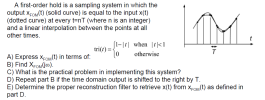 A first-order hold is a sampling system in which the output xfOM(t) (solid curve) is equal to the input x(t) (dotted curve) at every tenT (where n is an integer) and a linear interpolation between the points at all other times. m) when kI 0 otherwise trit) A) ExpressS XFoMt) in terms of: B) Find XFOMio) C) What is the practical problem in implementing this system? D) Repeat part B if the time domain output is shifted to the right...
For the system shown in Fig Q2. Determine the output c(t) when r(t) is: 2. (10...
 For the system shown in Fig Q2. Determine the output c(t) when r(t) is: 2. (10 marks) (15 marks) i. A step input of magnitude A ii. A unit ramp input. In each case sketch the expected output response c(t) based on the input r(t). C(s) Fig Q2
8-4) Lathi & Ding, Prob. P.5.1-10 (a) A first-order-hold circuit can also be used to reconstruct ...
 .
8-4) Lathi & Ding, Prob. P.5.1-10 (a) A first-order-hold circuit can also be used to reconstruct a signal g) from its samples. The impulse response of this circuit is h(f) = Δ(2,-2) where Ts is the sampling interval. Consider a typical sampled signal R() and show that this circuit performs the linear interpolation. In other words, the filter output consists of sample tops connected by straight-line segments. Follow the procedure discussed in Sec. 5.1.2 (Fig. 5.6) for a typical...
.
8-4) Lathi & Ding, Prob. P.5.1-10 (a) A first-order-hold circuit can also be used to reconstruct a signal g) from its samples. The impulse response of this circuit is h(f) = Δ(2,-2) where Ts is the sampling interval. Consider a typical sampled signal R() and show that this circuit performs the linear interpolation. In other words, the filter output consists of sample tops connected by straight-line segments. Follow the procedure discussed in Sec. 5.1.2 (Fig. 5.6) for a typical...
Please find the thevenin equivalent first as suggested 3. In the circuit below, R1 10k, R2...
 Please find the thevenin
equivalent first as suggested
3. In the circuit below, R1 10k, R2 20k and C 0.1uF. At t0, a step function of 10 V magnitude is applied to the input. Find V(t) at the output and sketch it. Your sketch should be quantitatively correct, that is, it should have labeled V and t axes. Strongly suggested: solve by first finding the Thévenin equivalent of the source voltage and resistor network Input (problem 3) 10V IN R2...
Please find the thevenin
equivalent first as suggested
3. In the circuit below, R1 10k, R2 20k and C 0.1uF. At t0, a step function of 10 V magnitude is applied to the input. Find V(t) at the output and sketch it. Your sketch should be quantitatively correct, that is, it should have labeled V and t axes. Strongly suggested: solve by first finding the Thévenin equivalent of the source voltage and resistor network Input (problem 3) 10V IN R2...
please clear your handwriting. 1. a) Sketch the input-output characteristic curve of the following circuit. b)...
 please clear your handwriting. 1. a) Sketch the input-output characteristic curve of the following circuit. b) If the waveform of the following signal as the input, sketch the output. +15 V 12.73 V 101 151 (a)
Please show all the work. Thanks QUESTION 1 Consider the following circuit. Given that XOR and...
 Please show all the work.
Thanks
QUESTION 1 Consider the following circuit. Given that XOR and AND gates have an input to output delay of 10 ns, the D Flip-Flops have a delay of 20 ns from clock to Q-output, and the minimum setup time of the D Flip-Flops is 8 ns, hold time of the D-FF is 5 ns. (a) what is the maximum frequency (in MHz) that this counter can be clocked before it fails? (b) Does the...
Please show all the work.
Thanks
QUESTION 1 Consider the following circuit. Given that XOR and AND gates have an input to output delay of 10 ns, the D Flip-Flops have a delay of 20 ns from clock to Q-output, and the minimum setup time of the D Flip-Flops is 8 ns, hold time of the D-FF is 5 ns. (a) what is the maximum frequency (in MHz) that this counter can be clocked before it fails? (b) Does the...
Stuck on this question. Please lease show out all your work step by step, than you....
 Stuck on this question. Please lease show out all your
work step by step, than you.
Question 2: In a Gallium Arsenide (GaAs) sample at T-300K, it is found that no 4Po and that N -0. (a) Determine Po,10, Na and (b) sketch the band diagram labeling Ec, Ev, Ei and EF. Note Ef should be reference to a band edge (15 points)
Stuck on this question. Please lease show out all your
work step by step, than you.
Question 2: In a Gallium Arsenide (GaAs) sample at T-300K, it is found that no 4Po and that N -0. (a) Determine Po,10, Na and (b) sketch the band diagram labeling Ec, Ev, Ei and EF. Note Ef should be reference to a band edge (15 points)
 Please show all of your work. Also, please draw a sketch
with a coordinate system and important points labeled.
Moreover, I need appropriate graphs
A box is released from rest at the top of a ramp. The surface of the ramp makes an angle of 31.5degrees with the horizontal, and is rough; the coefficients of friction between the ramp and the box are js = 0.500 and Mik = 0.350. What is the magnitude of the acceleration of the box?
Please show all of your work. Also, please draw a sketch
with a coordinate system and important points labeled.
Moreover, I need appropriate graphs
A box is released from rest at the top of a ramp. The surface of the ramp makes an angle of 31.5degrees with the horizontal, and is rough; the coefficients of friction between the ramp and the box are js = 0.500 and Mik = 0.350. What is the magnitude of the acceleration of the box?
 Please show all of your work. Also, please draw a sketch
with a coordinate system and important points labeled.
Moreover, I need appropriate graphs.
A box is released from rest at the top of a ramp. The surface of the ramp makes an angle of 22.6degrees with the horizontal, and is rough; the coefficients of friction between the ramp and the box are Hs = 0.500 and fix = 0.350. What is the magnitude of the acceleration of the box?
Please show all of your work. Also, please draw a sketch
with a coordinate system and important points labeled.
Moreover, I need appropriate graphs.
A box is released from rest at the top of a ramp. The surface of the ramp makes an angle of 22.6degrees with the horizontal, and is rough; the coefficients of friction between the ramp and the box are Hs = 0.500 and fix = 0.350. What is the magnitude of the acceleration of the box?
 A first-order hold is a sampling system in which the output xfOM(t) (solid curve) is equal to the input x(t) (dotted curve) at every tenT (where n is an integer) and a linear interpolation between the points at all other times. m) when kI 0 otherwise trit) A) ExpressS XFoMt) in terms of: B) Find XFOMio) C) What is the practical problem in implementing this system? D) Repeat part B if the time domain output is shifted to the right...
 For the system shown in Fig Q2. Determine the output c(t) when r(t) is: 2. (10 marks) (15 marks) i. A step input of magnitude A ii. A unit ramp input. In each case sketch the expected output response c(t) based on the input r(t). C(s) Fig Q2
 .
8-4) Lathi & Ding, Prob. P.5.1-10 (a) A first-order-hold circuit can also be used to reconstruct a signal g) from its samples. The impulse response of this circuit is h(f) = Δ(2,-2) where Ts is the sampling interval. Consider a typical sampled signal R() and show that this circuit performs the linear interpolation. In other words, the filter output consists of sample tops connected by straight-line segments. Follow the procedure discussed in Sec. 5.1.2 (Fig. 5.6) for a typical...
.
8-4) Lathi & Ding, Prob. P.5.1-10 (a) A first-order-hold circuit can also be used to reconstruct a signal g) from its samples. The impulse response of this circuit is h(f) = Δ(2,-2) where Ts is the sampling interval. Consider a typical sampled signal R() and show that this circuit performs the linear interpolation. In other words, the filter output consists of sample tops connected by straight-line segments. Follow the procedure discussed in Sec. 5.1.2 (Fig. 5.6) for a typical...
 Please find the thevenin
equivalent first as suggested
3. In the circuit below, R1 10k, R2 20k and C 0.1uF. At t0, a step function of 10 V magnitude is applied to the input. Find V(t) at the output and sketch it. Your sketch should be quantitatively correct, that is, it should have labeled V and t axes. Strongly suggested: solve by first finding the Thévenin equivalent of the source voltage and resistor network Input (problem 3) 10V IN R2...
Please find the thevenin
equivalent first as suggested
3. In the circuit below, R1 10k, R2 20k and C 0.1uF. At t0, a step function of 10 V magnitude is applied to the input. Find V(t) at the output and sketch it. Your sketch should be quantitatively correct, that is, it should have labeled V and t axes. Strongly suggested: solve by first finding the Thévenin equivalent of the source voltage and resistor network Input (problem 3) 10V IN R2...
 please clear your handwriting. 1. a) Sketch the input-output characteristic curve of the following circuit. b) If the waveform of the following signal as the input, sketch the output. +15 V 12.73 V 101 151 (a)
 Please show all the work.
Thanks
QUESTION 1 Consider the following circuit. Given that XOR and AND gates have an input to output delay of 10 ns, the D Flip-Flops have a delay of 20 ns from clock to Q-output, and the minimum setup time of the D Flip-Flops is 8 ns, hold time of the D-FF is 5 ns. (a) what is the maximum frequency (in MHz) that this counter can be clocked before it fails? (b) Does the...
Please show all the work.
Thanks
QUESTION 1 Consider the following circuit. Given that XOR and AND gates have an input to output delay of 10 ns, the D Flip-Flops have a delay of 20 ns from clock to Q-output, and the minimum setup time of the D Flip-Flops is 8 ns, hold time of the D-FF is 5 ns. (a) what is the maximum frequency (in MHz) that this counter can be clocked before it fails? (b) Does the...
 Stuck on this question. Please lease show out all your
work step by step, than you.
Question 2: In a Gallium Arsenide (GaAs) sample at T-300K, it is found that no 4Po and that N -0. (a) Determine Po,10, Na and (b) sketch the band diagram labeling Ec, Ev, Ei and EF. Note Ef should be reference to a band edge (15 points)
Stuck on this question. Please lease show out all your
work step by step, than you.
Question 2: In a Gallium Arsenide (GaAs) sample at T-300K, it is found that no 4Po and that N -0. (a) Determine Po,10, Na and (b) sketch the band diagram labeling Ec, Ev, Ei and EF. Note Ef should be reference to a band edge (15 points)
Most questions answered within 3 hours.
-
Where is the error in this code sequence?
String s1 = "Hello";
String s2 = "ello";...
asked 10 months ago -
Financial data for Joel de Paris, Inc., for last year
follow:
Joel de Paris, Inc.
Balance...
asked 10 months ago -
Consider this reaction:
Al2(SO4)3 (aq)+ BaCl3
(aq) Al2Cl6 (aq)- +
3BaSO4(s) . What is the...
asked 10 months ago -
Suppose that Savneet is considering increasing her
recent random sample from 20 car rentals to 40...
asked 10 months ago -
Trucks arrive at an unloading terminal at an average rate of 120
per hour.
Trucks arrive...
asked 10 months ago -
Why are methanol and ethanol completely soluble in water while
octanol is not very little soluble....
asked 10 months ago -
A facilities manager at a university reads in a research report
that the mean amount of...
asked 10 months ago -
When the CuSO4 is rehydrated by adding water to the anhydrous
compound, is this an endothermic...
asked 10 months ago -
A ray of sunlight is passing from diamond into crown glass; the
angle of incidence is...
asked 10 months ago -
A block of mass 0.249 kg is placed on top of a light, vertical
spring of...
asked 10 months ago -
how do the kidneys compensate in the presences of acidosis
a) trigger hyperventilate
b) reserve acid...
asked 10 months ago -
Question 501 pts
The rental rate of capital to the firm increases. Which of the
following...
asked 10 months ago