
Homework Answers
The choice 1 motor is rated at 85%, so it means if its rated 10HP, it will actually consume
10/.85=11.765HP. Since one HP is .7457kW, it means for motor A
11.765*.7457= 8.77316kW. So, the cost per hour for it would be
8.77316*.09= $0.7896 per hour.
Since the motor will operate for 2000 hours an year,
yearly cost=2000*0.7896=$1579.2 per year
Similarly, for motor 2
Cost per hour=(10/.9)*.7457*.09*2000= 1491.4 per year.
With this information, we can create the cashflow for all 15 years. This is shown below.
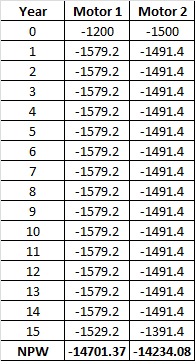
The NPW is also shown. Its been calculated by the formula =NPV(interest rate,cashflows)+initial investment.
It can also be calculated manually by the following formula-
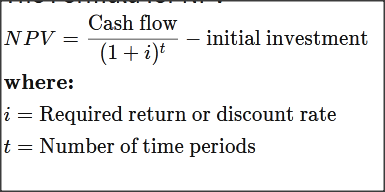
As we can see, motor 2 has a higher NPW. Hence, motor 2 should be recommended.
Add Answer to:
The purchasing department for Eversource Electric asked its operations and maintenance engineering department for its advice...
Problem 6-16 (algorithmic) Question Help A special-purpose 30-horsepower electric motor has an efficiency of 90%. Its...
 Problem 6-16 (algorithmic) Question Help A special-purpose 30-horsepower electric motor has an efficiency of 90%. Its purchase and installation price is $2,100. A second 30-horsepower high-efficiency motor can be purchased for $3,100, and its efficiency is 94%. Either motor will be operated 3,500 hours per year at full load, and electricity costs $0.09 per kilowatt-hour (kWh). MARR = 12% per year, and neither motor will have a market value at the end of the eight-year study period a. Which motor...
number 2 PW, AW An electric motor is rated at 10 horsepower (HP) and costs $800....
 number 2
PW, AW An electric motor is rated at 10 horsepower (HP) and costs $800. Its full-load efficiency is specified to be 85%. A newly designed, high-efficiency motor of the same size has an efficiency of 90%, but costs $1,200. It is estimated that the motors will operate at a rated 10-HP output for 1,500 hours a year, and the cost of energy will be $0.07 per kilowatt-hour. Each motor is expected to have a 15-year life. At the...
number 2
PW, AW An electric motor is rated at 10 horsepower (HP) and costs $800. Its full-load efficiency is specified to be 85%. A newly designed, high-efficiency motor of the same size has an efficiency of 90%, but costs $1,200. It is estimated that the motors will operate at a rated 10-HP output for 1,500 hours a year, and the cost of energy will be $0.07 per kilowatt-hour. Each motor is expected to have a 15-year life. At the...
A special-purpose 30-horsepower electric motor has an efficiency of 90%. Its purchase and installation price is...
 A special-purpose 30-horsepower electric motor has an efficiency of 90%. Its purchase and installation price is $2,200. A second 30-horsepower high-efficiency motor can be purchased for $3,200, and its efficiency is 92%. Either motor will be operated 4,000 hours per year at full load, and electricity costs $0.10 per kilowatt-hour (kWh). MARR = 12% per year, and neither motor will have a market value at the end of the eight-year study period. a. Which motor should be chosen? b. For...
D Question 3 5 pts A standard electric motor is rated at 10 horsepower (HP) and...
 D Question 3 5 pts A standard electric motor is rated at 10 horsepower (HP) and costs $800. its full-load efficiency is specified to be 87%. A newly designed, high efficiency motor of the same size has an efficiency of 93%, but costs $1,200. It is estimated that the motors will operate at a rated 10-HP output for 2,500 hours a year, and the cost of energy will be $0.07 per kilowatt- hour. Each motor is expected to have 12-year...
A special-purpose 30-horsepower electric motor has an efficiency of 90%. Its purchase and installation price is...
 A special-purpose 30-horsepower electric motor has an efficiency of 90%. Its purchase and installation price is $2.200 A second 30-horsepower high-efficiency motor can be purchased for $3,200, and its efficiency is 93%. Either motor will be operated 4,000 hours per year at full load, and electricity costs $0.10 per kilowatt-hour (kWh). MARR= 15% per year, and neither motor will have a market value at the end of the eight-year study period. Most motors are operated at a fraction of their...
Problem 6-30 (algorithmic) Question Help * Two electric motors are being considered to drive a ce...
 Problem 6-30 (algorithmic) Question Help * Two electric motors are being considered to drive a centrifugal pump. Each motor is capable of delivering 100 horsepower (output) to the pumping operation. It is expected that the motors will be in use 2,500 hours per year and the MARR-8% per year. (1 hp 0.746 kW) a. If electricity costs SX per kilowatt-hour, calculate the annual cost of electrical power for each motor b. What cost of electricity (S/kWh) makes the two pumps...
 Problem 6-16 (algorithmic) Question Help A special-purpose 30-horsepower electric motor has an efficiency of 90%. Its purchase and installation price is $2,100. A second 30-horsepower high-efficiency motor can be purchased for $3,100, and its efficiency is 94%. Either motor will be operated 3,500 hours per year at full load, and electricity costs $0.09 per kilowatt-hour (kWh). MARR = 12% per year, and neither motor will have a market value at the end of the eight-year study period a. Which motor...
 number 2
PW, AW An electric motor is rated at 10 horsepower (HP) and costs $800. Its full-load efficiency is specified to be 85%. A newly designed, high-efficiency motor of the same size has an efficiency of 90%, but costs $1,200. It is estimated that the motors will operate at a rated 10-HP output for 1,500 hours a year, and the cost of energy will be $0.07 per kilowatt-hour. Each motor is expected to have a 15-year life. At the...
number 2
PW, AW An electric motor is rated at 10 horsepower (HP) and costs $800. Its full-load efficiency is specified to be 85%. A newly designed, high-efficiency motor of the same size has an efficiency of 90%, but costs $1,200. It is estimated that the motors will operate at a rated 10-HP output for 1,500 hours a year, and the cost of energy will be $0.07 per kilowatt-hour. Each motor is expected to have a 15-year life. At the...
 A special-purpose 30-horsepower electric motor has an efficiency of 90%. Its purchase and installation price is $2,200. A second 30-horsepower high-efficiency motor can be purchased for $3,200, and its efficiency is 92%. Either motor will be operated 4,000 hours per year at full load, and electricity costs $0.10 per kilowatt-hour (kWh). MARR = 12% per year, and neither motor will have a market value at the end of the eight-year study period. a. Which motor should be chosen? b. For...
 D Question 3 5 pts A standard electric motor is rated at 10 horsepower (HP) and costs $800. its full-load efficiency is specified to be 87%. A newly designed, high efficiency motor of the same size has an efficiency of 93%, but costs $1,200. It is estimated that the motors will operate at a rated 10-HP output for 2,500 hours a year, and the cost of energy will be $0.07 per kilowatt- hour. Each motor is expected to have 12-year...
 A special-purpose 30-horsepower electric motor has an efficiency of 90%. Its purchase and installation price is $2.200 A second 30-horsepower high-efficiency motor can be purchased for $3,200, and its efficiency is 93%. Either motor will be operated 4,000 hours per year at full load, and electricity costs $0.10 per kilowatt-hour (kWh). MARR= 15% per year, and neither motor will have a market value at the end of the eight-year study period. Most motors are operated at a fraction of their...
 Problem 6-30 (algorithmic) Question Help * Two electric motors are being considered to drive a centrifugal pump. Each motor is capable of delivering 100 horsepower (output) to the pumping operation. It is expected that the motors will be in use 2,500 hours per year and the MARR-8% per year. (1 hp 0.746 kW) a. If electricity costs SX per kilowatt-hour, calculate the annual cost of electrical power for each motor b. What cost of electricity (S/kWh) makes the two pumps...
Most questions answered within 3 hours.
-
Where is the error in this code sequence?
String s1 = "Hello";
String s2 = "ello";...
asked 11 months ago -
Financial data for Joel de Paris, Inc., for last year
follow:
Joel de Paris, Inc.
Balance...
asked 11 months ago -
Consider this reaction:
Al2(SO4)3 (aq)+ BaCl3
(aq) Al2Cl6 (aq)- +
3BaSO4(s) . What is the...
asked 11 months ago -
Suppose that Savneet is considering increasing her
recent random sample from 20 car rentals to 40...
asked 11 months ago -
Trucks arrive at an unloading terminal at an average rate of 120
per hour.
Trucks arrive...
asked 11 months ago -
Why are methanol and ethanol completely soluble in water while
octanol is not very little soluble....
asked 11 months ago -
A facilities manager at a university reads in a research report
that the mean amount of...
asked 11 months ago -
When the CuSO4 is rehydrated by adding water to the anhydrous
compound, is this an endothermic...
asked 11 months ago -
A ray of sunlight is passing from diamond into crown glass; the
angle of incidence is...
asked 11 months ago -
A block of mass 0.249 kg is placed on top of a light, vertical
spring of...
asked 11 months ago -
how do the kidneys compensate in the presences of acidosis
a) trigger hyperventilate
b) reserve acid...
asked 11 months ago -
Question 501 pts
The rental rate of capital to the firm increases. Which of the
following...
asked 11 months ago