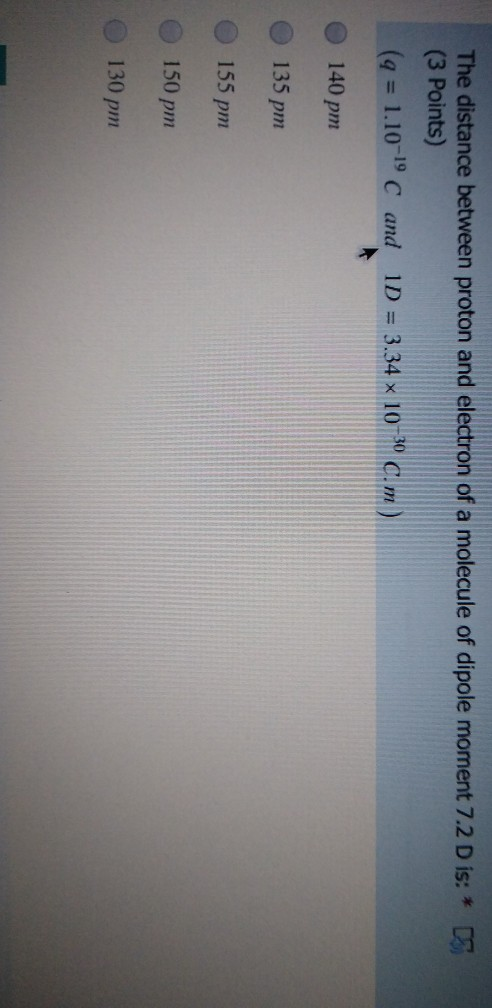
The distance between proton and electron or a molecule
of dipole and electron molecule of dipole moment is 7.2D:
(q=1.10^-19C and 1D= 3.34x10^-30C.m)
a 140 pm
b 135 pm
c 155 pm
d 150 pm
e 130 pm
need answer asap
Homework Answers
Add Answer to:
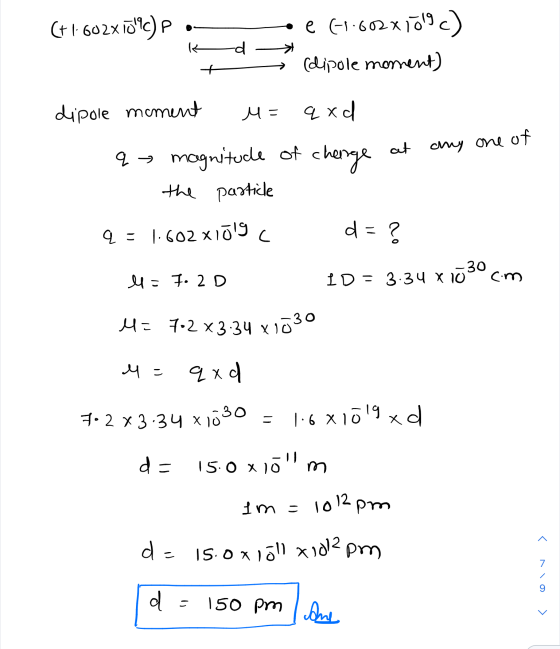
The distance between proton and electron or a molecule
of dipole and electron molecule of dipole...
1 Dipole Forces Water is a polar molecule. It has an electric dipole strength of p...
 1 Dipole Forces Water is a polar molecule. It has an electric dipole strength of p 6-10-30 C-n This is roughly equivalent to a proton and an electron separated by a distance of d 4.101 m (about the radius of a hydrogen atom) In this problem, we will use Coulomb's law to compare the force between two protons, a proton and a water molecule, and two water molecules. Use the arrangement of the charges shown in the figure for your...
1 Dipole Forces Water is a polar molecule. It has an electric dipole strength of p-6-10-30...
 1 Dipole Forces Water is a polar molecule. It has an electric dipole strength of p-6-10-30 С . m. This is roughly equivalent to a proton and an electron separated by a distance of d- 4 10-11 m (about the radius of a hydrogen atom) In this problem, we will use Coulomb's law to compare the force between two protons, a proton and a water molecule, and two water molecules. Use the arrangement of the charges shown in the figure...
12.32.. The water molecule is partially ionic, in that an electron is partially transferred from each...
 12.32.. The water molecule is partially ionic, in that an electron is partially transferred from each hydrogen to the oxygen, as indicated in Fig. 12.35, where q de- notes the magnitude of each of the two charges transferred. (a) Write down the electric dipole mo- ment p of the H2O molecule in terms of the charge g, the H-O bond length d, and the angle 0. (Note: e dipole moment of two charges q and -q a dis- tance d...
The dipole moment of the water molecule (H2O) is 6.17×10⁻³⁰ C.m. Consider a water molecule located...
The dipole moment of the water molecule (H2O) is 6.17×10⁻³⁰ C.m. Consider a water molecule located at the origin whose dipole moment p? points in the +x-direction. A chlorine ion (Cl-), of charge −1.60 × 10⁻¹⁹ C, is located at x = 3 nm. Assume that x is much larger than the separation d between the charges in the dipole, so that the approximate expression for the electric field along the dipole axis can be used. (a) Find the magnitude...
Water is a polar molecule. It has an electric dipole strength of p-6-10 30 C-n. This...
 Water is a polar molecule. It has an electric dipole strength of p-6-10 30 C-n. This is roughly equivalent to a proton and an electron separated by a distance of d 4-10-11 m (about the radius of a hydrogen atom) In this problem, we will use Coulomb's law to compare the force between two protons, a proton and a water molecule, and two water molecules. Use the arrangement of the charges shown in the figure for your calculations. (a) What...
Determine the magnitude of the force between an electric dipole with a dipole moment of 9...
Determine the magnitude of the force between an electric dipole with a dipole moment of 9 ✕ 10-29 C m and an electron. The electron is positioned r = 28 nm from the centre of the dipole, along the dipole axis. Hint: Assume that r >> d, with d the charge separation distance in the dipole.
Determine the magnitude of the force between an electric dipole with a dipole moment of 2...
Determine the magnitude of the force between an electric dipole with a dipole moment of 2 ✕ 10-29 C m and an electron. The electron is positioned r = 24 nm from the centre of the dipole, along the dipole axis. Hint: Assume that r >> d, with d the charge separation distance in the dipole.
Determine the magnitude of the free between an electric dipole with a dipole moment of 8...
 Determine the magnitude of the free between an electric dipole with a dipole moment of 8 x 10-29 C m and an electron. The electron is the dipole, along the dipole axis. Hint: Assume that r >> d, with d the charge separation distance in the dipole. positioned r 16nm from the centre of
The dipole moment of BrCl is 0.518 D and the distance between atoms is 213.9 pm....
The dipole moment of BrCl is 0.518 D and the distance between atoms is 213.9 pm. Part A What is the percent ionic character of the BrCl bond?
An electric field can induce an electric dipole in a neutral molecule (or atom) by pushing...
An electric field can induce an electric dipole in a neutral molecule (or atom) by pushing the positive and negative charges inside the molecule in opposite directions. The dipole moment of the induced dipole is directly proportional to the electric field at the molecule. That is, p⃗ =αE⃗ , where p⃗ is the induced dipole moment, α is called the polarizability of the molecule, and E⃗ is the electric field at the molecule. A stronger electric field at the molecule results in a...
 1 Dipole Forces Water is a polar molecule. It has an electric dipole strength of p 6-10-30 C-n This is roughly equivalent to a proton and an electron separated by a distance of d 4.101 m (about the radius of a hydrogen atom) In this problem, we will use Coulomb's law to compare the force between two protons, a proton and a water molecule, and two water molecules. Use the arrangement of the charges shown in the figure for your...
 1 Dipole Forces Water is a polar molecule. It has an electric dipole strength of p-6-10-30 С . m. This is roughly equivalent to a proton and an electron separated by a distance of d- 4 10-11 m (about the radius of a hydrogen atom) In this problem, we will use Coulomb's law to compare the force between two protons, a proton and a water molecule, and two water molecules. Use the arrangement of the charges shown in the figure...
 12.32.. The water molecule is partially ionic, in that an electron is partially transferred from each hydrogen to the oxygen, as indicated in Fig. 12.35, where q de- notes the magnitude of each of the two charges transferred. (a) Write down the electric dipole mo- ment p of the H2O molecule in terms of the charge g, the H-O bond length d, and the angle 0. (Note: e dipole moment of two charges q and -q a dis- tance d...
 Water is a polar molecule. It has an electric dipole strength of p-6-10 30 C-n. This is roughly equivalent to a proton and an electron separated by a distance of d 4-10-11 m (about the radius of a hydrogen atom) In this problem, we will use Coulomb's law to compare the force between two protons, a proton and a water molecule, and two water molecules. Use the arrangement of the charges shown in the figure for your calculations. (a) What...
 Determine the magnitude of the free between an electric dipole with a dipole moment of 8 x 10-29 C m and an electron. The electron is the dipole, along the dipole axis. Hint: Assume that r >> d, with d the charge separation distance in the dipole. positioned r 16nm from the centre of
Most questions answered within 3 hours.
-
Where is the error in this code sequence?
String s1 = "Hello";
String s2 = "ello";...
asked 10 months ago -
Financial data for Joel de Paris, Inc., for last year
follow:
Joel de Paris, Inc.
Balance...
asked 10 months ago -
Consider this reaction:
Al2(SO4)3 (aq)+ BaCl3
(aq) Al2Cl6 (aq)- +
3BaSO4(s) . What is the...
asked 10 months ago -
Suppose that Savneet is considering increasing her
recent random sample from 20 car rentals to 40...
asked 10 months ago -
Trucks arrive at an unloading terminal at an average rate of 120
per hour.
Trucks arrive...
asked 10 months ago -
Why are methanol and ethanol completely soluble in water while
octanol is not very little soluble....
asked 10 months ago -
A facilities manager at a university reads in a research report
that the mean amount of...
asked 10 months ago -
When the CuSO4 is rehydrated by adding water to the anhydrous
compound, is this an endothermic...
asked 10 months ago -
A ray of sunlight is passing from diamond into crown glass; the
angle of incidence is...
asked 10 months ago -
A block of mass 0.249 kg is placed on top of a light, vertical
spring of...
asked 10 months ago -
how do the kidneys compensate in the presences of acidosis
a) trigger hyperventilate
b) reserve acid...
asked 10 months ago -
Question 501 pts
The rental rate of capital to the firm increases. Which of the
following...
asked 10 months ago