Centauri A and Centauri B are binary stars with a separation of 3.45×10¹²m and an orbital...
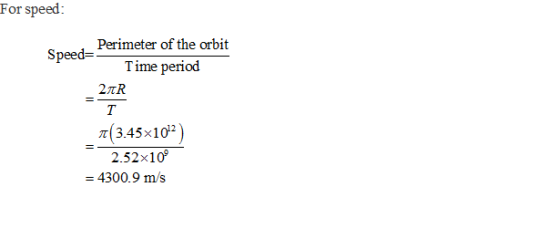
Centauri A and Centauri B are binary stars with a separation of 3.45×10¹²m and an orbital period of 2.52×10⁹s. Assuming the two stars are equally massive (which is approximately the case), determine their speed.
Homework Answers
Add Answer to:
Centauri A and Centauri B are binary stars with a separation of
3.45×10¹²m and an orbital...
Alpha Centauri A and B are Sun-like stars, and together they form the binary star Alpha...
Alpha Centauri A and B are Sun-like stars, and together they form the binary star Alpha Centauri AB. Alpha Centauri A has 1.1 times the mass of the Sun, while Alpha Centauri B has 0.907 times the Sun’s mass. (Sun’s mass is 1.989 × 1030 kg.) The pair orbit about a common centre with an orbital period of 79.91 years. Their elliptical orbit is eccentric, so that the distance between A and B varies, but if we assume it is...
Next stop is our nearest star: Alpha Centauri. Your Journey will take a while using fusion...
Next stop is our nearest star: Alpha Centauri. Your Journey will take a while using fusion power, so you will probably sleep for a few months. When you finally wake up near Alpha Centauri, you realize that Alpha Centauri is actually a binary star system! The two stars, Alpha-Cen-A and AlphaCen-B, have different masses; Alpha-Cen-A is more massive than Alpha-Cen-B. (a) Draw a schematic diagram representing the orbits of the two stars, labeling the stars and indicating their orbital paths....
4) A binary star system consists of two stars, one of which is 1 solar mass...
 4) A binary star system consists of two stars, one of which is 1 solar mass and one of which is 2 solar masses. They are separated by a distance of 5 astronomical units and have approximately circular orbits. a) What is the orbital period of each star? b) What is the orbital velocity of each star? c) What is the angular momentum of the two star system, assuming that each star's radius is much smaller than its orbital radius?
The spectral lines of two stars in a particular eclipsing binary system shift back and forth...
The spectral lines of two stars in a particular eclipsing binary system shift back and forth with a period of 10 months. The lines of both stars shift by equal amounts, and the amount of the Doppler shift indicates that each star has an orbital speed of 105 m/s. What are the masses of the two stars? Assume that each of the two stars traces a circular orbit around their center of mass.
Plaskett's binary system consists of two stars that revolve in a circular orbit about a center...
 Plaskett's binary system consists of two stars that revolve in a circular orbit about a center of mass midway between them. This statement implies that the masses of the two stars are equal (see figure below). Assume the orbital speed of each star is |v vector| = 170 km/s and the orbital period of each is 14.5 days. Find the mass M of each star. (For comparison, the mass of our Sun is 1.99 times 10^30 kg.) 1.02e-9 If you...
The spectral lines of two stars in a particular eclipsing binary system shift back and forth...
The spectral lines of two stars in a particular eclipsing binary system shift back and forth with a period of 6 months. The lines of both stars shift by equal amounts, and the amount of the Doppler shift indicates that each star has an orbital speed of 1.2×10⁵ m/s relative to the other. What are the masses of the two stars? Assume that each of the two stars traces a circular orbit around their center of mass. (Hint: See Mathematical...
op Plaskett's binary system consists of two stars that revolve In a circular orbit about a center of mass midway betwee...
 op
Plaskett's binary system consists of two stars that revolve In a circular orbit about a center of mass midway between them. This statement implies that the masses of the two stars are equal (see figure below). Assume the orbital speed of each star is |v | = 240 km/s and the orbital period of each is 12.5 days. Find the mass M of each star. (For comparison, the mass of our Sun is 1.99 times 1030 kg Your answer...
op
Plaskett's binary system consists of two stars that revolve In a circular orbit about a center of mass midway between them. This statement implies that the masses of the two stars are equal (see figure below). Assume the orbital speed of each star is |v | = 240 km/s and the orbital period of each is 12.5 days. Find the mass M of each star. (For comparison, the mass of our Sun is 1.99 times 1030 kg Your answer...
For the following, quote your numerical answers to two significant figures: a) A binary system consists...
 For the following, quote your numerical answers to two significant figures: a) A binary system consists of two stars orbiting a common center of mass. Star A is a white star of mass MA = 2.02Mo, where Mo = 1.989 x 1030 kg is the mass of the Sun. Its companion, Star B, is a white dwarf with mass Mg = 0.978M. The orbital period of the two objects is observed to be t = 50.09 years. What is the...
Need help with this problem. Thanks. Binary Stars Q1) A binary star system has a distance...
 Need help with this problem. Thanks.
Binary Stars Q1) A binary star system has a distance from Earth of 42.2 light years. The distance between the stars is 1.08 x 101 m and the rotation period is 104 days. Assume equal masses of the stars, and circular orbits (centre of mass of the system is at rest relative to the Earth). a) Calculate the speed of the stars relative to the centre of mass of the system. Further assume the...
Need help with this problem. Thanks.
Binary Stars Q1) A binary star system has a distance from Earth of 42.2 light years. The distance between the stars is 1.08 x 101 m and the rotation period is 104 days. Assume equal masses of the stars, and circular orbits (centre of mass of the system is at rest relative to the Earth). a) Calculate the speed of the stars relative to the centre of mass of the system. Further assume the...
Before leaving Alpha Centauri, you change from the shuttle to a light speed interstellar cruiser and head out deep into the galaxy to visit another binary star system - but this one is composed...
 Before leaving Alpha Centauri, you change from the shuttle to a light speed interstellar cruiser and head out deep into the galaxy to visit another binary star system - but this one is composed of dead stars! To occupy your waking travel time by reading about this star system in the "Outer Space Tourbook": Stars spend most of their lifetimes undergoing nuclear fusion in their cores, which is why they give off so much light. However, when the material necessary...
 4) A binary star system consists of two stars, one of which is 1 solar mass and one of which is 2 solar masses. They are separated by a distance of 5 astronomical units and have approximately circular orbits. a) What is the orbital period of each star? b) What is the orbital velocity of each star? c) What is the angular momentum of the two star system, assuming that each star's radius is much smaller than its orbital radius?
 Plaskett's binary system consists of two stars that revolve in a circular orbit about a center of mass midway between them. This statement implies that the masses of the two stars are equal (see figure below). Assume the orbital speed of each star is |v vector| = 170 km/s and the orbital period of each is 14.5 days. Find the mass M of each star. (For comparison, the mass of our Sun is 1.99 times 10^30 kg.) 1.02e-9 If you...
 op
Plaskett's binary system consists of two stars that revolve In a circular orbit about a center of mass midway between them. This statement implies that the masses of the two stars are equal (see figure below). Assume the orbital speed of each star is |v | = 240 km/s and the orbital period of each is 12.5 days. Find the mass M of each star. (For comparison, the mass of our Sun is 1.99 times 1030 kg Your answer...
op
Plaskett's binary system consists of two stars that revolve In a circular orbit about a center of mass midway between them. This statement implies that the masses of the two stars are equal (see figure below). Assume the orbital speed of each star is |v | = 240 km/s and the orbital period of each is 12.5 days. Find the mass M of each star. (For comparison, the mass of our Sun is 1.99 times 1030 kg Your answer...
 For the following, quote your numerical answers to two significant figures: a) A binary system consists of two stars orbiting a common center of mass. Star A is a white star of mass MA = 2.02Mo, where Mo = 1.989 x 1030 kg is the mass of the Sun. Its companion, Star B, is a white dwarf with mass Mg = 0.978M. The orbital period of the two objects is observed to be t = 50.09 years. What is the...
 Need help with this problem. Thanks.
Binary Stars Q1) A binary star system has a distance from Earth of 42.2 light years. The distance between the stars is 1.08 x 101 m and the rotation period is 104 days. Assume equal masses of the stars, and circular orbits (centre of mass of the system is at rest relative to the Earth). a) Calculate the speed of the stars relative to the centre of mass of the system. Further assume the...
Need help with this problem. Thanks.
Binary Stars Q1) A binary star system has a distance from Earth of 42.2 light years. The distance between the stars is 1.08 x 101 m and the rotation period is 104 days. Assume equal masses of the stars, and circular orbits (centre of mass of the system is at rest relative to the Earth). a) Calculate the speed of the stars relative to the centre of mass of the system. Further assume the...
 Before leaving Alpha Centauri, you change from the shuttle to a light speed interstellar cruiser and head out deep into the galaxy to visit another binary star system - but this one is composed of dead stars! To occupy your waking travel time by reading about this star system in the "Outer Space Tourbook": Stars spend most of their lifetimes undergoing nuclear fusion in their cores, which is why they give off so much light. However, when the material necessary...
Most questions answered within 3 hours.
-
Where is the error in this code sequence?
String s1 = "Hello";
String s2 = "ello";...
asked 10 months ago -
Financial data for Joel de Paris, Inc., for last year
follow:
Joel de Paris, Inc.
Balance...
asked 10 months ago -
Consider this reaction:
Al2(SO4)3 (aq)+ BaCl3
(aq) Al2Cl6 (aq)- +
3BaSO4(s) . What is the...
asked 10 months ago -
Suppose that Savneet is considering increasing her
recent random sample from 20 car rentals to 40...
asked 10 months ago -
Trucks arrive at an unloading terminal at an average rate of 120
per hour.
Trucks arrive...
asked 10 months ago -
Why are methanol and ethanol completely soluble in water while
octanol is not very little soluble....
asked 10 months ago -
A facilities manager at a university reads in a research report
that the mean amount of...
asked 10 months ago -
When the CuSO4 is rehydrated by adding water to the anhydrous
compound, is this an endothermic...
asked 10 months ago -
A ray of sunlight is passing from diamond into crown glass; the
angle of incidence is...
asked 10 months ago -
A block of mass 0.249 kg is placed on top of a light, vertical
spring of...
asked 10 months ago -
how do the kidneys compensate in the presences of acidosis
a) trigger hyperventilate
b) reserve acid...
asked 10 months ago -
Question 501 pts
The rental rate of capital to the firm increases. Which of the
following...
asked 10 months ago