Proof by Mathematic Induction $(x^{n+1}-y^{n+1})=(x-y)(\sum_{i=0}^nx^{n-i}y^i)$

Homework Answers


Add Answer to:
Proof by Mathematic Induction $(x^{n+1}-y^{n+1})=(x-y)(\sum_{i=0}^nx^{n-i}y^i)$
Which of these are linear systems? y[n] nx[n-3] y[n] x[n-1]+3
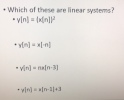 Which of these are linear systems? y[n] nx[n-3] y[n] x[n-1]+3
DISCRETE MATHEMATIC For question 1, Use mathematical induction to prove the statements are correct for n...
DISCRETE MATHEMATIC For question 1, Use mathematical induction to prove the statements are correct for n ∈ Z+(set of positive integers). 1. Prove that for n ≥ 1 1 + 8 + 15 + ... + (7n - 6) = [n(7n - 5)]/2 For question 2, Use a direct proof, proof by contraposition or proof by contradiction. 2. Let m, n ≥ 0 be integers. Prove that if m + n ≥ 59 then (m ≥ 30 or n ≥...
2. Prove by induction that Ση.c)-(7+1) for n > 0 and i > 0.
 2. Prove by induction that Ση.c)-(7+1) for n > 0 and i > 0.
Suppose X, Y are independent with X ∼ N (0, 1) and Y ∼ N (0,...
Suppose X, Y are independent with X ∼ N (0, 1) and Y ∼ N (0, 1). Show that the distribution of Q = X/Y follows the Cauchy distribution, i.e., f(q) = 1/π(1+q2) . Hint: Let Q = X/Y and V=Y. Find the joint pdf of Q and V and finally find the marginal pdf of Q by integrating the joint pdf of Q and V w.r.t. V: Y π(1+q2) Y V = Y . Find the joint pdf of...
part (c) 7.23. Let y(x) = n²x e-nx. (a) Show that lim, - fn(x)=0 for all...
 part (c)
7.23. Let y(x) = n²x e-nx. (a) Show that lim, - fn(x)=0 for all x > 0. (Hint: Treat x = 0 as for x > 0 you can use L'Hospital's rule (Theorem A.11) - but remember that n is the variable, not x.) (b) Find lim - So fn(x)dx. (Hint: The answer is not 0.) (c) Why doesn't your answer to part (b) violate Proposition 7.27 Proposition 7.27. Suppose f. : G C is continuous, for n...
part (c)
7.23. Let y(x) = n²x e-nx. (a) Show that lim, - fn(x)=0 for all x > 0. (Hint: Treat x = 0 as for x > 0 you can use L'Hospital's rule (Theorem A.11) - but remember that n is the variable, not x.) (b) Find lim - So fn(x)dx. (Hint: The answer is not 0.) (c) Why doesn't your answer to part (b) violate Proposition 7.27 Proposition 7.27. Suppose f. : G C is continuous, for n...
Strong induction (a) For any x, y € R, if n e N then x –...
 Strong induction
(a) For any x, y € R, if n e N then x – y is a factor of x" — y”.
Strong induction
(a) For any x, y € R, if n e N then x – y is a factor of x" — y”.
2. Given x[n]— 1-ae-ja' find the DTFT of: (a) y[n] = nx[n],(b) z[n] = (n −...
 2. Given x[n]— 1-ae-ja' find the DTFT of: (a) y[n] = nx[n],(b) z[n] = (n − 1)x[n] dX(92) Hint: nx[n]< > ; dΩ
Problem Show that a system with excitation x[n] and response y[n] described by yin] nx[n], is...
 Problem Show that a system with excitation x[n] and response y[n] described by yin] nx[n], is linear, time variant and static.
Want proof by induction 2.38 Show that &* () – 12v k=0
 Want proof by induction
2.38 Show that &* () – 12v k=0
Want proof by induction
2.38 Show that &* () – 12v k=0
Consider the difference equation y(n) = -0.6y(n-1) - x(n-1) for n>=0 and y(-1) = 0 1....
Consider the difference equation y(n) = -0.6y(n-1) - x(n-1) for n>=0 and y(-1) = 0 1. WITHOUT using Laplace or Z-Transform, determine the unit-impulse response h(n) starting from h(0).
 Which of these are linear systems? y[n] nx[n-3] y[n] x[n-1]+3
 2. Prove by induction that Ση.c)-(7+1) for n > 0 and i > 0.
 part (c)
7.23. Let y(x) = n²x e-nx. (a) Show that lim, - fn(x)=0 for all x > 0. (Hint: Treat x = 0 as for x > 0 you can use L'Hospital's rule (Theorem A.11) - but remember that n is the variable, not x.) (b) Find lim - So fn(x)dx. (Hint: The answer is not 0.) (c) Why doesn't your answer to part (b) violate Proposition 7.27 Proposition 7.27. Suppose f. : G C is continuous, for n...
part (c)
7.23. Let y(x) = n²x e-nx. (a) Show that lim, - fn(x)=0 for all x > 0. (Hint: Treat x = 0 as for x > 0 you can use L'Hospital's rule (Theorem A.11) - but remember that n is the variable, not x.) (b) Find lim - So fn(x)dx. (Hint: The answer is not 0.) (c) Why doesn't your answer to part (b) violate Proposition 7.27 Proposition 7.27. Suppose f. : G C is continuous, for n...
 Strong induction
(a) For any x, y € R, if n e N then x – y is a factor of x" — y”.
Strong induction
(a) For any x, y € R, if n e N then x – y is a factor of x" — y”.
 2. Given x[n]— 1-ae-ja' find the DTFT of: (a) y[n] = nx[n],(b) z[n] = (n − 1)x[n] dX(92) Hint: nx[n]< > ; dΩ
 Problem Show that a system with excitation x[n] and response y[n] described by yin] nx[n], is linear, time variant and static.
 Want proof by induction
2.38 Show that &* () – 12v k=0
Want proof by induction
2.38 Show that &* () – 12v k=0
Most questions answered within 3 hours.
-
Where is the error in this code sequence?
String s1 = "Hello";
String s2 = "ello";...
asked 10 months ago -
Financial data for Joel de Paris, Inc., for last year
follow:
Joel de Paris, Inc.
Balance...
asked 10 months ago -
Consider this reaction:
Al2(SO4)3 (aq)+ BaCl3
(aq) Al2Cl6 (aq)- +
3BaSO4(s) . What is the...
asked 10 months ago -
Suppose that Savneet is considering increasing her
recent random sample from 20 car rentals to 40...
asked 10 months ago -
Trucks arrive at an unloading terminal at an average rate of 120
per hour.
Trucks arrive...
asked 10 months ago -
Why are methanol and ethanol completely soluble in water while
octanol is not very little soluble....
asked 10 months ago -
A facilities manager at a university reads in a research report
that the mean amount of...
asked 10 months ago -
When the CuSO4 is rehydrated by adding water to the anhydrous
compound, is this an endothermic...
asked 10 months ago -
A ray of sunlight is passing from diamond into crown glass; the
angle of incidence is...
asked 10 months ago -
A block of mass 0.249 kg is placed on top of a light, vertical
spring of...
asked 10 months ago -
how do the kidneys compensate in the presences of acidosis
a) trigger hyperventilate
b) reserve acid...
asked 10 months ago -
Question 501 pts
The rental rate of capital to the firm increases. Which of the
following...
asked 10 months ago