
Homework Answers
D1 is the demand curve that represents a monopolistic competitive firm earning zero long run economic profit, because in long run, for such a firm, price equals ATC, that is, demand curve intersects ATC curve to the left of its minimum point (that explains existence of excess capacity).
D2 intersects MC and ATC at their lowest points which violates the condition of excess capacity, and D3 is a horizontal demand curve that is applicable to a perfectly competitive firm, while a monopolistic competitive firm faces a downward sloping demand curve.
Add Answer to:
In the diagram below, identify the demand curve consistent with a monopolistic competitor making zero long...
Which of the following curves in the figure is consistent with a monopolistic competitor making zero...
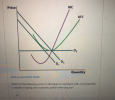 Which of the following curves in the figure is consistent with a monopolistic competitor making zero economic profit in the long run?
Would the demand curve for a monopolistic competitor be more or less elastic than the demand...
 Would the demand curve for a monopolistic competitor be more or less elastic than the demand curve for a monopolist? Justify your answer. What are the characteristics of a monopolistically competitive market? In what sense is there com- petition and in what sense is there monopoly in this type of market structure? What are three examples of monopolistically competitive markets? True, false or uncertain, and why? "Monopolistic competition is just another form of pure monopoly. True, false or uncertain, and...
A monopolistic competitor in long-run equilibrium is like a perfect competitor in that A. zero economic...
A monopolistic competitor in long-run equilibrium is like a perfect competitor in that A. zero economic profits are made. B. price equals marginal cost. C. both produce at the minimum points of their average total cost curves. D. price is greater than marginal cost.
2) Why is the firm’s demand curve flatter than the total market demand curve in monopolistic...
2) Why is the firm’s demand curve flatter than the total market demand curve in monopolistic competition? Suppose a monopolistically competitive firm is making a profit in the short run. What will happen to its demand curve in long run equilibrium ? What could this firm do to affect what happens to its demand curve? Explain in detail.
Show and explain why profits go to zero in the long run under monopolistic competition. Hint: Sta...
 Show and explain why profits go to zero in the long run under monopolistic competition. Hint: Start with a firm making profit and then explain what happens next. Explain why economists consider monopolistic competition inefficient. What are the benefits of allowing this inefficiency?
Show and explain why profits go to zero in the long run under monopolistic competition. Hint: Start with a firm making profit and then explain what happens next. Explain why economists consider monopolistic competition inefficient. What are...
Show and explain why profits go to zero in the long run under monopolistic competition. Hint: Start with a firm making profit and then explain what happens next. Explain why economists consider monopolistic competition inefficient. What are the benefits of allowing this inefficiency?
Show and explain why profits go to zero in the long run under monopolistic competition. Hint: Start with a firm making profit and then explain what happens next. Explain why economists consider monopolistic competition inefficient. What are...
QUESTION 7 Monopolistic competitive firms in the long run earn: positive economic profits. zero pure economic...
QUESTION 7 Monopolistic competitive firms in the long run earn: positive economic profits. zero pure economic profits. negative economic profits. Positive, zero, or negative economic profits. QUESTION 8 Which of the following statements best describes firms under monopolistic competition? Profits will be positive in the long run. Price always equals average variable cost. In the long run, positive economic profit will be eliminated. Marginal revenue equals minimum average total cost in the short run. QUESTION 9 Which of the following...
The major difference between monopolistic competition and monopoly is O A. only a firm in monopolistic...
The major difference between monopolistic competition and monopoly is A. only a firm in monopolistic competition can earn an economic profit in the short run. B. only firms in monopolistic competition are protected by barriers to entryC. only a monopoly can earn an economic profit in the long run. D. how the quantity of output is determined. E. monopoly is a price setter and a firm in monopolistic competition is a price taker.In the long run, firms in monopolistic competition earn zero economic profit...
Please Help Question 21 0.16 pts Examining the cost, revenue, and demand curves for a monopolistic...
 Please Help
Question 21 0.16 pts Examining the cost, revenue, and demand curves for a monopolistic competitor reveals that, at optimal output, the demand curve lies above the average total cost curve. Which of the following is true? O There is economic profit in the long run. Firms will enter the industry in the long run. O There is not enough information because demand is an imperfect benchmark for measuring profitability O There is an economic loss in the long...
Please Help
Question 21 0.16 pts Examining the cost, revenue, and demand curves for a monopolistic competitor reveals that, at optimal output, the demand curve lies above the average total cost curve. Which of the following is true? O There is economic profit in the long run. Firms will enter the industry in the long run. O There is not enough information because demand is an imperfect benchmark for measuring profitability O There is an economic loss in the long...
Figure 01. Cost and Demand for a Monopolistic Competitor Price $15.00 --- $10.00 --- — АС MC Imre 11 Demand curve...
 Figure 01. Cost and Demand for a Monopolistic Competitor Price $15.00 --- $10.00 --- — АС MC Imre 11 Demand curve facing each firm, de 324250 Quantity Question 02. Using Figure 01, the total cost of producing the profit-maximizing output for each firm is: A. $320. B. $480 C. $420 D. $500 Question 03. Using Figure 01, the profits at the profit-maximizing output for each firm is: A. $320. B. $480 C. $160. D. $420. Question 04. Suppose that at...
 Which of the following curves in the figure is consistent with a monopolistic competitor making zero economic profit in the long run?
 Would the demand curve for a monopolistic competitor be more or less elastic than the demand curve for a monopolist? Justify your answer. What are the characteristics of a monopolistically competitive market? In what sense is there com- petition and in what sense is there monopoly in this type of market structure? What are three examples of monopolistically competitive markets? True, false or uncertain, and why? "Monopolistic competition is just another form of pure monopoly. True, false or uncertain, and...
 Show and explain why profits go to zero in the long run under monopolistic competition. Hint: Start with a firm making profit and then explain what happens next. Explain why economists consider monopolistic competition inefficient. What are the benefits of allowing this inefficiency?
Show and explain why profits go to zero in the long run under monopolistic competition. Hint: Start with a firm making profit and then explain what happens next. Explain why economists consider monopolistic competition inefficient. What are...
Show and explain why profits go to zero in the long run under monopolistic competition. Hint: Start with a firm making profit and then explain what happens next. Explain why economists consider monopolistic competition inefficient. What are the benefits of allowing this inefficiency?
Show and explain why profits go to zero in the long run under monopolistic competition. Hint: Start with a firm making profit and then explain what happens next. Explain why economists consider monopolistic competition inefficient. What are...
 Please Help
Question 21 0.16 pts Examining the cost, revenue, and demand curves for a monopolistic competitor reveals that, at optimal output, the demand curve lies above the average total cost curve. Which of the following is true? O There is economic profit in the long run. Firms will enter the industry in the long run. O There is not enough information because demand is an imperfect benchmark for measuring profitability O There is an economic loss in the long...
Please Help
Question 21 0.16 pts Examining the cost, revenue, and demand curves for a monopolistic competitor reveals that, at optimal output, the demand curve lies above the average total cost curve. Which of the following is true? O There is economic profit in the long run. Firms will enter the industry in the long run. O There is not enough information because demand is an imperfect benchmark for measuring profitability O There is an economic loss in the long...
 Figure 01. Cost and Demand for a Monopolistic Competitor Price $15.00 --- $10.00 --- — АС MC Imre 11 Demand curve facing each firm, de 324250 Quantity Question 02. Using Figure 01, the total cost of producing the profit-maximizing output for each firm is: A. $320. B. $480 C. $420 D. $500 Question 03. Using Figure 01, the profits at the profit-maximizing output for each firm is: A. $320. B. $480 C. $160. D. $420. Question 04. Suppose that at...
Most questions answered within 3 hours.
-
Where is the error in this code sequence?
String s1 = "Hello";
String s2 = "ello";...
asked 10 months ago -
Financial data for Joel de Paris, Inc., for last year
follow:
Joel de Paris, Inc.
Balance...
asked 10 months ago -
Consider this reaction:
Al2(SO4)3 (aq)+ BaCl3
(aq) Al2Cl6 (aq)- +
3BaSO4(s) . What is the...
asked 10 months ago -
Suppose that Savneet is considering increasing her
recent random sample from 20 car rentals to 40...
asked 10 months ago -
Trucks arrive at an unloading terminal at an average rate of 120
per hour.
Trucks arrive...
asked 10 months ago -
Why are methanol and ethanol completely soluble in water while
octanol is not very little soluble....
asked 10 months ago -
A facilities manager at a university reads in a research report
that the mean amount of...
asked 10 months ago -
When the CuSO4 is rehydrated by adding water to the anhydrous
compound, is this an endothermic...
asked 10 months ago -
A ray of sunlight is passing from diamond into crown glass; the
angle of incidence is...
asked 10 months ago -
A block of mass 0.249 kg is placed on top of a light, vertical
spring of...
asked 10 months ago -
how do the kidneys compensate in the presences of acidosis
a) trigger hyperventilate
b) reserve acid...
asked 10 months ago -
Question 501 pts
The rental rate of capital to the firm increases. Which of the
following...
asked 10 months ago