
Homework Answers
A2 (g) + B2 (g) <-----------> 2 AB (g)
0.080 0.080 0.040
Keq = [AB]^2 / [A2] [B2]
= (0.040)^2 / (0.080)^2
Keq = 0.25
A2 (g) + B2 (g) <-----------> 2 AB (g)
0.080 0.080 0.040
0.08 -x 0.08 - x 0.040 + 2x
At equilibrium :
0.040 + 2x = 0.1
x = 0.03
concentration of species :
[A2] = 0.050 M
[B2] = 0.050 M
[AB] = 0.10 M
Add Answer to:
Please answer ASAP THANKS
post Diagram (a) shows the reaction By(g)- 2ABig) at equilibrium at a...
For the reaction given below, the value of the equilibrium constant at a certain temperature is...
 For the reaction given below, the value of the equilibrium constant at a certain temperature is 0.50. 2SO_3(g) 2SO_2(g) + O_2(g) Sulfur trioxide, sulfur dioxide, and oxygen are each introduced at a concentration of 1.0 mol/L in a container. Select the correct statement. The partial pressures represent a system in equilibrium The reaction will proceed to the right The reaction will proceed to the left
please answer all parts asap! this is all one question so i could not post separately....
 please answer all parts asap! this is all one question so i
could not post separately. will give thumbs up! thanks!
0.175 g of solid PCI, is sealed inside a 100. mL container from which all the air has been removed. The container is heated to 250 °C. At this temperature, the entire sample vaporizes and the resulting gaseous PCls undergoes the following reaction. PC15 (9) = PC13(9) + C12(g) After the reaction reaches equilibrium, the total pressure inside the...
please answer all parts asap! this is all one question so i
could not post separately. will give thumbs up! thanks!
0.175 g of solid PCI, is sealed inside a 100. mL container from which all the air has been removed. The container is heated to 250 °C. At this temperature, the entire sample vaporizes and the resulting gaseous PCls undergoes the following reaction. PC15 (9) = PC13(9) + C12(g) After the reaction reaches equilibrium, the total pressure inside the...
The diagram represents the equilibrium state for the reaction X2(g) + 2 Y(g) = 2 XY(g)...
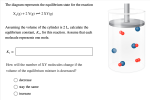 The diagram represents the equilibrium state for the reaction X2(g) + 2 Y(g) = 2 XY(g) Assuming the volume of the cylinder is 2 L, calculate the equlibrium constant, Kc, for this reaction. Assume that each molecule represents one mole. Kc = How will the number of XY molecules change if the volume of the equilibrium mixture is decreased? O decrease O stay the same O increase
For the reaction system: H2 (g) + CO2 (g) → H2O (g) + CO (g) The...
For the reaction system: H2 (g) + CO2 (g) → H2O (g) + CO (g) The equilibrium constant is 1.60 at a certain temperature. 1.00 mole each of hydrogen, carbon dioxide is placed in a sealed 5.00 L container. After equilibrium is established, determine the molarity (M) of each species.
4. Consider the following reaction at equilibrium CO(g) + H2O(g) + CO2(g) + H2(g) 2.50 mole...
 4. Consider the following reaction at equilibrium CO(g) + H2O(g) + CO2(g) + H2(g) 2.50 mole of CO(g) and 2.50 mole of H2O(g) gas at 588 K are mixed in a 10.00 L container. (Kc = 31.4 at 588 K) Calculate the concentration of CO(g), H2O(g), CO (g), and H.(g) at equilibrium. 5. Consider the following reaction: CO(g) + H2O(g) + CO2(g) + H2(g) (a) If a 10.00L container has 2.50 mole of CO(g), 2.50 mole of H2O(g), 5.00 mole...
13 please answer and explaination 2 H2S(g) + CH (g) = CS2(g) + 4H2(g) K =...
 13 please answer and explaination
2 H2S(g) + CH (g) = CS2(g) + 4H2(g) K = 3.4 x 10⁻⁴ More Poactants Than Products A 0.10 mol sample of each of the four species in the reaction represented above is injected into a rigid, previously evacuated 1.0 L container. Which of the following species will have the highest concentration when the system reaches equilibrium? H2S(8) B.CH.(g) CS2(g) P. Hz(8) because kis small - H
13 please answer and explaination
2 H2S(g) + CH (g) = CS2(g) + 4H2(g) K = 3.4 x 10⁻⁴ More Poactants Than Products A 0.10 mol sample of each of the four species in the reaction represented above is injected into a rigid, previously evacuated 1.0 L container. Which of the following species will have the highest concentration when the system reaches equilibrium? H2S(8) B.CH.(g) CS2(g) P. Hz(8) because kis small - H
The value of the equilibrium constant Kc for the reaction N2(g)+3H2(g)⇌2NH3(g) changes in the following manner...
The value of the equilibrium constant Kc for the reaction N2(g)+3H2(g)⇌2NH3(g) changes in the following manner as a function of temperature Temperature (∘C) Kc 300 9.6 400 0.50 500 0.058 Part A Use the standard enthalpies of formation given in Appendix C to determine the ΔH for this reaction at standard conditions. Express your answer in kilojoules to two decimal places. Part B If 0.027 mole of gaseous NH3 is added to a 1.00 L container and heated to 500 ∘C,...
particular temperature. A 2. For the reaction SO2C12(g) SO2(g) Cl2(g), Ke 0.011 at a + 2.00...
 particular temperature. A 2. For the reaction SO2C12(g) SO2(g) Cl2(g), Ke 0.011 at a + 2.00 L container at this temperature contains 0.30 mole SO2,0.20 mole Cl2, and 0.50 mole SO2C12 a) Is this system at equilibrium? b) If it is not at equilibrium, in which direction will the system move to reach equilibrium? Why? NO(g) 85.0 at 4.60 x 10² °C. A 3. For the reaction SO2(g) + NO2(g) reaction is started with 0.0500 M of both reactants (Note,...
At a certain temperature, the equilibrium constant, Kc, for this reaction is 53.3. H2(g) +12(g) =...
 At a certain temperature, the equilibrium constant, Kc, for this reaction is 53.3. H2(g) +12(g) = 2 HI(g) Kc = 53.3 At this temperature, 0.500 mol H, and 0.500 moll, were placed in a 1.00 L container to react. What concentration of HI is present at equilibrium? [HI] =
2 H2S(g) + CH4(g) 근 CS2(g) + 4 H2(g) Ke = 3.4 × 10⁻⁴ A 0.10...
 2 H2S(g) + CH4(g) 근 CS2(g) + 4 H2(g) Ke = 3.4 × 10⁻⁴ A 0.10 mol sample of each of the four species in the reaction represented above is injected into a rigid, previously evacuated 1.0 L container. Which of the following species will have the highest concentration when the system reaches equilibrium? A) H2S(g) B) CH4(8) C) CS2(8) D) H2(8)
 For the reaction given below, the value of the equilibrium constant at a certain temperature is 0.50. 2SO_3(g) 2SO_2(g) + O_2(g) Sulfur trioxide, sulfur dioxide, and oxygen are each introduced at a concentration of 1.0 mol/L in a container. Select the correct statement. The partial pressures represent a system in equilibrium The reaction will proceed to the right The reaction will proceed to the left
 please answer all parts asap! this is all one question so i
could not post separately. will give thumbs up! thanks!
0.175 g of solid PCI, is sealed inside a 100. mL container from which all the air has been removed. The container is heated to 250 °C. At this temperature, the entire sample vaporizes and the resulting gaseous PCls undergoes the following reaction. PC15 (9) = PC13(9) + C12(g) After the reaction reaches equilibrium, the total pressure inside the...
please answer all parts asap! this is all one question so i
could not post separately. will give thumbs up! thanks!
0.175 g of solid PCI, is sealed inside a 100. mL container from which all the air has been removed. The container is heated to 250 °C. At this temperature, the entire sample vaporizes and the resulting gaseous PCls undergoes the following reaction. PC15 (9) = PC13(9) + C12(g) After the reaction reaches equilibrium, the total pressure inside the...
 The diagram represents the equilibrium state for the reaction X2(g) + 2 Y(g) = 2 XY(g) Assuming the volume of the cylinder is 2 L, calculate the equlibrium constant, Kc, for this reaction. Assume that each molecule represents one mole. Kc = How will the number of XY molecules change if the volume of the equilibrium mixture is decreased? O decrease O stay the same O increase
 4. Consider the following reaction at equilibrium CO(g) + H2O(g) + CO2(g) + H2(g) 2.50 mole of CO(g) and 2.50 mole of H2O(g) gas at 588 K are mixed in a 10.00 L container. (Kc = 31.4 at 588 K) Calculate the concentration of CO(g), H2O(g), CO (g), and H.(g) at equilibrium. 5. Consider the following reaction: CO(g) + H2O(g) + CO2(g) + H2(g) (a) If a 10.00L container has 2.50 mole of CO(g), 2.50 mole of H2O(g), 5.00 mole...
 13 please answer and explaination
2 H2S(g) + CH (g) = CS2(g) + 4H2(g) K = 3.4 x 10⁻⁴ More Poactants Than Products A 0.10 mol sample of each of the four species in the reaction represented above is injected into a rigid, previously evacuated 1.0 L container. Which of the following species will have the highest concentration when the system reaches equilibrium? H2S(8) B.CH.(g) CS2(g) P. Hz(8) because kis small - H
13 please answer and explaination
2 H2S(g) + CH (g) = CS2(g) + 4H2(g) K = 3.4 x 10⁻⁴ More Poactants Than Products A 0.10 mol sample of each of the four species in the reaction represented above is injected into a rigid, previously evacuated 1.0 L container. Which of the following species will have the highest concentration when the system reaches equilibrium? H2S(8) B.CH.(g) CS2(g) P. Hz(8) because kis small - H
 particular temperature. A 2. For the reaction SO2C12(g) SO2(g) Cl2(g), Ke 0.011 at a + 2.00 L container at this temperature contains 0.30 mole SO2,0.20 mole Cl2, and 0.50 mole SO2C12 a) Is this system at equilibrium? b) If it is not at equilibrium, in which direction will the system move to reach equilibrium? Why? NO(g) 85.0 at 4.60 x 10² °C. A 3. For the reaction SO2(g) + NO2(g) reaction is started with 0.0500 M of both reactants (Note,...
 At a certain temperature, the equilibrium constant, Kc, for this reaction is 53.3. H2(g) +12(g) = 2 HI(g) Kc = 53.3 At this temperature, 0.500 mol H, and 0.500 moll, were placed in a 1.00 L container to react. What concentration of HI is present at equilibrium? [HI] =
 2 H2S(g) + CH4(g) 근 CS2(g) + 4 H2(g) Ke = 3.4 × 10⁻⁴ A 0.10 mol sample of each of the four species in the reaction represented above is injected into a rigid, previously evacuated 1.0 L container. Which of the following species will have the highest concentration when the system reaches equilibrium? A) H2S(g) B) CH4(8) C) CS2(8) D) H2(8)
Most questions answered within 3 hours.
-
Where is the error in this code sequence?
String s1 = "Hello";
String s2 = "ello";...
asked 10 months ago -
Financial data for Joel de Paris, Inc., for last year
follow:
Joel de Paris, Inc.
Balance...
asked 10 months ago -
Consider this reaction:
Al2(SO4)3 (aq)+ BaCl3
(aq) Al2Cl6 (aq)- +
3BaSO4(s) . What is the...
asked 10 months ago -
Suppose that Savneet is considering increasing her
recent random sample from 20 car rentals to 40...
asked 10 months ago -
Trucks arrive at an unloading terminal at an average rate of 120
per hour.
Trucks arrive...
asked 10 months ago -
Why are methanol and ethanol completely soluble in water while
octanol is not very little soluble....
asked 10 months ago -
A facilities manager at a university reads in a research report
that the mean amount of...
asked 10 months ago -
When the CuSO4 is rehydrated by adding water to the anhydrous
compound, is this an endothermic...
asked 10 months ago -
A ray of sunlight is passing from diamond into crown glass; the
angle of incidence is...
asked 10 months ago -
A block of mass 0.249 kg is placed on top of a light, vertical
spring of...
asked 10 months ago -
how do the kidneys compensate in the presences of acidosis
a) trigger hyperventilate
b) reserve acid...
asked 10 months ago -
Question 501 pts
The rental rate of capital to the firm increases. Which of the
following...
asked 10 months ago