
Homework Answers
1. As we increase the number of transfers, the volume of the water in the graduated cylinder decreases. As we go transferring, some molecules do not get transferred from one cylinder to another. As a result after many transfers we find decrease in the volume.
2. Please mention what is VB and VA so that their quotient can be found out
Add Answer to:
24 12 25 Questions for Part II 1. What happens to the volume of water in...
Student Number Soichiometry II Mass-Volume Calculations Lat Volume-Volume Calculations Part I: Mass - Volume 1. How...
 Student Number Soichiometry II Mass-Volume Calculations Lat Volume-Volume Calculations Part I: Mass - Volume 1. How many grams of sodium water? y grams of sodium metal are needed to generate 4.00 L of hydrogen (at STP) from What volume of hydrogen at 20°C and 800. mm Hg will be formed by the reaction of 20.0 g of calcium with an excess of hydrochloric acid 3. When water is decomposed by electrolysis, what volume of oxygen 25°C and 750. mm Hg...
Refer to the Energy Lab Part II. What happens to the energy loss, dE/dS, if the...
Refer to the Energy Lab Part II. What happens to the energy loss, dE/dS, if the “G-force” increases? a. Increases b. Decreases c. Stays the same d. None of the above
Ecological Interactions EXPERIMENT 1: ECOLOGICAL INTERACTIONS Data Tables Table 2: Volume and Con...
 Ecological Interactions EXPERIMENT 1: ECOLOGICAL INTERACTIONS Data Tables Table 2: Volume and Concentration Totals Trophic Cylinder oil Volume of Level 1st 2nd 1000 mL 100 mL Post-Lab Questions What does the water in this experiment represent? What does the oil represent? 1. 2. How did the amount of oil change from one trophic level to the next? 3. How does the change in the amount of oil relate to biomagnification? 4. Why would this change in amount of an accumulating...
Data Analysis 1. Compare the volumes measured in Part I. Which estimated volume was most reproducible...
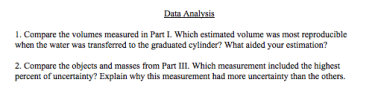 Data Analysis 1. Compare the volumes measured in Part I. Which estimated volume was most reproducible when the water was transferred to the graduated cylinder? What aided your estimation? 2. Compare the objects and masses from Part III. Which measurement included the highest percent of uncertainty? Explain why this measurement had more uncertainty than the others.
pls help me Question 1 (1 point) What happens to the volume of a gas if...
 pls help me
Question 1 (1 point) What happens to the volume of a gas if the temperature of the gas decreases from 40°C to 20°C? Doubles Increases a little Does not change Decreases a little Gets halved Question 2 (1 point) Convert 25°C to K. -212 K -248 K 262 K -298 K 298 K Question 3 (1 point) What happens to the pressure of a gas if the volume of the gas increases? The pressure increases. The pressure...
pls help me
Question 1 (1 point) What happens to the volume of a gas if the temperature of the gas decreases from 40°C to 20°C? Doubles Increases a little Does not change Decreases a little Gets halved Question 2 (1 point) Convert 25°C to K. -212 K -248 K 262 K -298 K 298 K Question 3 (1 point) What happens to the pressure of a gas if the volume of the gas increases? The pressure increases. The pressure...
Materials 10 mL Vegetable Oil "Water Labware 10 mL Graduated Cylinder 100 mL Graduated Cylinder N...
 thanks
Materials 10 mL Vegetable Oil "Water Labware 10 mL Graduated Cylinder 100 mL Graduated Cylinder Note: You must provide the materials listed in red. EXPERIMENT 1: ECOLOGICAL INTERACTIONS In this experiment, you will demonstrate how substances accumulate in trophic levels through biomagnification PROCEDURE 9 mL of water into the 10 ml graduated cylinder. The graduated cylinder represents a primary producer. □ 2. Add 1 mL f oil to the 10 ml graduated cylinder containing the water. Note that the...
thanks
Materials 10 mL Vegetable Oil "Water Labware 10 mL Graduated Cylinder 100 mL Graduated Cylinder Note: You must provide the materials listed in red. EXPERIMENT 1: ECOLOGICAL INTERACTIONS In this experiment, you will demonstrate how substances accumulate in trophic levels through biomagnification PROCEDURE 9 mL of water into the 10 ml graduated cylinder. The graduated cylinder represents a primary producer. □ 2. Add 1 mL f oil to the 10 ml graduated cylinder containing the water. Note that the...
Part II : Volume - Volume 1. Carbon monoxide burns in oxygen to form carbon dioxide....
 Part II : Volume - Volume 1. Carbon monoxide burns in oxygen to form carbon dioxide. What volume of oxygen at 25°C and 760. mm Hg is required to react with 15.0 L of carbon monoxide (at STP)? 2. What volume of hydrogen and nitrogen are required to produce 20.0 L of ammonia (all gases at STP)? 3. Acetylene ( CH) burns in oxygen to form carbon dioxide and water. How many liters of oxygen (at STP) are needed to...
question 11 1 of 5 A SHEET: LABI, Mesurements and Density Determination form ***Make sure to...
 question 11
1 of 5 A SHEET: LABI, Mesurements and Density Determination form ***Make sure to include your NAMES: SECTION Use the correct number of digits and include units on your answers PARTA 1. Temperature of tap water 25.0°C 2. Temperature of hot water 60.0°C name 10.0018 20.0258 29.995 PART 3 3. Mass of metal piece I: shortest 4. Mass of metal piece 2 5. Mass of metal piece 3 tallest PART. DIRECT METHOD 6. Height of ullostylinder 7. Radius...
question 11
1 of 5 A SHEET: LABI, Mesurements and Density Determination form ***Make sure to include your NAMES: SECTION Use the correct number of digits and include units on your answers PARTA 1. Temperature of tap water 25.0°C 2. Temperature of hot water 60.0°C name 10.0018 20.0258 29.995 PART 3 3. Mass of metal piece I: shortest 4. Mass of metal piece 2 5. Mass of metal piece 3 tallest PART. DIRECT METHOD 6. Height of ullostylinder 7. Radius...
I need the density (g/mL) for the water column and the isopropyl alcohol column. With math...
 I need the density (g/mL) for the water column and the isopropyl
alcohol column. With math shown and included please! The question
requires me to show work. If possible, I would also like the
percent error's (with work shown) of the water and isopropyl
alcohol columns. Thank you!
Part 1: Volume and Density Measurements (Liquid) 1 Gather the graduated cylinder, distilled water, short stem pipet, and isopropyl alcohol. 2 Place the clean, dry, 25 ml graduated cylinder on the tared...
I need the density (g/mL) for the water column and the isopropyl
alcohol column. With math shown and included please! The question
requires me to show work. If possible, I would also like the
percent error's (with work shown) of the water and isopropyl
alcohol columns. Thank you!
Part 1: Volume and Density Measurements (Liquid) 1 Gather the graduated cylinder, distilled water, short stem pipet, and isopropyl alcohol. 2 Place the clean, dry, 25 ml graduated cylinder on the tared...
1. Calculate the volume (in liters) of 0.518 moles of an ideal gas at 0.818 atm...
 1. Calculate the volume (in liters) of 0.518 moles of an ideal gas at 0.818 atm and 17.3 °C. R = 0.0821 L atm /mol K 2. Why must the height of the meniscus in the graduated cylinder match the height of the water in the tub when measuring volume? This ensures that the pressure inside of the graduated cylinder is the same as the atmospheric pressure in the room This alleviates the diffraction of water in the tub from...
 Student Number Soichiometry II Mass-Volume Calculations Lat Volume-Volume Calculations Part I: Mass - Volume 1. How many grams of sodium water? y grams of sodium metal are needed to generate 4.00 L of hydrogen (at STP) from What volume of hydrogen at 20°C and 800. mm Hg will be formed by the reaction of 20.0 g of calcium with an excess of hydrochloric acid 3. When water is decomposed by electrolysis, what volume of oxygen 25°C and 750. mm Hg...
 Ecological Interactions EXPERIMENT 1: ECOLOGICAL INTERACTIONS Data Tables Table 2: Volume and Concentration Totals Trophic Cylinder oil Volume of Level 1st 2nd 1000 mL 100 mL Post-Lab Questions What does the water in this experiment represent? What does the oil represent? 1. 2. How did the amount of oil change from one trophic level to the next? 3. How does the change in the amount of oil relate to biomagnification? 4. Why would this change in amount of an accumulating...
 Data Analysis 1. Compare the volumes measured in Part I. Which estimated volume was most reproducible when the water was transferred to the graduated cylinder? What aided your estimation? 2. Compare the objects and masses from Part III. Which measurement included the highest percent of uncertainty? Explain why this measurement had more uncertainty than the others.
 pls help me
Question 1 (1 point) What happens to the volume of a gas if the temperature of the gas decreases from 40°C to 20°C? Doubles Increases a little Does not change Decreases a little Gets halved Question 2 (1 point) Convert 25°C to K. -212 K -248 K 262 K -298 K 298 K Question 3 (1 point) What happens to the pressure of a gas if the volume of the gas increases? The pressure increases. The pressure...
pls help me
Question 1 (1 point) What happens to the volume of a gas if the temperature of the gas decreases from 40°C to 20°C? Doubles Increases a little Does not change Decreases a little Gets halved Question 2 (1 point) Convert 25°C to K. -212 K -248 K 262 K -298 K 298 K Question 3 (1 point) What happens to the pressure of a gas if the volume of the gas increases? The pressure increases. The pressure...
 thanks
Materials 10 mL Vegetable Oil "Water Labware 10 mL Graduated Cylinder 100 mL Graduated Cylinder Note: You must provide the materials listed in red. EXPERIMENT 1: ECOLOGICAL INTERACTIONS In this experiment, you will demonstrate how substances accumulate in trophic levels through biomagnification PROCEDURE 9 mL of water into the 10 ml graduated cylinder. The graduated cylinder represents a primary producer. □ 2. Add 1 mL f oil to the 10 ml graduated cylinder containing the water. Note that the...
thanks
Materials 10 mL Vegetable Oil "Water Labware 10 mL Graduated Cylinder 100 mL Graduated Cylinder Note: You must provide the materials listed in red. EXPERIMENT 1: ECOLOGICAL INTERACTIONS In this experiment, you will demonstrate how substances accumulate in trophic levels through biomagnification PROCEDURE 9 mL of water into the 10 ml graduated cylinder. The graduated cylinder represents a primary producer. □ 2. Add 1 mL f oil to the 10 ml graduated cylinder containing the water. Note that the...
 Part II : Volume - Volume 1. Carbon monoxide burns in oxygen to form carbon dioxide. What volume of oxygen at 25°C and 760. mm Hg is required to react with 15.0 L of carbon monoxide (at STP)? 2. What volume of hydrogen and nitrogen are required to produce 20.0 L of ammonia (all gases at STP)? 3. Acetylene ( CH) burns in oxygen to form carbon dioxide and water. How many liters of oxygen (at STP) are needed to...
 question 11
1 of 5 A SHEET: LABI, Mesurements and Density Determination form ***Make sure to include your NAMES: SECTION Use the correct number of digits and include units on your answers PARTA 1. Temperature of tap water 25.0°C 2. Temperature of hot water 60.0°C name 10.0018 20.0258 29.995 PART 3 3. Mass of metal piece I: shortest 4. Mass of metal piece 2 5. Mass of metal piece 3 tallest PART. DIRECT METHOD 6. Height of ullostylinder 7. Radius...
question 11
1 of 5 A SHEET: LABI, Mesurements and Density Determination form ***Make sure to include your NAMES: SECTION Use the correct number of digits and include units on your answers PARTA 1. Temperature of tap water 25.0°C 2. Temperature of hot water 60.0°C name 10.0018 20.0258 29.995 PART 3 3. Mass of metal piece I: shortest 4. Mass of metal piece 2 5. Mass of metal piece 3 tallest PART. DIRECT METHOD 6. Height of ullostylinder 7. Radius...
 I need the density (g/mL) for the water column and the isopropyl
alcohol column. With math shown and included please! The question
requires me to show work. If possible, I would also like the
percent error's (with work shown) of the water and isopropyl
alcohol columns. Thank you!
Part 1: Volume and Density Measurements (Liquid) 1 Gather the graduated cylinder, distilled water, short stem pipet, and isopropyl alcohol. 2 Place the clean, dry, 25 ml graduated cylinder on the tared...
I need the density (g/mL) for the water column and the isopropyl
alcohol column. With math shown and included please! The question
requires me to show work. If possible, I would also like the
percent error's (with work shown) of the water and isopropyl
alcohol columns. Thank you!
Part 1: Volume and Density Measurements (Liquid) 1 Gather the graduated cylinder, distilled water, short stem pipet, and isopropyl alcohol. 2 Place the clean, dry, 25 ml graduated cylinder on the tared...
 1. Calculate the volume (in liters) of 0.518 moles of an ideal gas at 0.818 atm and 17.3 °C. R = 0.0821 L atm /mol K 2. Why must the height of the meniscus in the graduated cylinder match the height of the water in the tub when measuring volume? This ensures that the pressure inside of the graduated cylinder is the same as the atmospheric pressure in the room This alleviates the diffraction of water in the tub from...
Most questions answered within 3 hours.
-
Where is the error in this code sequence?
String s1 = "Hello";
String s2 = "ello";...
asked 11 months ago -
Financial data for Joel de Paris, Inc., for last year
follow:
Joel de Paris, Inc.
Balance...
asked 11 months ago -
Consider this reaction:
Al2(SO4)3 (aq)+ BaCl3
(aq) Al2Cl6 (aq)- +
3BaSO4(s) . What is the...
asked 11 months ago -
Suppose that Savneet is considering increasing her
recent random sample from 20 car rentals to 40...
asked 11 months ago -
Trucks arrive at an unloading terminal at an average rate of 120
per hour.
Trucks arrive...
asked 11 months ago -
Why are methanol and ethanol completely soluble in water while
octanol is not very little soluble....
asked 11 months ago -
A facilities manager at a university reads in a research report
that the mean amount of...
asked 11 months ago -
When the CuSO4 is rehydrated by adding water to the anhydrous
compound, is this an endothermic...
asked 11 months ago -
A ray of sunlight is passing from diamond into crown glass; the
angle of incidence is...
asked 11 months ago -
A block of mass 0.249 kg is placed on top of a light, vertical
spring of...
asked 11 months ago -
how do the kidneys compensate in the presences of acidosis
a) trigger hyperventilate
b) reserve acid...
asked 11 months ago -
Question 501 pts
The rental rate of capital to the firm increases. Which of the
following...
asked 11 months ago