
Homework Answers
Add Answer to:
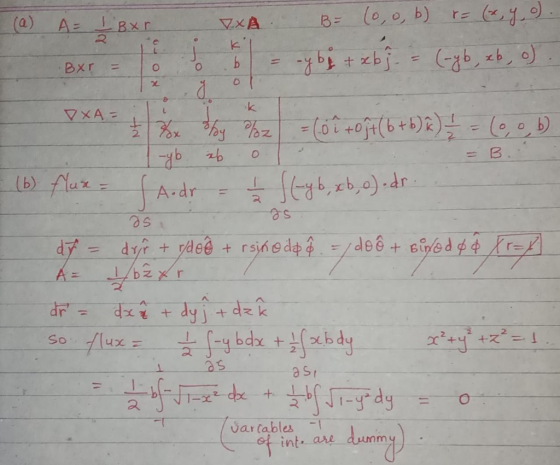
Recall that it is conservative, then the line intera/ F.dr is path-independent meaning that the the...
LE 4) (Ungraded) In Cartesian coordinates, the curl of a vector field Air) is defined as...
 LE 4) (Ungraded) In Cartesian coordinates, the curl of a vector field Air) is defined as Use the definition of electric potential to find the potential difference between the origin and r = x + y + 27, V(r) - V(O) = - Ed. As the line integral is independent of path, choose whatever path you find to be con- vertient Taking V(0) = 0, what is V(r)? Finally, confirm that taking the gradient of the potential recovers our original...
(2) For the vector field f 2z(ri yi)(22)k use the definition of line integral to evaluate the line integral J f.dr along the helical path r-costi + sintj+tk, 0St (3) You are given that the vector fie...
 (2) For the vector field f 2z(ri yi)(22)k use the definition of line integral to evaluate the line integral J f.dr along the helical path r-costi + sintj+tk, 0St (3) You are given that the vector field f in Q2 is conservative. Find the corresponding potential function and use this to check the line integral evaluated in Q2
(2) For the vector field f 2z(ri yi)(22)k use the definition of line integral to evaluate the line integral J f.dr along...
(2) For the vector field f 2z(ri yi)(22)k use the definition of line integral to evaluate the line integral J f.dr along the helical path r-costi + sintj+tk, 0St (3) You are given that the vector field f in Q2 is conservative. Find the corresponding potential function and use this to check the line integral evaluated in Q2
(2) For the vector field f 2z(ri yi)(22)k use the definition of line integral to evaluate the line integral J f.dr along...
QB(27pts)(a). Evaluate the circulation ofF(xy)-<x,y+x> on the curve r(t)=<2cost, 2sinp, foross2n (b) Evaluate J F.dr, where C is a piecewise smooth path from (1,0) to (2,1) and F- (e'...
 QB(27pts)(a). Evaluate the circulation ofF(xy)-<x,y+x> on the curve r(t)=<2cost, 2sinp, foross2n (b) Evaluate J F.dr, where C is a piecewise smooth path from (1,0) to (2,1) and F- (e'cos x)i +(e'sinx)j [Hint: Test F for conservative (c). Use green theorem to express the line integral as a double integral and then evaluate. where C is the circle x+y-4 with counterclockwise orientation. (d(Bonus10 pts) Consider the vector field Foxyz) a. Find curl F y, ,z> F.dr where C is the curve...
Problem 6 Using Stokes' Theorem, we equate F dr curl F dA. Find curl F- PreviousS...
 Problem 6 Using Stokes' Theorem, we equate F dr curl F dA. Find curl F- PreviousS us Problem ListNext Noting that the surface is given by (1 point) Calculate the circulation, Fdr7in z - 16-x2 - y2, find two ways, directly and using Stokes' Theorem. dA The vector field F = 6y1-6y and C is the boundary of S, the part of the surface dy dx With R giving the region in the xy-plane enclosed by the surface, this gives...
(a) Find the flux of the vector field F=yi-xjtk across the surface σ which is 4. x2 +y2 and below z the portion of z 4 and is oriented by the outward normal. _t7г (b) Use Stokes' Theorem to ev...
 (a) Find the flux of the vector field F=yi-xjtk across the surface σ which is 4. x2 +y2 and below z the portion of z 4 and is oriented by the outward normal. _t7г (b) Use Stokes' Theorem to evaluate the line integral of J F.dr of F--уз ì_x3 j+(x+z)k where C is the clockwise path along the triangle with vertices (0,0,0). (1.0,0)and (1.i.o) aong the thiangle with(i) t)
(a) Find the flux of the vector field F=yi-xjtk across the...
(a) Find the flux of the vector field F=yi-xjtk across the surface σ which is 4. x2 +y2 and below z the portion of z 4 and is oriented by the outward normal. _t7г (b) Use Stokes' Theorem to evaluate the line integral of J F.dr of F--уз ì_x3 j+(x+z)k where C is the clockwise path along the triangle with vertices (0,0,0). (1.0,0)and (1.i.o) aong the thiangle with(i) t)
(a) Find the flux of the vector field F=yi-xjtk across the...
Line Integral & Path Independency Problem 1 Prove that the vector field = (2x-3yz)i +(2-3x-2) 1-6xyzk...
 Line Integral & Path Independency Problem 1 Prove that the vector field = (2x-3yz)i +(2-3x-2) 1-6xyzk is the gradient of a scalar function f(x,y,z). Hint: find the curl of F, is it a zero vector? Integrate and find f(x,y,z), called a potential, like from potential energy? Show all your work, Then, use f(x,y,z) to compute the line integral, or work of the force F: Work of F= di from A:(-1,0, 2) to B:(3,-4,0) along any curve that goes from A...
(1 point) This problem will illustrate the divergence theorem by computing the outward flux of th...
 (1 point) This problem will illustrate the divergence theorem by computing the outward flux of the vector field F(x, y, z) -2ri + 5yj + 2k across the boundary of the right rectangular prism:-1< x< 7, -4
(2 pts) Calculate the circulation, rF dr, in two ways, directly and using Stokes' Theorem. The vector field F (...
 (2 pts) Calculate the circulation, rF dr, in two ways, directly and using Stokes' Theorem. The vector field F (8x-8y+62)(i + j) and C is the triangle with vertices (0,0,0), (8, 0, 0), (8,2,0), traversed in that order. Calculating directly, we break C into three paths. For each, give a parameterization r (t) that traverses the path from start to end for 0sts 1 On Ci from (0,0, 0) to (8,0,0), r(t) = <8t,0,0> On C2 from (8, 0, 0)...
please give some explanation to each step 15 Total Question 3 Let F: R3R3 be any...
 please give some explanation to each step
15 Total Question 3 Let F: R3R3 be any C2 vector field. 3(a). Prove that the divergence of the curl of F is zero. /4 marks 3(b). For F as defined above, a misguided professor claims that for any closed curve C, F dr 0 because of the argument: (x F)ds F-dr div (eurl F) dV X 0-APO by using Stokes' theorem, the divergence theorem, and then part (a) for an appropriately chosen...
please give some explanation to each step
15 Total Question 3 Let F: R3R3 be any C2 vector field. 3(a). Prove that the divergence of the curl of F is zero. /4 marks 3(b). For F as defined above, a misguided professor claims that for any closed curve C, F dr 0 because of the argument: (x F)ds F-dr div (eurl F) dV X 0-APO by using Stokes' theorem, the divergence theorem, and then part (a) for an appropriately chosen...
Q4 please and thank you (3) You are given that the vector field f in Q2 is conservative. Find the corresponding potential function and use this to check the line integral evaluated in Q2. (4) Conside...
 Q4 please and thank you
(3) You are given that the vector field f in Q2 is conservative. Find the corresponding potential function and use this to check the line integral evaluated in Q2. (4) Consider the vector field F(x, y) -ryi - 2j (-Fii F2j) and let C be the closed curve consisting of three segments: the straight line from (0, 0) to (1,0) followed by the circular arc from (1,0) to (0,1) followed by the straight line from...
Q4 please and thank you
(3) You are given that the vector field f in Q2 is conservative. Find the corresponding potential function and use this to check the line integral evaluated in Q2. (4) Consider the vector field F(x, y) -ryi - 2j (-Fii F2j) and let C be the closed curve consisting of three segments: the straight line from (0, 0) to (1,0) followed by the circular arc from (1,0) to (0,1) followed by the straight line from...
 LE 4) (Ungraded) In Cartesian coordinates, the curl of a vector field Air) is defined as Use the definition of electric potential to find the potential difference between the origin and r = x + y + 27, V(r) - V(O) = - Ed. As the line integral is independent of path, choose whatever path you find to be con- vertient Taking V(0) = 0, what is V(r)? Finally, confirm that taking the gradient of the potential recovers our original...
 (2) For the vector field f 2z(ri yi)(22)k use the definition of line integral to evaluate the line integral J f.dr along the helical path r-costi + sintj+tk, 0St (3) You are given that the vector field f in Q2 is conservative. Find the corresponding potential function and use this to check the line integral evaluated in Q2
(2) For the vector field f 2z(ri yi)(22)k use the definition of line integral to evaluate the line integral J f.dr along...
(2) For the vector field f 2z(ri yi)(22)k use the definition of line integral to evaluate the line integral J f.dr along the helical path r-costi + sintj+tk, 0St (3) You are given that the vector field f in Q2 is conservative. Find the corresponding potential function and use this to check the line integral evaluated in Q2
(2) For the vector field f 2z(ri yi)(22)k use the definition of line integral to evaluate the line integral J f.dr along...
 QB(27pts)(a). Evaluate the circulation ofF(xy)-<x,y+x> on the curve r(t)=<2cost, 2sinp, foross2n (b) Evaluate J F.dr, where C is a piecewise smooth path from (1,0) to (2,1) and F- (e'cos x)i +(e'sinx)j [Hint: Test F for conservative (c). Use green theorem to express the line integral as a double integral and then evaluate. where C is the circle x+y-4 with counterclockwise orientation. (d(Bonus10 pts) Consider the vector field Foxyz) a. Find curl F y, ,z> F.dr where C is the curve...
 Problem 6 Using Stokes' Theorem, we equate F dr curl F dA. Find curl F- PreviousS us Problem ListNext Noting that the surface is given by (1 point) Calculate the circulation, Fdr7in z - 16-x2 - y2, find two ways, directly and using Stokes' Theorem. dA The vector field F = 6y1-6y and C is the boundary of S, the part of the surface dy dx With R giving the region in the xy-plane enclosed by the surface, this gives...
 (a) Find the flux of the vector field F=yi-xjtk across the surface σ which is 4. x2 +y2 and below z the portion of z 4 and is oriented by the outward normal. _t7г (b) Use Stokes' Theorem to evaluate the line integral of J F.dr of F--уз ì_x3 j+(x+z)k where C is the clockwise path along the triangle with vertices (0,0,0). (1.0,0)and (1.i.o) aong the thiangle with(i) t)
(a) Find the flux of the vector field F=yi-xjtk across the...
(a) Find the flux of the vector field F=yi-xjtk across the surface σ which is 4. x2 +y2 and below z the portion of z 4 and is oriented by the outward normal. _t7г (b) Use Stokes' Theorem to evaluate the line integral of J F.dr of F--уз ì_x3 j+(x+z)k where C is the clockwise path along the triangle with vertices (0,0,0). (1.0,0)and (1.i.o) aong the thiangle with(i) t)
(a) Find the flux of the vector field F=yi-xjtk across the...
 Line Integral & Path Independency Problem 1 Prove that the vector field = (2x-3yz)i +(2-3x-2) 1-6xyzk is the gradient of a scalar function f(x,y,z). Hint: find the curl of F, is it a zero vector? Integrate and find f(x,y,z), called a potential, like from potential energy? Show all your work, Then, use f(x,y,z) to compute the line integral, or work of the force F: Work of F= di from A:(-1,0, 2) to B:(3,-4,0) along any curve that goes from A...
 (1 point) This problem will illustrate the divergence theorem by computing the outward flux of the vector field F(x, y, z) -2ri + 5yj + 2k across the boundary of the right rectangular prism:-1< x< 7, -4
 (2 pts) Calculate the circulation, rF dr, in two ways, directly and using Stokes' Theorem. The vector field F (8x-8y+62)(i + j) and C is the triangle with vertices (0,0,0), (8, 0, 0), (8,2,0), traversed in that order. Calculating directly, we break C into three paths. For each, give a parameterization r (t) that traverses the path from start to end for 0sts 1 On Ci from (0,0, 0) to (8,0,0), r(t) = <8t,0,0> On C2 from (8, 0, 0)...
 please give some explanation to each step
15 Total Question 3 Let F: R3R3 be any C2 vector field. 3(a). Prove that the divergence of the curl of F is zero. /4 marks 3(b). For F as defined above, a misguided professor claims that for any closed curve C, F dr 0 because of the argument: (x F)ds F-dr div (eurl F) dV X 0-APO by using Stokes' theorem, the divergence theorem, and then part (a) for an appropriately chosen...
please give some explanation to each step
15 Total Question 3 Let F: R3R3 be any C2 vector field. 3(a). Prove that the divergence of the curl of F is zero. /4 marks 3(b). For F as defined above, a misguided professor claims that for any closed curve C, F dr 0 because of the argument: (x F)ds F-dr div (eurl F) dV X 0-APO by using Stokes' theorem, the divergence theorem, and then part (a) for an appropriately chosen...
 Q4 please and thank you
(3) You are given that the vector field f in Q2 is conservative. Find the corresponding potential function and use this to check the line integral evaluated in Q2. (4) Consider the vector field F(x, y) -ryi - 2j (-Fii F2j) and let C be the closed curve consisting of three segments: the straight line from (0, 0) to (1,0) followed by the circular arc from (1,0) to (0,1) followed by the straight line from...
Q4 please and thank you
(3) You are given that the vector field f in Q2 is conservative. Find the corresponding potential function and use this to check the line integral evaluated in Q2. (4) Consider the vector field F(x, y) -ryi - 2j (-Fii F2j) and let C be the closed curve consisting of three segments: the straight line from (0, 0) to (1,0) followed by the circular arc from (1,0) to (0,1) followed by the straight line from...
Most questions answered within 3 hours.
-
Where is the error in this code sequence?
String s1 = "Hello";
String s2 = "ello";...
asked 11 months ago -
Financial data for Joel de Paris, Inc., for last year
follow:
Joel de Paris, Inc.
Balance...
asked 11 months ago -
Consider this reaction:
Al2(SO4)3 (aq)+ BaCl3
(aq) Al2Cl6 (aq)- +
3BaSO4(s) . What is the...
asked 11 months ago -
Suppose that Savneet is considering increasing her
recent random sample from 20 car rentals to 40...
asked 11 months ago -
Trucks arrive at an unloading terminal at an average rate of 120
per hour.
Trucks arrive...
asked 11 months ago -
Why are methanol and ethanol completely soluble in water while
octanol is not very little soluble....
asked 11 months ago -
A facilities manager at a university reads in a research report
that the mean amount of...
asked 11 months ago -
When the CuSO4 is rehydrated by adding water to the anhydrous
compound, is this an endothermic...
asked 11 months ago -
A ray of sunlight is passing from diamond into crown glass; the
angle of incidence is...
asked 11 months ago -
A block of mass 0.249 kg is placed on top of a light, vertical
spring of...
asked 11 months ago -
how do the kidneys compensate in the presences of acidosis
a) trigger hyperventilate
b) reserve acid...
asked 11 months ago -
Question 501 pts
The rental rate of capital to the firm increases. Which of the
following...
asked 11 months ago