The earthquake ___ is the location of the rupture initiation at depth along a fault within...
The earthquake ___ is the location of the rupture initiation at depth along a fault within the crust.
a hypocenter (focus)
b epicenter
c time lag
d fault
Homework Answers
The earthquake fault is the location of the rupture initiation at depth along a fault within the crust.
Earthquake rupture is the process of slip during earthquake.
Add Answer to:
The earthquake ___ is the location of the rupture initiation at
depth along a fault within...
47. Descent of the edge of a lithospheric plate under an adjoining plate and into the...
47. Descent of the edge of a lithospheric plate under an adjoining plate and into the asthenosphere a. subduction b. conduction c. uplift d. deception 48. Amount of energy released by an earthquake is called its _________ a. lava b. subduction c. magnitude d. focus 49. Any body of intrusive igneous rock that has solidified below the surface, enclosed in preexisting rock is called ______ a. neutron b. pluton c. proton d. garfieldon 50. The point within the earth where...
Earthquake Lab: Locating the Epicenter, Determining the Magnitude, and Calculating the Time of Earthquake The goal...
 Earthquake Lab: Locating the Epicenter, Determining the Magnitude, and Calculating the Time of Earthquake The goal of this lab is to learn how seismograms are used to locate the epicenter of earthquakes, determine earthquake magnitudes, and to calculate the origin time of earthquakes. A seismogram measures the amount of shaking caused by earthquake waves. The seismogram first records the arrival of P-Waves (Primary), followed by the arrival of the S-Waves (Secondary). The S-P interval is the time difference between the...
A. Which location is currently like Minnesota TODAY? B. Which location is like Minnesota during the rifting event 1.1 billion years ago? C. Name a rock that would be formed at location A. D. What haz...
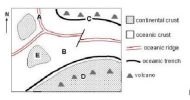 A. Which location is currently like Minnesota TODAY?
B. Which location is like Minnesota during the rifting event 1.1
billion years ago?
C. Name a rock that would be formed at location A.
D. What hazards would location D experience? Mark all that
apply. Ash Fall, Breccia, Lahar, Pyroclastic Flow, Rapture,
Rupture, Sinkholes
스 CA LI continental crust oceanic crust -. oceanic ridge oceanic trench ▲ volcano
스 CA LI continental crust oceanic crust -. oceanic ridge oceanic trench ▲...
A. Which location is currently like Minnesota TODAY?
B. Which location is like Minnesota during the rifting event 1.1
billion years ago?
C. Name a rock that would be formed at location A.
D. What hazards would location D experience? Mark all that
apply. Ash Fall, Breccia, Lahar, Pyroclastic Flow, Rapture,
Rupture, Sinkholes
스 CA LI continental crust oceanic crust -. oceanic ridge oceanic trench ▲ volcano
스 CA LI continental crust oceanic crust -. oceanic ridge oceanic trench ▲...
Question 1: Is the magnitude of an earthquake related to the depth below the surface at...
 Question 1: Is the magnitude of an earthquake related to the depth below the surface at which the quake occurs? In order to answer this question an analysis is conducted. Let we wish to explain depth (in kilometers) of the quake below the surface at the epicenterx by magnitude of an earthquake (on the Richter scale). Data are as follows: 1 2 3 4 5 6 7 8 9 10 3.9 4.3 3.3 4.6 3.9 3.2 3.4 4.5 5.1 2.6...
EXERCISE 24 A Section Fault Problems Fault Problems on Block Diagrams 1. In figure 5.28, the...
 EXERCISE 24 A Section Fault Problems Fault Problems on Block Diagrams 1. In figure 5.28, the upper group of three block diagrams shows A, an unfaulted segment of the earth's crust with an incipient fault plane (dashed line): B, movement along the fault plane; and C. the appearance of the faulted area after erosion has reduced it to a relatively flat surface. The sequence D, E, F is similar. Complete the outcrop patterns of the inclined formation on block diagrams...
Question 1 : Is the magnitude of an earthquake related to the depth below the surface...
 Question 1 : Is the magnitude of an earthquake related to the depth below the surface at which the quake occurs? In order to answer this question an analysis is conducted. Let we wish to explain depth (in kilometers) of the quake below the surface at the epicenterx by magnitude of an earthquake (on the Richter scale). Data are as follows: 1 2 3 4 5 6 7 8 9 10 3.9 4.3 3.3 4.6 3.9 3.2 3.4 4.5 5.1...
Question 164 points): Is the magnitude of an earthquake related to the depth below the surface...
 Question 164 points): Is the magnitude of an earthquake related to the depth below the surface at which the quake occurs? In order to answer this question an analysis is conducted. Let we wish to explain depth (in kilometers) of the quake below the surface at the spicenterx by magnitude of an earthquake (on the Richter scale). Data are as follows: 1 2 3 4 5 6 7 00 9 10 3.9 4.3 3.3 4.6 3.9 3.2 Subject Magnitude of...
The temperature within the Earth's crust increases about 1.0 C∘ for each 30 m of depth....
The temperature within the Earth's crust increases about 1.0 C∘ for each 30 m of depth. The thermal conductivity of the crust is 0.80 W/C∘⋅m. a)Determine the heat transferred from the interior to the surface for the entire Earth in 7.0 h. Answer for this is : 3.4×10¹⁷ b)Compare this heat to the amount of energy incident on the Earth in 7.0 h due to radiation from the Sun. Am not sure how to do part B. Any help is...
The temperature within the Earth's crust increases about 1.0 C∘ for each 30 m of depth....
The temperature within the Earth's crust increases about 1.0 C∘ for each 30 m of depth. The thermal conductivity of the crust is 0.80 W/C∘⋅m. Part A Determine the heat transferred from the interior to the surface for the entire Earth in 9.0 h . Express your answer using two significant figures. Part B Compare this heat to the amount of energy incident on the Earth in 9.0 h due to radiation from the Sun. Express your answer using two...
 Earthquake Lab: Locating the Epicenter, Determining the Magnitude, and Calculating the Time of Earthquake The goal of this lab is to learn how seismograms are used to locate the epicenter of earthquakes, determine earthquake magnitudes, and to calculate the origin time of earthquakes. A seismogram measures the amount of shaking caused by earthquake waves. The seismogram first records the arrival of P-Waves (Primary), followed by the arrival of the S-Waves (Secondary). The S-P interval is the time difference between the...
 A. Which location is currently like Minnesota TODAY?
B. Which location is like Minnesota during the rifting event 1.1
billion years ago?
C. Name a rock that would be formed at location A.
D. What hazards would location D experience? Mark all that
apply. Ash Fall, Breccia, Lahar, Pyroclastic Flow, Rapture,
Rupture, Sinkholes
스 CA LI continental crust oceanic crust -. oceanic ridge oceanic trench ▲ volcano
스 CA LI continental crust oceanic crust -. oceanic ridge oceanic trench ▲...
A. Which location is currently like Minnesota TODAY?
B. Which location is like Minnesota during the rifting event 1.1
billion years ago?
C. Name a rock that would be formed at location A.
D. What hazards would location D experience? Mark all that
apply. Ash Fall, Breccia, Lahar, Pyroclastic Flow, Rapture,
Rupture, Sinkholes
스 CA LI continental crust oceanic crust -. oceanic ridge oceanic trench ▲ volcano
스 CA LI continental crust oceanic crust -. oceanic ridge oceanic trench ▲...
 Question 1: Is the magnitude of an earthquake related to the depth below the surface at which the quake occurs? In order to answer this question an analysis is conducted. Let we wish to explain depth (in kilometers) of the quake below the surface at the epicenterx by magnitude of an earthquake (on the Richter scale). Data are as follows: 1 2 3 4 5 6 7 8 9 10 3.9 4.3 3.3 4.6 3.9 3.2 3.4 4.5 5.1 2.6...
 EXERCISE 24 A Section Fault Problems Fault Problems on Block Diagrams 1. In figure 5.28, the upper group of three block diagrams shows A, an unfaulted segment of the earth's crust with an incipient fault plane (dashed line): B, movement along the fault plane; and C. the appearance of the faulted area after erosion has reduced it to a relatively flat surface. The sequence D, E, F is similar. Complete the outcrop patterns of the inclined formation on block diagrams...
 Question 1 : Is the magnitude of an earthquake related to the depth below the surface at which the quake occurs? In order to answer this question an analysis is conducted. Let we wish to explain depth (in kilometers) of the quake below the surface at the epicenterx by magnitude of an earthquake (on the Richter scale). Data are as follows: 1 2 3 4 5 6 7 8 9 10 3.9 4.3 3.3 4.6 3.9 3.2 3.4 4.5 5.1...
 Question 164 points): Is the magnitude of an earthquake related to the depth below the surface at which the quake occurs? In order to answer this question an analysis is conducted. Let we wish to explain depth (in kilometers) of the quake below the surface at the spicenterx by magnitude of an earthquake (on the Richter scale). Data are as follows: 1 2 3 4 5 6 7 00 9 10 3.9 4.3 3.3 4.6 3.9 3.2 Subject Magnitude of...
Most questions answered within 3 hours.
-
Where is the error in this code sequence?
String s1 = "Hello";
String s2 = "ello";...
asked 11 months ago -
Financial data for Joel de Paris, Inc., for last year
follow:
Joel de Paris, Inc.
Balance...
asked 11 months ago -
Consider this reaction:
Al2(SO4)3 (aq)+ BaCl3
(aq) Al2Cl6 (aq)- +
3BaSO4(s) . What is the...
asked 11 months ago -
Suppose that Savneet is considering increasing her
recent random sample from 20 car rentals to 40...
asked 11 months ago -
Trucks arrive at an unloading terminal at an average rate of 120
per hour.
Trucks arrive...
asked 11 months ago -
Why are methanol and ethanol completely soluble in water while
octanol is not very little soluble....
asked 11 months ago -
A facilities manager at a university reads in a research report
that the mean amount of...
asked 11 months ago -
When the CuSO4 is rehydrated by adding water to the anhydrous
compound, is this an endothermic...
asked 11 months ago -
A ray of sunlight is passing from diamond into crown glass; the
angle of incidence is...
asked 11 months ago -
A block of mass 0.249 kg is placed on top of a light, vertical
spring of...
asked 11 months ago -
how do the kidneys compensate in the presences of acidosis
a) trigger hyperventilate
b) reserve acid...
asked 11 months ago -
Question 501 pts
The rental rate of capital to the firm increases. Which of the
following...
asked 11 months ago