The driver of a car of mass M which is moving along a straight road with...
The driver of a car of mass M which is moving along a straight road with initial speed v0 sees a deer in her headlights, and reacts quickly, lifting her foot of the gas and applying the brake pedal with maximum force. The anti-lock brakes cause the largest possible static friction force to be applied on the tires by the road, which continue to roll so the car does not skid. The coefficient of static friction between the tires and the road is μs. The car comes to a stop at a distance d from where the driver first applied the brakes, and the startled deer slowly walks away, unharmed.
Part 1 Over the distance the car moves while the brakes are applied, the work done by the static friction force acting on the car is (positive, negative, or zero)?
Part 2 The direction of the static friction force on the car tires due to the road is, relative to the direction in which the car is moving (up, right, left, backward, down, or forward)?
Part 3 Choose all answers which could equal the work done by the static friction over the distance the car moves while the brakes are applied.
- − ½ M v02
- 0
- ½ M v02 − μs M g d
- − μs M g d
- − μs M g
- ½ M v02
- μs M g d
- μs M g
Part 4 If the mass of the car is 1,073 kg, its initial speed is 19.6 m/s, and the distance it moves while braking and coming to a stop is 31.7 m, what is the coefficient of static friction between the tires and the road?
Homework Answers
Plz ask doubts in the comment section and give it a thumbs up if
you liked the answer. Have a good day.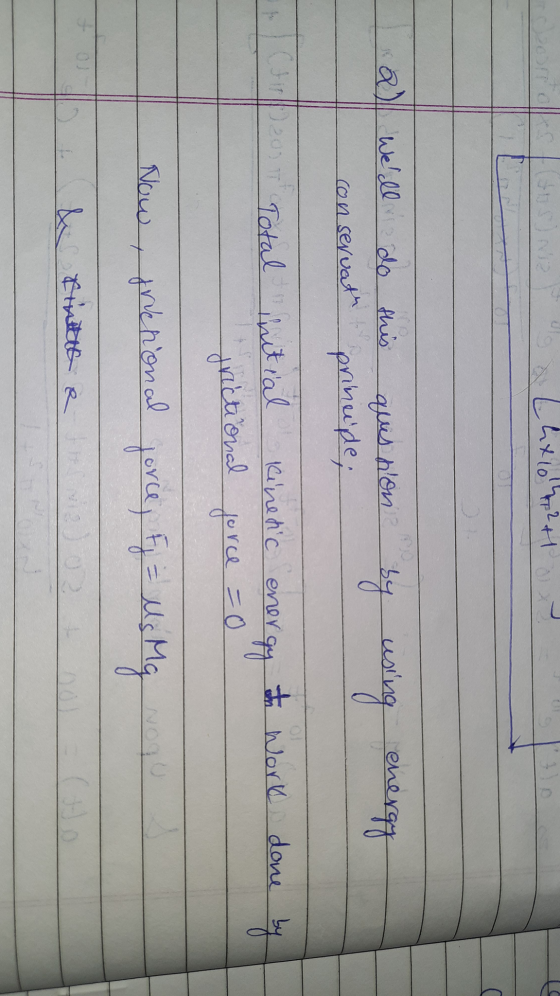
![Date Page & Kinetic energy Cinitially ] = 1 1 Muot; thus work done by frictional energy I Mu ? 2 + Work done 7 Work done = -](http://img.homeworklib.com/questions/d92adf90-bf0c-11eb-8771-3ba6da15729e.png?x-oss-process=image/resize,w_560)
Add Answer to:
The driver of a car of mass M which is moving along a
straight road with...
A car has a mass of 1500 kg. If the driver applies the brakes while on...
 A car has a mass of 1500 kg. If the driver applies the brakes while on a gravel road, the maximum friction force that the tires can provide without skidding is about 7000 N Part A If the car is moving at 25 m/s, what is the shortest distance in which the car can stop safely? Express your answer with the appropriate units. ? Value Units
A car has a mass of 1500 kg. If the driver applies the brakes while on...
A car has a mass of 1500 kg. If the driver applies the brakes while on a gravel road, the maximum friction force that the tires can provide without skidding is about 7000 N. If the car is moving at 22 m/s, what is the shortest distance in which the car can stop safely?
a 1,100 kg car is moving on a horizontal road at 21 m/s when it's breaks...
a 1,100 kg car is moving on a horizontal road at 21 m/s when it's breaks are applied and the car skids to a stop at 36m. Use the concepts of work and energy to find the friction force between the car's tires and the road.
An old car is traveling down a long, straight, dry road at 25.0 m/s when the...
An old car is traveling down a long, straight, dry road at 25.0 m/s when the driver slams on the brakes, locking the wheels. The car comes to a complete stop after sliding 235 m in a straight line. If the car has a mass of 755 kg, what is the coefficient of kinetic friction between the tires and the road?
22. Two cars are driving down a straight country road when the driver of the first...
 22. Two cars are driving down a straight country road when the driver of the first car (traveling at speed vi v sees a deer crossing the road in front of her. She quickly applies her brakes, causing her car to slow down with a (negative) acceleration a--2a. The second car is a distance D behind her and is traveling at an initial speed v2 v. Its driver immediately applies his brakes as well-assume at the same time as the...
4. A car with a mass of 1500 kg moves along a level road with an...
 4. A car with a mass of 1500 kg moves along a level road with an initial speed of 20 m/s. If the puts on his brakes and slides to a stop with a friction force of 3000N, How far will it take him to stop? Sketch a diagram of the situation.
A ride-sharing car moving along a straight section of road starts from rest, accelerating at 2.00...
 A ride-sharing car moving along a straight section of road starts from rest, accelerating at 2.00 m/s2 until it reaches a speed of 32.0 m/s. Then the vehicle moves for 41.0 s at constant speed until the brakes are applied, stopping the vehicle in a uniform manner in an additional 5.00 s. (a) How long is the ride-sharing car in motion (in s)? 62 (b) What is the average velocity of the ride-sharing car for the motion described? (Enter the...
A car is traveling at 27.7 m/s along a horizontal road. The coefficients of friction between...
 A car is traveling at 27.7 m/s along a horizontal road. The coefficients of friction between the road and the tires are μs-0.54 and μk-0.1. Calculate the distance the car travel before stopping if the car is braked hard with no antilock braking system so that the wheels lock? (Take g-9.81 m/s2. 2% of error will be tolerated in your answers.)
A driver in a 1000 kg car travelling at 20 m/s slams on the brakes and...
A driver in a 1000 kg car travelling at 20 m/s slams on the brakes and skids to a stop. If the coefficient of friction between the tires and the horizontal road is 0.80, how long will the skid marks be? A) 33m B) 24m C) 21m D)26m
car moving along a straight section of road starts from rest, accelerating at 2.00 m/s? until...
 car moving along a straight section of road starts from rest, accelerating at 2.00 m/s? until it reaches a speed of 25.0 m/s. Then the vehicle moves for 87.0 s at constant speed until the brakes are applied, stopping the vehicle in a uniform manner in an additional 5.00 s (a) How long is the three-wheeled car in motion (in s)? (b) What is the average velocity of the three-wheeled car for the motion described? (Enter the magnitude in m/s.)...
 A car has a mass of 1500 kg. If the driver applies the brakes while on a gravel road, the maximum friction force that the tires can provide without skidding is about 7000 N Part A If the car is moving at 25 m/s, what is the shortest distance in which the car can stop safely? Express your answer with the appropriate units. ? Value Units
 22. Two cars are driving down a straight country road when the driver of the first car (traveling at speed vi v sees a deer crossing the road in front of her. She quickly applies her brakes, causing her car to slow down with a (negative) acceleration a--2a. The second car is a distance D behind her and is traveling at an initial speed v2 v. Its driver immediately applies his brakes as well-assume at the same time as the...
 4. A car with a mass of 1500 kg moves along a level road with an initial speed of 20 m/s. If the puts on his brakes and slides to a stop with a friction force of 3000N, How far will it take him to stop? Sketch a diagram of the situation.
 A ride-sharing car moving along a straight section of road starts from rest, accelerating at 2.00 m/s2 until it reaches a speed of 32.0 m/s. Then the vehicle moves for 41.0 s at constant speed until the brakes are applied, stopping the vehicle in a uniform manner in an additional 5.00 s. (a) How long is the ride-sharing car in motion (in s)? 62 (b) What is the average velocity of the ride-sharing car for the motion described? (Enter the...
 A car is traveling at 27.7 m/s along a horizontal road. The coefficients of friction between the road and the tires are μs-0.54 and μk-0.1. Calculate the distance the car travel before stopping if the car is braked hard with no antilock braking system so that the wheels lock? (Take g-9.81 m/s2. 2% of error will be tolerated in your answers.)
 car moving along a straight section of road starts from rest, accelerating at 2.00 m/s? until it reaches a speed of 25.0 m/s. Then the vehicle moves for 87.0 s at constant speed until the brakes are applied, stopping the vehicle in a uniform manner in an additional 5.00 s (a) How long is the three-wheeled car in motion (in s)? (b) What is the average velocity of the three-wheeled car for the motion described? (Enter the magnitude in m/s.)...
Most questions answered within 3 hours.
-
Where is the error in this code sequence?
String s1 = "Hello";
String s2 = "ello";...
asked 11 months ago -
Financial data for Joel de Paris, Inc., for last year
follow:
Joel de Paris, Inc.
Balance...
asked 11 months ago -
Consider this reaction:
Al2(SO4)3 (aq)+ BaCl3
(aq) Al2Cl6 (aq)- +
3BaSO4(s) . What is the...
asked 11 months ago -
Suppose that Savneet is considering increasing her
recent random sample from 20 car rentals to 40...
asked 11 months ago -
Trucks arrive at an unloading terminal at an average rate of 120
per hour.
Trucks arrive...
asked 11 months ago -
Why are methanol and ethanol completely soluble in water while
octanol is not very little soluble....
asked 11 months ago -
A facilities manager at a university reads in a research report
that the mean amount of...
asked 11 months ago -
When the CuSO4 is rehydrated by adding water to the anhydrous
compound, is this an endothermic...
asked 11 months ago -
A ray of sunlight is passing from diamond into crown glass; the
angle of incidence is...
asked 11 months ago -
A block of mass 0.249 kg is placed on top of a light, vertical
spring of...
asked 11 months ago -
how do the kidneys compensate in the presences of acidosis
a) trigger hyperventilate
b) reserve acid...
asked 11 months ago -
Question 501 pts
The rental rate of capital to the firm increases. Which of the
following...
asked 11 months ago